HANDS-ON REVIEW
Pocket Hose Ballistic Expandable Garden Hose Review: Is It Worth It?
The toughest version of the famous expandable hose — ballistic-weave shell, copper fittings, expands with pressure and shrinks to a bucket-sized coil that never kinks.
Quick answer: Yes — the Pocket Hose Ballistic is the best expandable garden hose in 2026 because it's the concept finally built to survive its own popularity: the magic (featherweight, kink-free, self-storing) paired with the materials (ballistic-nylon weave shell, real copper fittings) that end the burst-and-crack cycle that plagued every earlier generation and every $25 no-name knockoff. Respect the three storage rules (drain after use, store shaded, cold-water only) and its honest lane, and the fifty-pound rubber python in your garage becomes a bucket in the corner. For human-held yard work, it's the right hose.
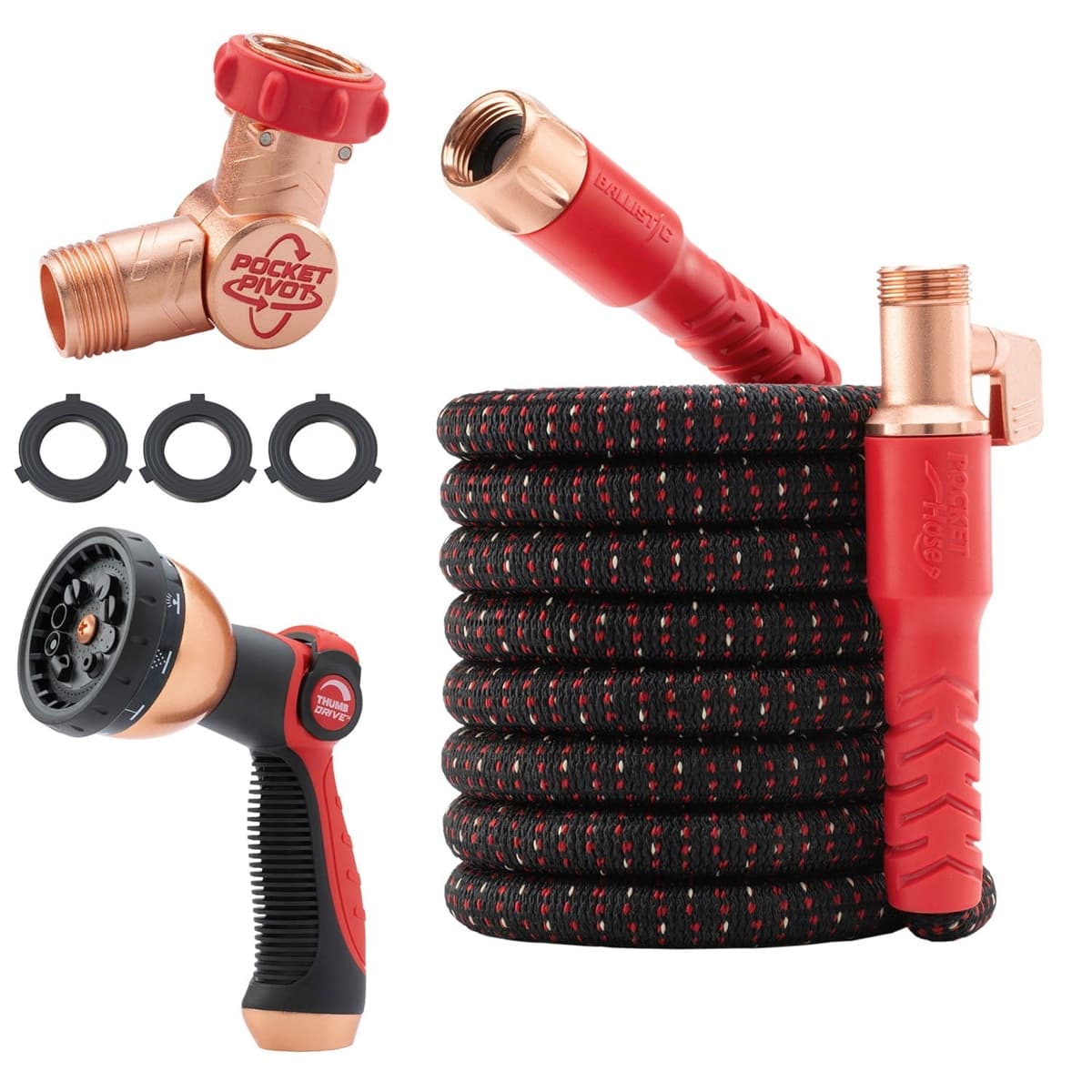
The Ballistic kit: ballistic-weave hose, copper connectors and sprayer — a fraction of a rubber hose's weight. Photo: Pocket Hose
Our verdict
Yes — the Pocket Hose Ballistic is the best expandable garden hose in 2026 because it's the concept finally built to survive its own popularity: the magic (featherweight, kink-free, self-storing) paired with the materials (ballistic-nylon weave shell, real copper fittings) that end the burst-and-crack cycle that plagued every earlier generation and every $25 no-name knockoff. Respect the three storage rules (drain after use, store shaded, cold-water only) and its honest lane, and the fifty-pound rubber python in your garage becomes a bucket in the corner. For human-held yard work, it's the right hose.
The short version
The traditional garden hose is fifty pounds of kinking, coiling misery that lives as a trip hazard because wrestling it back onto the reel isn't worth it. Pocket Hose invented the expandable answer, and the Ballistic is its armored generation: an inner tube that expands three-fold under water pressure, wrapped in a ballistic-nylon weave that solves the burst-and-leak failures that plagued early expandables, tipped with real copper fittings instead of the plastic that cracked. Charged, it reaches the whole yard; drained, it self-shrinks to a coil that fits in a bucket. Watering stops being a workout, and the hose reel retires.
Pros & cons
Pros
- Ballistic-weave shell fixes the classic expandable failure points
- Copper fittings — not the crackable plastic of the cheap tier
- Expands ~3x with pressure; self-drains and shrinks for storage
- A fraction of a rubber hose's weight — seniors' favorite upgrade
- Genuinely kink-free: the expansion physics prevents it
- Coils into a bucket — no reel, no garage python
Cons
- Store it out of the sun and drained — UV and pressure-sitting age any expandable
- Not for hot water, pressure washers or being driven over
- Softer flow-rate ceiling than a commercial rubber hose
How it works
Connect and charge
Screw the copper fitting to the spigot, open the valve, and the inner tube expands the hose to full length in seconds.
Water without the workout
Featherweight and kink-proof by design — drag it around beds and corners one-handed, no wrestling, no loops tightening into knots.
Drain and it packs itself
Shut the spigot, squeeze the sprayer to release pressure, and the hose contracts and self-drains into a light coil that stores in a bucket.
Who it's for
- Anyone whose hose reel is a monument to regret
- Older gardeners done dragging fifty pounds of rubber
- Small-storage homes: condos, patios, balconies, RVs
- Car washers and plant waterers who want zero setup friction
The expandable hose, redeemed by materials
The first expandable-hose wave (Pocket Hose's own early generations included) earned its infomercial reputation honestly in both directions: the featherweight expansion trick was real, and so were the burst inner tubes, split seams and cracked plastic couplings after one summer. Every failure traced to materials — thin latex cores, loose fabric shells, plastic fittings at the highest-stress points.
The Ballistic generation is the materials apology tour: a woven ballistic-nylon jacket that contains and protects the pressurized core (the same logic as reinforced fire hose), a beefed inner tube, and machined copper fittings where every early version cracked. The physics that made expandables great was never the problem — near-zero weight, self-draining, geometrically incapable of kinking — and with the failure points armored, the trade against a rubber hose becomes lifestyle versus flow-rate instead of convenience versus reliability.
Living with an expandable: the three rules
Expandables reward three habits that take zero effort once known. One: drain after use — shut the spigot and squeeze the trigger until the hose contracts; storing it pressurized is the single biggest lifespan killer in the category. Two: shade storage — UV ages any polymer shell, so the bucket lives in the garage or a shaded corner, not baking on the south wall. Three: respect the spec — cold-water garden duty, not hot water, pressure washers or the truck tire.
Follow those and the Ballistic's weave does the rest through years of seasons. The kit's 10-pattern sprayer covers the mist-to-jet range, and the copper threads seat cleanly on standard spigots and splitters. It pairs naturally with the rest of the low-effort yard stack — a cordless leaf blower for the cleanup the hose used to do badly, motion lighting for the shed it all lives in, and a palm-sized DIY tool like the Kelvin 17 multi-tool for the constant flow of small yard fixes (loose fence board, sticking spigot handle, garden-timer battery) that used to send you back to the garage.
Is the Ballistic worth $59.99?
The price ladder: no-name expandables run $20–35 and re-enact the early category's failures on schedule (the Amazon review histograms are a genre); quality rubber hoses run $40–80 plus a $40 reel plus the weekly forearm tax; the Ballistic at $59.99 buys the expandable experience with the materials that survive it. Given that serial $25 expandable replacement is the actual alternative most buyers live, the armored version is cheaper by summer two.
Right-sizing note: pick the length for your real yard — expandables lose a little pressure per foot like any hose, and the sweet spot is the shortest length that reaches your farthest bed. For balcony and RV owners, the small sizes deliver the whole value proposition in a shoebox. The honest non-buyer: anyone running sprinklers off high-flow commercial pressure all day — that's rubber-hose work. For human-held watering, washing and spraying, the Ballistic is the version of this famous product that finally matches the ads.
Frequently asked questions
What is the best expandable garden hose in 2026?
For most homeowners doing normal cold-water yard work — watering beds, washing cars, hosing off patios, filling buckets — the Pocket Hose Ballistic is the best expandable garden hose in 2026, because it's the version of the category built to survive its own popularity. The two armoring changes that matter versus the $20-35 no-name expandables that fail every summer: a ballistic-nylon weave jackets the inner tube (the old burst point), and machined copper fittings replace the plastic that cracked. Drain and shade-store it — the whole maintenance manual — and it outlasts the cheap-tier competitors people replace annually. If your work is all-day commercial sprinkler runs or pressure washers, a heavy rubber hose still wins; for human-held yard work, the Ballistic is the right expandable hose.
Is the Pocket Hose Ballistic actually worth it in 2026?
Yes — for the human-held watering, washing and spraying most homeowners actually do, the Pocket Hose Ballistic is the version of the famous expandable finally built to last more than a summer. The two armoring changes that matter: a ballistic-nylon weave jackets the inner tube (the old burst point), and machined copper fittings replace the plastic that cracked on the cheap tier. Drain and shade-store it — the whole maintenance manual — and it outlasts the $25 no-name expandables people replace every year. Not the tool for pressure washers or all-day commercial sprinkler runs; that's rubber-hose work. For everything else, this is the right hose.
Will it burst like the old expandable hoses?
The Ballistic generation exists to answer that: a ballistic-nylon weave jackets the inner tube (the old burst point) and copper replaces the crackable plastic fittings. Drain it after use and store it shaded, and the classic failures don't happen.
How much does it expand?
Roughly 3x: water pressure expands it to full working length in seconds, and it self-contracts and drains when depressurized — down to a coil that fits in a bucket.
Is the water flow as strong as a regular hose?
Strong enough for watering, washing cars and spraying beds — the working jobs. A commercial rubber hose still wins on maximum flow for sprinkler arrays and all-day irrigation; that's not this tool's lane.
How should I store it?
Drained (squeeze the trigger after shutting the spigot until it contracts) and out of direct sun — a bucket in the garage is the classic home. Those two habits are the entire maintenance manual.
Can I use it with hot water or a pressure washer?
No — it's a cold-water garden hose. Hot water and pressure-washer PSI exceed the design spec of every expandable on the market.
Why is it so much better for older gardeners?
Weight and kink physics: it's a fraction of rubber-hose weight, never fights back, and puts itself away. It's one of the most-gifted products in the category for exactly that reason.
When you buy through links on this page, TopCrate may earn an affiliate commission at no extra cost to you. Cold-water garden use only; drain and store shaded for maximum lifespan. Prices accurate as of publish time.