TRENDING ON AMAZON
Ninja Air Fryer DoubleStack XL SL401 10-Quart 6-in-1 (2-Basket) Review: Is It Worth It?
The stacked dual-basket air fryer that solves the two-basket-side-by-side problem — 10 quarts across two vertically stacked zones, four separate cooking racks and a 5-lb chicken capacity, all in the counter footprint of a single-basket fryer.
Quick answer: Yes — the Ninja Double Stack air fryer (DoubleStack XL SL401) is worth $250-300 for the specific family who wants dual-basket cooking without the DZ550's counter sprawl. Stacking two 5-qt baskets vertically gives you 10-qt total capacity in single-basket footprint, four independent cooking racks handle full weeknight dinners for 3-5 people in one appliance, and Smart Finish times different foods to finish together. The trade-offs are real (top basket cooks slightly faster, needs 18"+ vertical clearance, premium price). For singles and couples, a basic [Ninja Air Fryer](/reviews/ninja-air-fryer) or [Cosori](/reviews/cosori-air-fryer) is smarter. For families cooking most weeknights, this is the 2026 kitchen upgrade that finally makes DualZone cooking practical for normal counter setups.
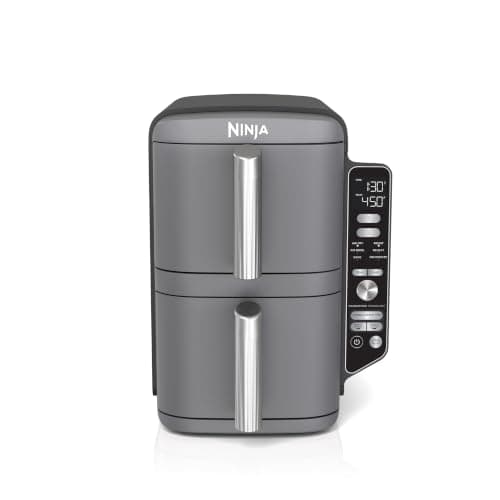
Product image from the Amazon listing.
Our verdict
Yes — the Ninja Double Stack air fryer (DoubleStack XL SL401) is worth $250-300 for the specific family who wants dual-basket cooking without the DZ550's counter sprawl. Stacking two 5-qt baskets vertically gives you 10-qt total capacity in single-basket footprint, four independent cooking racks handle full weeknight dinners for 3-5 people in one appliance, and Smart Finish times different foods to finish together. The trade-offs are real (top basket cooks slightly faster, needs 18"+ vertical clearance, premium price). For singles and couples, a basic [Ninja Air Fryer](/reviews/ninja-air-fryer) or [Cosori](/reviews/cosori-air-fryer) is smarter. For families cooking most weeknights, this is the 2026 kitchen upgrade that finally makes DualZone cooking practical for normal counter setups.
The short version
The Ninja DoubleStack XL SL401 is Ninja's answer to the biggest complaint about the DualZone air fryers: they were huge. Sliding two side-by-side baskets across your counter meant giving up nearly two feet of real estate. The DoubleStack stacks two 5-quart baskets vertically instead, so the counter footprint drops back to a single-basket size while total capacity climbs to 10 quarts. Each drawer has two independent racks (four cooking zones total), you can run each basket at a different temperature with Smart Finish syncing them to finish together, and it fits a 5-lb whole chicken or a full sheet-pan dinner for four. Downsides are real — the top basket is at eye level so tall people don't have to bend, but shorter people do the opposite; the vertical layout means the top basket's food is closer to the heating element and cooks slightly faster; and at $250-300 it's a serious kitchen commitment. But for households sick of the side-by-side DZ550 taking over the counter, this is the smart-money 2026 upgrade.
Pros & cons
Pros
- 10-quart total capacity in the counter footprint of a single 5-qt fryer
- Two vertically stacked baskets — no more DualZone counter sprawl
- Four independent racks (two per basket) — cook 4 foods at once
- Smart Finish syncs different foods to finish together
- 6-in-1: air fry, broil, roast, bake, reheat, dehydrate
- Fits a 5-lb whole chicken or full family sheet-pan dinner
Cons
- Tall footprint — needs 18"+ vertical clearance under cabinets
- Top basket cooks slightly faster (closer to heating element)
- Premium price versus a basic single-basket Ninja
Why people love it
Two 5-qt baskets, stacked vertically
Instead of two baskets side by side eating counter space, the DoubleStack puts one basket above the other. Each 5-qt drawer pulls out from the front independently — same access, half the counter footprint.
Four racks, four zones
Each basket holds two removable racks, so you can cook up to four different foods at four different rack levels. Chicken thighs on the bottom rack, vegetables on the upper — no crowding, no basket-shaking rotation.
Smart Finish sync
Set different foods, different times, different temperatures across the two baskets and Smart Finish coordinates them so everything is ready together. Or use Match Cook to run both baskets identically for a 10-qt single-recipe cook.
Who it's for
- Families of 3-5 cooking dinner most nights
- Anyone tired of side-by-side dual-basket counter sprawl
- Households with limited counter space but real cooking capacity needs
- Meal-preppers making multiple proteins and sides simultaneously
Why Ninja invented the DoubleStack: solving the DualZone counter-space problem
The DualZone air fryer category launched with the DZ550 Foodi in 2020, and it was genuinely useful — two independent baskets meant you could cook a protein and a side at different temperatures simultaneously, finish them at the same time, and skip the wall oven for weeknight meals. The problem was physical size. The DZ550 measured about 15 inches wide and 20 inches deep — a footprint that dominated most kitchen counters. Owners loved the cooking capacity and hated giving up nearly two feet of counter width to a single appliance. Ninja spent several years engineering the fix: same dual-zone cooking, same 10-quart capacity, but stacked vertically instead of laid out horizontally. The DoubleStack XL SL401 launched in 2024 and became one of Ninja's fastest-selling air fryers by 2025 specifically because it kept everything that worked about the DualZone concept and solved the counter-space complaint that limited its market.
The engineering trick is real. Vertical stacking meant redesigning the airflow pattern (heating elements at the top of each basket, fan pushing down through the food, exhaust vented out the back) so that each basket cooks independently at its own temperature without the heat from one drawer affecting the other. The four-rack layout (two per basket) also changed how families use it: instead of running one large food per basket, most owners cook up to four different foods across the four racks at the same temperature per basket. Weeknight dinner becomes 'protein on rack 1, roasted vegetables on rack 2, potato wedges on rack 3, garlic bread on rack 4' — one appliance, one temperature set, one press of start. That's a different cooking pattern than the original DZ550 enabled, and for busy families it's genuinely faster and better.
Ninja DoubleStack XL vs Emeril French Door vs Breville Smart Oven Air: choosing the family-size countertop appliance in 2026
Three main products dominate the family-size countertop-cooking category in 2026, and picking depends on how you actually cook. The Ninja DoubleStack XL is the specialist — best-in-class for dual-temperature cooking and stacked basket efficiency, with the smallest footprint of the three. Best for families whose weeknight cooking is 'protein plus side' and who want the flexibility to cook them at different temperatures simultaneously. Downside: it's an air fryer at heart — best at fry/roast, less versatile than a true multifunction oven for baking, toasting bagels, or making toast. Around $250-300.
The Emeril Lagasse French Door Air Fryer is the multifunction generalist — 25+ preset functions including air fry, but also rotisserie, dehydrate, slow cook, toast, bagel, pizza and bake. Fits a 12-inch pizza or a 6-lb rotisserie chicken. Best for families who want to replace both a toaster oven and an air fryer with one machine. Downside: single-basket design means no simultaneous different-temperature cooking, and the larger footprint (~21×15×13") eats more counter space. Around $200-250. The Breville Smart Oven Air Pro is the premium precision pick — better temperature stability, more elegant UI, higher build quality — but at roughly 2× the price. For families where every dinner is 'protein plus side at different temps,' the DoubleStack wins. For families who cook a broader mix (bake, toast, rotisserie, pizza), the Emeril wins. If budget is unlimited and you want the highest-quality build, Breville wins. Most families in 2026 are choosing between the DoubleStack and the Emeril, and the decision comes down to counter space and cooking style.
Getting the most from a DoubleStack: recipes, timing tricks and meal-prep patterns
The DoubleStack rewards specific cooking patterns most single-basket owners never develop. First: master the four-rack sheet-pan-dinner mode. Load protein (chicken thighs, salmon fillets, meatballs) on rack 1, sturdy vegetables (broccoli, brussels sprouts, sweet potatoes) on rack 2, and a starch (potato wedges, rice-paper crackers) on the other basket. Run both baskets at 400°F for 18-22 minutes, and you have a complete dinner for 4 with 5 minutes of prep and one appliance. This is the specific meal pattern that makes the DoubleStack replace 4-5 wall-oven dinners per week.
Second: use Smart Finish for asymmetric cooking. Chicken breasts at 380°F for 18 minutes (bottom basket) plus quick-roasted asparagus at 400°F for 10 minutes (top basket) — set both, Smart Finish delays the asparagus so both finish together. This is the DualZone superpower that side-by-side and single-basket fryers can't match, and it's how you eliminate the 'protein's ready but the sides aren't' timing problem. Third: meal-prep Sundays. Sunday night, batch-cook 4 different protein/vegetable combinations across the four racks at 400°F for 20 minutes → portion into containers for the week → refrigerate. One DoubleStack session produces 4-5 days of lunches. Pair with a solid Cosori Air Fryer as your smaller everyday backup if you also want basket-format cooking for 1-2 person snacks, and you've built out a serious kitchen without touching the wall oven for months.
See Ninja DoubleStack XL on Amazon
Check the latest price, photos and buyer reviews on Amazon.
Check Price on Amazon →Sold and shipped by AmazonFrequently asked questions
Is the Ninja double stack air fryer any good — and what makes it different from a double-stacked air fryer setup?
Yes, on the specific dimensions the format was engineered around: same 10-quart dual-basket capacity as a side-by-side dual-zone air fryer, but stacked vertically so the counter footprint drops back to a single-basket size. Where a traditional double stacked air fryer setup means two separate machines eating 30+ inches of counter width (or the wide DZ550 Foodi footprint), the Ninja Double Stack XL SL401 puts one 5-qt basket above another in a single ~15-inch-wide unit. Each drawer has two independent racks (four cooking zones total), you can run each basket at a different temperature simultaneously with Smart Finish syncing them to finish together, and the whole thing fits a 5-lb chicken or a sheet-pan family dinner. The honest limits: the top basket cooks slightly faster (closer to heat), you need at least 18" of vertical cabinet clearance above the counter, and it's a premium $250-300 commitment. For a family cooking most weeknights in a normal-sized kitchen, that's the specific problem this appliance solves — and the reason it became one of Ninja's fastest-selling air fryers in 2025-26.
Ninja DoubleStack XL vs DZ550 Foodi vs regular Ninja Air Fryer: which one should I buy?
Different tools for different kitchens. The classic single-basket Ninja Air Fryer is a 4-quart compact perfect for households of 1-2 who cook one thing at a time — smallest, cheapest, easiest cleanup. The DZ550 Foodi is the horizontal 10-qt dual-basket that started the DualZone category — two independent baskets side by side, DualZone Smart Finish, Foodi Smart Thermometer for precise doneness. Its downside is real: it eats about 20 inches of counter width. The DoubleStack XL SL401 is the 2024/2025 stacked evolution — same 10-qt capacity and DualZone concept as the DZ550, but vertically stacked so the counter footprint drops to single-basket size. Decision rule: single or couple → single-basket Ninja. Family of 3+ with lots of counter space → DZ550. Family of 3+ with limited counter space → DoubleStack XL. For families who don't need dual-basket at all, the Cosori 5.8-qt or Emeril French Door oven may be smarter buys.
Is the Ninja DoubleStack XL worth $250-300 or is that too much?
Worth it for a specific household. For a family of 3-5 cooking dinner most nights, the DoubleStack pays back in three specific ways: (1) no more taking turns cooking the protein and the sides sequentially — cook both at once, hot together. (2) 10 quarts is enough for real family dinners (whole chicken plus roasted vegetables, or a full pound of wings plus a batch of fries) that a single-basket 5-qt fryer requires batch-cooking. (3) It replaces both the wall-oven use for weeknight meals (faster, energy-cheaper, keeps the kitchen cooler) and a toaster oven. For singles or couples cooking small portions, the DoubleStack is overkill — a $100 Cosori or basic Ninja does everything you need for less than half the price. The specific value math: if you cook 4+ nights a week for a family, it pays for itself in saved oven-warmup electricity and takeout in about a year. If you cook occasionally, it doesn't.
How big is it and will it fit under my kitchen cabinets?
Roughly 15"W × 14"D × 13"H — narrower than the side-by-side DZ550 but taller. Fits on a standard 24" deep countertop with room to spare front-to-back, and slides under most standard 18" upper-cabinet clearance. Check your specific setup: measure vertical clearance from countertop to cabinet bottom, subtract 3" for ventilation above the unit, and confirm you have at least 13" of usable height. The top basket lifts out for cleaning, so you also need horizontal clearance above the unit when the basket is out — plan for the same 3"+ clearance above the closed unit. If cabinet clearance is a tight fit, the side-by-side DZ550 is actually the shorter option; the DoubleStack trades footprint width for height.
Does food in the top basket cook differently than the bottom basket?
Yes, slightly. The top basket sits closer to the heating element and airflow pattern, so foods cook 5-10% faster there. In practice, this matters most for delicate proteins (fish fillets, thin chicken breasts) — cook them in the bottom basket to avoid overcooking, and put more forgiving foods (fries, roasted vegetables, wings) in the top. For Match Cook mode where both baskets run the same recipe simultaneously, some owners bump the bottom basket by an extra minute to balance timing. The four-rack design mitigates this: rotating rack positions between basket zones is easy for meal-preppers who care about precision. For everyday family cooking, the difference is minor and Smart Finish handles the sync automatically.
How do you clean the Ninja DoubleStack XL?
The removable baskets, racks and crisper plates are dishwasher-safe (though hand-washing extends nonstick life). For daily cleanup: pull each basket, brush loose crumbs into the trash, hand-wash with warm soapy water and a soft sponge, and wipe the interior heating chamber with a damp cloth once cool. Every few weeks, deep-clean the fan cover and heating element area — grease buildup on the fan reduces airflow and hurts crisping over time. Never submerge the main unit in water. The four racks add a few extra items to wash versus a single-basket fryer, but they're small and rinse quickly. Total daily cleanup: about 3-5 minutes.
Can I bake, dehydrate or reheat in it, or is it only for frying?
6-in-1: air fry, broil, roast, bake, reheat and dehydrate. Air fry is the marquee mode (crispy fries, wings, chicken with less oil). Roast handles proteins and vegetables at higher temps for browning. Bake is the mode for cookies, muffins, small baked goods — great for a batch of six chocolate-chip cookies without heating the wall oven. Reheat is genuinely better than a microwave for pizza, fries and anything breaded — 350°F for 3-4 minutes crisps leftovers like fresh. Dehydrate uses low temperatures (105-170°F) for jerky, dried fruit and vegetable chips over several hours. Broil is at the top of the temperature range for surface browning (melting cheese, crisping bacon). The one thing it can't do that a full oven can: bake very tall items (tall cakes, whole turkeys) — the vertical rack spacing limits food height per rack to about 4 inches.
As an Amazon Associate, TopCrate earns from qualifying purchases at no extra cost to you. Product image, price, availability and ratings are shown on Amazon and are subject to change.