TRENDING ON AMAZON
Meditherapy Retinal Skin Booster Serum Review: Is It Worth It?
The Korean encapsulated-retinaldehyde serum that broke into Amazon's overall beauty top 20 — 11× the potency of retinol, wrapped in soothing Cica so sensitive skin actually tolerates it.
Quick answer: Yes — Meditherapy Retinal Skin Booster Serum is worth the hype, and it's currently the smartest first-retinal buy on Amazon. Encapsulated retinaldehyde (11× more potent than retinol) with Cica and 5% niacinamide, in a 150ml bottle for around $20-25 — roughly a third the price of comparable Western retinal serums. The formulation genuinely makes retinal tolerable for first-time users who bounced off Medik8 or Avene. Skip if you're already on max-strength Crystal Retinal or need prescription-tier results. Buy if you want a real, evidence-based anti-aging active in a K-beauty routine, or if you're rebuilding a routine on a budget. Ramp slowly (every third night → nightly over 4-6 weeks), layer with a barrier moisturizer, and stay on SPF. Amazon's #1 facial serum spot is earned.
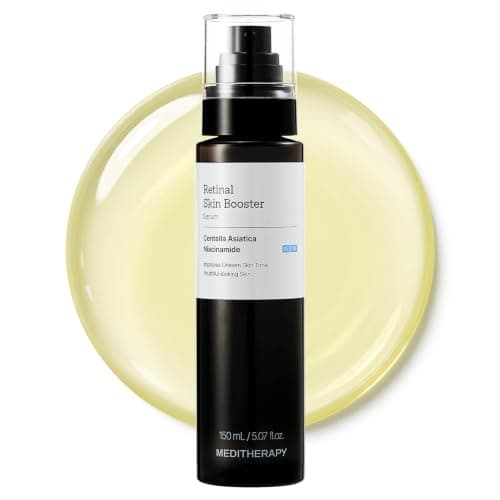
Product image from the Amazon listing.
Our verdict
Yes — Meditherapy Retinal Skin Booster Serum is worth the hype, and it's currently the smartest first-retinal buy on Amazon. Encapsulated retinaldehyde (11× more potent than retinol) with Cica and 5% niacinamide, in a 150ml bottle for around $20-25 — roughly a third the price of comparable Western retinal serums. The formulation genuinely makes retinal tolerable for first-time users who bounced off Medik8 or Avene. Skip if you're already on max-strength Crystal Retinal or need prescription-tier results. Buy if you want a real, evidence-based anti-aging active in a K-beauty routine, or if you're rebuilding a routine on a budget. Ramp slowly (every third night → nightly over 4-6 weeks), layer with a barrier moisturizer, and stay on SPF. Amazon's #1 facial serum spot is earned.
The short version
Meditherapy is the Korean skincare brand that came out of nowhere to take Amazon US's #1 facial serum spot in 2026, and the Retinal Skin Booster Serum is the product that did it. The pitch is straightforward: retinaldehyde (not retinol) is one step closer to the active retinoic acid your skin actually uses, meaning it converts faster and works harder at the same concentration. Meditherapy encapsulates the retinal in liposomes so it releases gradually into the skin instead of hitting all at once, and pairs it with 5% niacinamide and Cica (Centella Asiatica) to buffer the irritation retinal usually causes. The result is a genuinely potent anti-aging serum that first-time retinal users can actually tolerate — no purge, no peeling, no burning. Bigger 150ml bottle for around $20-25, half the price of comparable Western retinal serums. For anyone who wanted to try retinal but bounced off a stronger US version, or who's rebuilding a routine on a budget, this is the K-beauty entry point that's earning its viral status.
Pros & cons
Pros
- Retinaldehyde — 11× more potent than retinol, one step from active retinoic acid
- Encapsulated liposome delivery — gradual release, less irritation
- 5% niacinamide for tone and barrier support
- Cica (Centella Asiatica) calms and soothes
- 150ml bottle — 3-4× the size of Western retinal serums
- Under $25 for a genuine clinical-grade active
- Amazon US #1 facial serum, top 20 in overall Beauty
Cons
- Still a real retinoid — pregnancy/breastfeeding warning applies
- 6-8 week ramp for visible fine-line results
- Some Amazon listings have authenticity concerns — buy from verified sellers
Why people love it
Retinaldehyde in liposomes
Encapsulated retinal releases gradually into the skin over hours rather than all at once, so you get the anti-aging benefit without the sting, redness and peeling that a raw retinol usually causes.
Cica calms as retinal works
Centella Asiatica (Cica) is the go-to K-beauty ingredient for reactive skin — anti-inflammatory, barrier-supporting, and specifically included here to buffer the retinal's turnover action.
Niacinamide finishes the job
5% niacinamide brightens dull tone, tightens visible pores and reinforces the skin barrier — the natural complement to retinal that gets you tone + texture + firmness from a single product.
Who it's for
- First-time retinal users who couldn't tolerate a Western retinol
- Sensitive skin ready for an anti-aging active
- K-beauty routine builders
- Budget skincare shoppers wanting a real active
Why Meditherapy hit Amazon's #1 spot — the retinaldehyde-plus-Cica formulation, explained
The retinal-and-Cica combination is why Meditherapy broke through in a category (facial serums) that hasn't had a genuine best-seller shake-up in years. Retinaldehyde is the smart form of over-the-counter Vitamin A: it's one conversion step from retinoic acid (the active form your skin binds), roughly 11× more potent than retinol at the same concentration, and works dramatically faster. The catch that's kept it niche is irritation — potent retinoids historically mean redness, peeling, and a 4-6 week 'purge' that most people can't stomach. Meditherapy's contribution isn't inventing retinal; it's solving the tolerability problem by encapsulating the retinal in liposomes (so it releases gradually into skin over hours instead of hitting all at once) and pairing it with Cica (Centella Asiatica) and niacinamide as soothing counter-actives.
The result reads on the skin like a much gentler retinoid than the concentration suggests. First-time retinal users who bounced off Western brands (Medik8 Crystal Retinal, Avene Retrinal) at even lower percentages often tolerate Meditherapy without irritation. And because the retinal is still doing real turnover work under the calm surface, results — fine lines soften, tone evens, pores tighten — build on the 6-8 week timeline you'd expect from a proper retinoid. It's the rare skincare product where the marketing story and the actual formulation science align. That's why it climbed to Amazon US's #1 facial serum spot in 2026, not just editorial praise.
Meditherapy Retinal vs Medik8 Crystal Retinal vs Avene Retrinal — the retinaldehyde comparison
Western retinal serums have been available for years, but they're expensive and often irritating. Medik8 Crystal Retinal 3 ($60 for 30ml) is the reference — clinical-grade retinaldehyde at graduated strengths (Crystal Retinal 1, 3, 6, 10, 20), progressive concentration with a physician-clinic ramp. Excellent product, but $60 for 30ml is $2/ml, and the pure retinal formulation is more irritating than Meditherapy's Cica-buffered version. Avene Retrinal ($80 for 30ml) is the French pharmacy standard — well-tolerated, gentle formula, but at $2.66/ml even pricier. La Roche-Posay Retinol B3 Serum ($45 for 30ml) uses retinol (not retinal), so it's a step milder.
Meditherapy Retinal Skin Booster ($20-25 for 150ml) prices out at roughly $0.15/ml — 13-18× cheaper per volume than Medik8 or Avene, and half the strength category (K-beauty retinal formulations typically run 0.03-0.1% vs Western 0.03-0.2%). Trade-off: Meditherapy is milder than max-strength Western options, so if you've built up a tolerance to Crystal Retinal 6 or higher, you're better staying with the concentration you've already ramped to. But for first-time retinal users, K-beauty-routine builders, or anyone rebuilding a barrier who needs the gentler formulation, Meditherapy is the smart-money entry point. Many derms now recommend it as the starter retinal for exactly that reason. Layer it with a proper barrier moisturizer like Byoma Rich Cream to make the routine bulletproof.
How to build a routine around Meditherapy Retinal (and where it fits in a full anti-aging stack)
A retinal serum is one part of a routine, not the whole routine. The evidence-based anti-aging stack is well-established: retinoid + antioxidant (usually vitamin C) + SPF + moisturizer. Meditherapy Retinal is the retinoid; you still need the other three legs of the stool. A proven full routine on a K-beauty budget: AM — gentle cleanser, vitamin C serum, Naturium Multi-Peptide moisturizer or a barrier moisturizer, SPF 30+. PM — same gentle cleanser, Meditherapy Retinal (start slow — every third night, ramp to nightly over 4-6 weeks), then Byoma Moisturising Rich Cream to buffer and hydrate. Total cost: under $80 for a full stack that will produce visible results in 8-12 weeks.
Common mistakes to avoid: (1) Layering Meditherapy Retinal with strong exfoliants (glycolic acid pads, high-concentration BHA) on the same night — irritates the barrier. Alternate nights instead. (2) Skipping SPF in the morning after starting retinal — retinal makes skin more UV-sensitive and unprotected sun exposure undoes all the anti-aging benefit. (3) Overusing — a pea-sized amount is the right dose; more increases irritation without more benefit. (4) Expecting fast results — retinal works on a 6-12 week timeline. Take before-and-after photos in consistent lighting so you can actually see the change. Consistency for 12 weeks beats intensity for 4 weeks every time. Pair with sleep quality (magnesium at night, cool dark bedroom, phone away 30 min before bed) — skin regenerates overnight and a proper retinal + sleep routine compounds. For hormonal-cycle irritation flares, temporarily switch to just CeraVe Hydrating Cleanser and Byoma Rich Cream, drop the retinal for 3-4 days, then reintroduce.
See Meditherapy Retinal on Amazon
Check the latest price, photos and buyer reviews on Amazon.
Check Price on Amazon →Sold and shipped by AmazonFrequently asked questions
Is Meditherapy Retinal Skin Booster Serum worth the hype?
Yes for most people looking for a first retinal, and this is one of the rare 'the Amazon best-seller list is right' cases. The formula is genuinely well-designed — encapsulated retinaldehyde (a more potent, faster-converting form than retinol), soothing Cica to prevent the classic retinoid irritation, and 5% niacinamide for tone. At $20-25 for a 150ml bottle it's roughly a third of the price of comparable Western retinal serums (Medik8 Crystal Retinal, Avene Retrinal, etc.), and the gentle-formulation approach means sensitive skin actually tolerates it. Where to be careful: pregnancy and breastfeeding — retinaldehyde is still in the retinoid family and the standard 'avoid during pregnancy' guidance applies. Buy from a Meditherapy-authorized Amazon seller (some third-party listings have authenticity concerns). Give it a 6-8 week fair trial — visible fine-line and tone results build over that window.
What's the difference between retinal (retinaldehyde), retinol, and retinoic acid?
Your skin converts retinoids through steps to reach retinoic acid, the active form that binds receptors and drives cell turnover. Retinoic acid → directly active (prescription tretinoin). Retinaldehyde (retinal) → one conversion step, roughly 11× more potent than retinol at the same concentration. Retinol → two conversion steps, gentler but slower. Retinyl esters → three steps, weakest and slowest. Meditherapy uses retinal, so you get closer-to-prescription strength in an OTC product, but the encapsulation and Cica buffer keep it tolerable. For most people who've been on retinol and want more without going prescription, retinal is the natural next step.
Meditherapy Retinal vs [Naturium Multi-Peptide](/reviews/naturium-multi-peptide) vs [Byoma Rich Cream](/reviews/byoma-moisturizer): which should I pick?
Different jobs. Meditherapy Retinal is the active — a real retinoid that drives cell turnover, fades lines, evens tone. Naturium Multi-Peptide is complementary — peptides support collagen without irritation, layer well with retinal. Byoma Rich Cream is the barrier — ceramides plus fatty acids that repair the skin barrier and buffer retinal irritation. The proper routine uses all three: cleanser, Meditherapy Retinal at night, Byoma Rich Cream on top (buffers and hydrates); Naturium Multi-Peptide in the morning under SPF (firming support without adding a second irritant). Together, under $80 total, they cover a proper evidence-based anti-aging routine.
How do I start using retinal without a purge or peeling?
Start slow. Week 1-2: apply Meditherapy Retinal every third night after cleansing, followed by a barrier moisturizer like Byoma Rich Cream. Week 3-4: every other night. Week 5+: nightly, if tolerated. Use a pea-sized amount for the full face — more isn't better and increases irritation. Skip on nights you use strong exfoliants (AHA/BHA), vitamin C serums, or physical scrubs. Always follow with moisturizer — don't leave retinal to sit on bare skin. And SPF 30+ every single morning is non-negotiable once you're on any retinoid; retinal makes skin more sun-sensitive and undoes its own work if you skip sunscreen. Done this way, most people avoid the classic 4-week retinol purge entirely.
Can I use Meditherapy Retinal with vitamin C, niacinamide or acids?
With rules. Niacinamide is already in the Meditherapy serum, so no need to layer another niacinamide. Vitamin C (L-ascorbic acid) — use vitamin C in the morning and Meditherapy Retinal at night; layering them the same time can neutralize both. Salicylic acid / glycolic acid — alternate nights (BHA/AHA one night, retinal the next), not the same night. Peptides — layer freely, they pair beautifully with retinal in a routine. Hyaluronic acid, ceramides, squalane — layer freely, they support the retinal's work. If you're new to actives, start with just Meditherapy Retinal and a barrier moisturizer; add complexity over months.
Is Meditherapy Retinal safe during pregnancy or breastfeeding?
No — the standard retinoid pregnancy/breastfeeding avoidance applies. All retinoids, including retinaldehyde (retinal), are on the standard 'avoid during pregnancy' list. Topical retinoid absorption is low, but the theoretical fetal risk with any Vitamin A derivative is why every dermatology guideline says to pause. Switch to a plain ceramide moisturizer like Byoma Rich Cream plus vitamin C in the morning during pregnancy, and return to Meditherapy Retinal after you finish breastfeeding. Always confirm with your OB.
As an Amazon Associate, TopCrate earns from qualifying purchases at no extra cost to you. Buy from verified Meditherapy-authorized Amazon sellers to ensure authenticity. Not for use during pregnancy or breastfeeding — all retinoids are on the standard pregnancy-avoid list; consult your OB. Product image, price, availability and ratings are shown on Amazon and are subject to change.
More reviews you might like
SKINCARE
Celimax Vita-A Retinal Shot Review: Best K-Beauty Retinal for Sensitive Skin?
SPORTS
Body Glide Original Review: The Anti-Chafe Balm That Actually Works
SKINCARE
Foreo Luna Mini 3 Review: Is the Silicone Cleansing Brush Worth It?
SKINCARE