TRENDING ON AMAZON
Medicube PDRN Pink Peptide Serum with Rose PDRN Review: Is It Worth It?
The K-beauty pink serum with 'salmon-DNA' PDRN plus a five-peptide complex — the viral firming-and-glow serum from Medicube, dermatologist-founded, at drugstore prices.
Quick answer: Yes — Medicube's PDRN Pink Peptide Serum is worth trying, and it's the K-beauty ingredient-of-the-moment delivered in a legitimate dermatologist-founded formulation at accessible prices. Real Rose PDRN, real five-peptide complex, real niacinamide and adenosine, real dermatologist-founded brand (Dr. Song's clinic), under $30 for 30ml. The honest limits: topical PDRN is milder than in-clinic PDRN injections (this won't replace a Rejuran Healer treatment), results take 4-8 weeks of consistent daily use, and only buy from verified Medicube-authorized sellers to avoid the authenticity concerns some Amazon listings have. Skip if you're chasing overnight dramatic anti-aging results (retinal or prescription tretinoin will outperform). For anyone interested in PDRN as an active, building a K-beauty routine, or wanting a gentle firming-and-glow serum that layers well with everything else, this is the current best entry point.
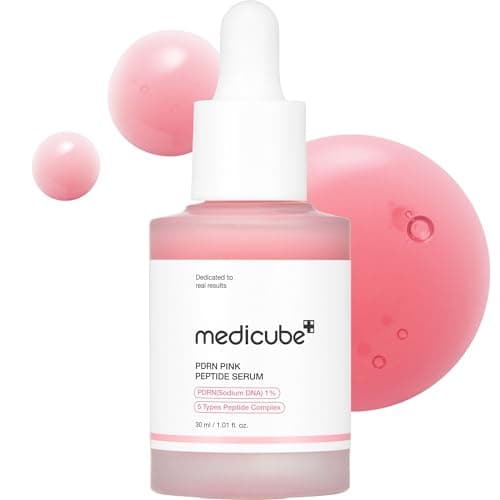
Product image from the Amazon listing.
Our verdict
Yes — Medicube's PDRN Pink Peptide Serum is worth trying, and it's the K-beauty ingredient-of-the-moment delivered in a legitimate dermatologist-founded formulation at accessible prices. Real Rose PDRN, real five-peptide complex, real niacinamide and adenosine, real dermatologist-founded brand (Dr. Song's clinic), under $30 for 30ml. The honest limits: topical PDRN is milder than in-clinic PDRN injections (this won't replace a Rejuran Healer treatment), results take 4-8 weeks of consistent daily use, and only buy from verified Medicube-authorized sellers to avoid the authenticity concerns some Amazon listings have. Skip if you're chasing overnight dramatic anti-aging results (retinal or prescription tretinoin will outperform). For anyone interested in PDRN as an active, building a K-beauty routine, or wanting a gentle firming-and-glow serum that layers well with everything else, this is the current best entry point.
The short version
Medicube's PDRN Pink Peptide Serum went viral on TikTok in 2024-2025 for a specific reason: PDRN (polydeoxyribonucleotide, sometimes called 'salmon DNA' or 'rose PDRN') is the ingredient South Korean dermatology clinics use for injectable skin-boosting treatments, and Medicube figured out how to deliver it in a topical serum at drugstore prices. Combined with a five-peptide complex, niacinamide, adenosine, and the vitamin B12 that gives the serum its natural pink color, the formula targets firmness, texture and glow simultaneously. Medicube is dermatologist-founded (K-beauty's Dr. Song's clinic brand), so the clinical formulation approach is legitimate rather than marketing. Results build over 4-8 weeks — not overnight glow — but the pattern of real K-beauty enthusiasts sticking with it long-term is what makes it worth trying.
Pros & cons
Pros
- Rose PDRN — the injectable-clinic-ingredient in topical form
- Five-peptide complex for firmness and elasticity
- Niacinamide for tone and pore refinement
- Adenosine for anti-aging signaling
- Fragrance-free, gentle enough for reactive skin
- Under $30 for 30ml (2-3 months of daily use)
- Dermatologist-founded brand (Medicube = Dr. Song's clinic)
Cons
- Results take 4-8 weeks — this is a slow build, not overnight glow
- Topical PDRN is less potent than in-clinic PDRN injections
- Some batches have received authenticity concerns — buy from verified sellers
Why people love it
PDRN supports skin regeneration
Polydeoxyribonucleotide (PDRN) is a DNA-fragment ingredient that supports cell repair and collagen synthesis at the cellular level. In K-dermatology clinics, injectable PDRN is used for skin rejuvenation and post-procedure healing. Topical PDRN like Medicube's isn't as potent as injections but delivers a real (if smaller) effect.
Five-peptide complex + niacinamide
Signal peptides tell cells to make more collagen; carrier peptides transport them; the five-peptide roster covers multiple pathways. Niacinamide adds tone-evening, pore-refining and barrier support in the same bottle.
Vitamin B12 gives the natural pink color
The signature pink hue is from vitamin B12 (methylcobalamin) — not artificial dye. It adds mild antioxidant support and is what makes the serum visually distinctive on the counter.
Who it's for
- K-beauty enthusiasts exploring PDRN topically
- People wanting a serum-based alternative to injectable PDRN clinics
- Sensitive skin users looking for gentle actives
- Anyone building a K-beauty layered routine on a budget
What PDRN actually is, and why it's suddenly everywhere in K-beauty
PDRN — polydeoxyribonucleotide — is one of the most quietly important ingredients in Korean dermatology. It's not new: dermatology clinics in Seoul have been using PDRN injections (marketed as Rejuran Healer) for over a decade for skin rejuvenation, wound healing, and post-procedure recovery. What's new is Medicube and other K-beauty brands figuring out how to formulate PDRN into topical serums at accessible prices. Structurally, PDRN is a purified fragment of DNA — most commonly from salmon or trout — that binds to specific receptors on skin cells and triggers regeneration signaling. In injectable form, PDRN has documented effects on collagen synthesis, wound healing, elasticity, and hydration. Topical PDRN penetrates less deeply, so effects are milder, but well-formulated serums have shown measurable improvement in hydration, texture and elasticity over 4-8 weeks of daily use.
The reason PDRN is trending in 2025-2026 is the convergence of two things: K-beauty's evolution from trendy-active hopping (snail mucin, bee venom, propolis) to clinical-tier ingredient science (retinal, azelaic acid, tranexamic acid, PDRN), and Western consumer interest in Korean dermatology treatments like Rejuran Healer. Medicube's PDRN Pink Peptide Serum specifically became viral because it packaged the ingredient in an aesthetically distinctive way (natural pink from vitamin B12), combined it with a peptide complex that adds anti-aging benefit, and priced it at under $30 rather than the $50-80 that clinical-formulation Korean serums often hit. It's the specific product that made PDRN a mainstream Western skincare consideration rather than an exotic Korean-only ingredient.
Medicube's ecosystem, and how the PDRN Serum fits into a full K-beauty routine
Medicube's product range covers a full K-beauty routine at clinical-quality: the Zero Pore Pad (BHA + AHA + PHA for daily exfoliation), the Deep Vita C Capsule Cream (stabilized vitamin C moisturizer), various PDRN products (this serum, the PDRN Cream), and dermatologist-line retinol products. Together they build a complete AM/PM routine designed to work with in-clinic treatments Medicube's parent dermatology clinic offers. A typical full-routine setup: AM — cleanser, Zero Pore Pad (2-3x/week), vitamin C serum, PDRN Pink Peptide Serum, Deep Vita C Capsule Cream, SPF. PM — cleanser, retinol or another active, PDRN Pink Peptide Serum, PDRN Cream or barrier moisturizer.
In a more mixed routine (using multiple brands): PDRN Pink Peptide Serum sits in the 'treatment serum' slot — after cleanser and toner, before moisturizer. It layers well with almost any skincare brand. Combine with a K-beauty layering approach (thinnest to thickest), K-beauty's characteristic focus on hydration (multiple hydrating steps), and a strong SPF, and you have a full clinical-adjacent routine at accessible prices. For someone starting from zero, a good starting stack is: [Beauty of Joseon Relief Sun sunscreen](https://www.amazon.com/s?k=beauty+of+joseon+relief+sun&tag=topcrate-20), Medicube PDRN Pink Peptide Serum, a barrier moisturizer like Byoma Moisturising Rich Cream, a gentle cleanser like CeraVe Hydrating Cleanser. Under $80 total, covers a complete daily routine, uses evidence-based actives.
How to use PDRN Pink Peptide Serum for real, visible results at 8 weeks
The mistake most first-time PDRN users make is inconsistent use. PDRN's effects are cumulative — 4-8 weeks of daily use builds enough cellular repair signaling to produce visible changes; 3-4 weeks of every-other-day use produces almost nothing visible. The protocol that works: apply once daily (morning or evening — either is fine, but consistency matters more than timing), use 3-4 drops for the full face and neck, apply to clean skin after any toner but before moisturizer, and don't skip days. Take a before photo in consistent lighting. Take another at 4 weeks and 8 weeks. The change is easier to see side-by-side than in the mirror daily.
Combine with the rest of a routine that supports skin regeneration. Sleep matters — skin cell repair happens overnight, and PDRN's effects are amplified by good sleep. Magnesium at night (Pure Encapsulations Magnesium Glycinate) helps sleep quality. Consistent SPF prevents undoing PDRN's regeneration work with new UV damage. Hydration (drink water, use hydrating serums under and over the PDRN serum) enhances all skincare active effects. For someone specifically doing an aggressive anti-aging routine, layering PDRN Serum with retinol (nightly, alternating with the serum), niacinamide (morning, with the serum), and peptides (evening, with the serum) creates a compound effect that's greater than any single active alone. Be consistent for 8 weeks minimum before evaluating — this isn't a quick-fix serum.
See Medicube PDRN Serum on Amazon
Check the latest price, photos and buyer reviews on Amazon.
Check Price on Amazon →Sold and shipped by AmazonFrequently asked questions
What is PDRN and does it actually work in a topical serum?
PDRN (polydeoxyribonucleotide) is a DNA-fragment ingredient — literally purified DNA fragments, most commonly from salmon or trout, used in medical dermatology as a skin-regeneration active. In injectable form (used in K-beauty clinics for treatments like Rejuran Healer), PDRN has documented clinical effects on collagen synthesis, cell repair and skin quality. In topical form, PDRN penetrates less effectively than an injection, so the effects are milder — but skin studies have shown that topical PDRN in well-formulated serums does produce measurable improvements in hydration, elasticity and fine lines over 4-8 weeks of consistent use. Medicube's formulation uses 'Rose PDRN' (a rose-derived variant) alongside marine PDRN and combines it with peptides and niacinamide for a multi-active approach. It's not a substitute for in-clinic PDRN injections, but it's a legitimate topical version at a fraction of the cost.
Is Medicube a real dermatologist brand, or is it just K-beauty marketing?
Genuine dermatologist brand. Medicube is founded by Dr. Song from the well-known K-dermatology clinic Uni-Song Dermatology in Seoul. The brand's founding philosophy is 'clinic-tested K-beauty' — every formulation is designed to complement in-clinic treatments Medicube's parent clinics offer. This is why their product range leans clinical (retinol, PDRN, tranexamic acid, azelaic acid) rather than trendy (bee venom, snail mucin, etc.). Dermatologist-founded doesn't automatically mean 'better than any other K-beauty brand,' but it does mean the formulations tend to be evidence-driven and appropriate for sensitive skin. Medicube's other well-loved products include the Zero Pore Pad and their PDRN Cream — this Pink Peptide Serum is the star of the PDRN line.
Medicube PDRN Pink Peptide Serum vs Rejuran Healer injections vs other PDRN products — how does it compare?
Very different tiers. Rejuran Healer injections (in-clinic, ~$400-800 per session, 2-3 sessions over 6-8 weeks): the gold standard for PDRN treatment, delivers PDRN directly into the dermis for maximum effect. Best results for serious anti-aging. Medicube PDRN Pink Peptide Serum (~$25-30, 30ml, 2-3 months of use): topical formulation, milder but real effect, no needles required. Best for maintenance between clinic visits or for people who don't want injections. Other topical PDRN products (Beauty of Joseon PDRN products, Anua PDRN Serum, various Korean brands): similar concept, similar price range, formulation differences are subtle. For most people wanting to try PDRN topically, Medicube is the best-known and most-recommended entry point. For serious anti-aging results, in-clinic PDRN treatments outperform topicals by a wide margin. For a combined approach: use Medicube's serum daily as maintenance, plan on 1-2 in-clinic PDRN treatments per year for deeper effect.
How long until I see results, and what should I expect?
Hydration and glow improvements appear within 1-2 weeks — that's the niacinamide, vitamin B12 and PDRN's immediate hydration effect. Firming and elasticity improvements take 4-8 weeks of consistent daily use. Fine-line improvement takes 8-12 weeks. Take a photo in consistent lighting when you start and another at 8 weeks; the change is easier to see side-by-side than in the mirror day by day. Realistic expectations: this is a slow-build, gentle-active serum. It won't produce the dramatic overnight results of a strong retinol or the immediate lift of a filler. What it does deliver is the type of gradual, cumulative improvement that most K-beauty enthusiasts describe: skin that looks smoother, more even-toned and slightly firmer at week 8-12. If you're chasing dramatic anti-aging results, pair with a retinal serum (Beauty of Joseon Revive Eye Serum for eye area) for compound effect.
Can I use it with retinol, vitamin C, and other actives?
Yes, with some layering rules. Morning routine: cleanser, vitamin C serum (if using), Medicube PDRN Pink Peptide Serum, moisturizer, SPF. Evening routine: cleanser, retinol/retinal (if using) — wait 2-3 minutes for absorption — Medicube PDRN Pink Peptide Serum, moisturizer. The serum layers well with almost all common actives. The one caution is not to over-apply — a single dropperful (about 3-4 drops) is enough for the whole face; more doesn't work better and just wastes product. If you're using an aggressive routine (nightly retinol + morning vitamin C + daily acid toner), be cautious about adding more actives; skin barrier can only tolerate so much stimulation. Alternate: retinol on odd nights, this serum on even nights, and let each active work on its own schedule.
Is Medicube PDRN Pink Peptide Serum safe during pregnancy and breastfeeding?
Generally considered safe, but with a caveat. PDRN itself has no known contraindications for pregnancy — it's derived from fish DNA and acts locally on skin cells rather than systemically. Peptides similarly are considered safe. Niacinamide is on the standard 'safe for pregnancy' list. The one caution: any active-heavy skincare product during pregnancy warrants a check-in with your OB or a dermatologist, since individual skin can react differently during pregnancy hormones. Most K-beauty PDRN and peptide products (Medicube included) are considered pregnancy-safe by K-beauty communities and Western dermatology, but always confirm with your doctor. If in doubt, switch to a plain ceramide moisturizer like Byoma Moisturising Rich Cream during pregnancy and return to PDRN afterward.
As an Amazon Associate, TopCrate earns from qualifying purchases at no extra cost to you. Buy from verified Medicube-authorized Amazon sellers to ensure authenticity. Consult a dermatologist before use during pregnancy or if you have very reactive skin. Product image, price, availability and ratings are shown on Amazon and are subject to change.
More reviews you might like
SKINCARE
Celimax Vita-A Retinal Shot Review: Best K-Beauty Retinal for Sensitive Skin?
SPORTS
Body Glide Original Review: The Anti-Chafe Balm That Actually Works
SKINCARE
Foreo Luna Mini 3 Review: Is the Silicone Cleansing Brush Worth It?
SKINCARE