TRENDING ON AMAZON
KitchenAid Artisan Series 5-Quart Tilt-Head Stand Mixer Review: Is It Worth It?
The iconic 5-quart tilt-head stand mixer that whips, kneads and creams everything you'd ever want to bake — and outlasts almost everything else on your counter.
Quick answer: The KitchenAid Artisan is the rare appliance that's worth its premium because you'll keep using it for decades. The mixing is excellent, the attachment ecosystem turns it into half a kitchen, and the repairability is unmatched. The defining kitchen workhorse.
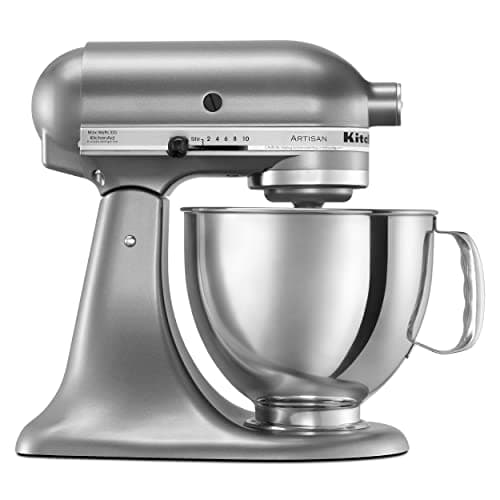
Product image from the Amazon listing.
Our verdict
The KitchenAid Artisan is the rare appliance that's worth its premium because you'll keep using it for decades. The mixing is excellent, the attachment ecosystem turns it into half a kitchen, and the repairability is unmatched. The defining kitchen workhorse.
The short version
The KitchenAid Artisan is the rare countertop appliance that earns its place because it never goes away. The 5-quart polished bowl handles everything from a single batch of cookies to a double loaf of bread dough; the 10-speed planetary action mixes evenly without a hand pass; and the tilt-head locks back so you can swap the whisk for the dough hook one-handed. The hub on the front turns it into a pasta roller, a meat grinder, or a sausage stuffer with optional attachments. Most are still running on countertops after twenty-five years — there's a reason this thing is a wedding registry default.
Pros & cons
Pros
- 10-speed planetary mixing reaches every spot in the bowl
- Powerful enough to knead bread dough without complaining
- Tilt-head design swaps attachments one-handed
- Power hub adds pasta, grinder, ice cream, sausage attachments
- Glossy enamel finish in dozens of colors
- Built to last decades — the workhorse of American kitchens
Cons
- Heavy enough that you'll want a dedicated counter spot
- Larger batches need the bigger bowl-lift Pro model
- Premium price for a single appliance
Why people love it
Tilt and load
Tilt the head back, click in the bowl and the attachment, lower the head into the bowl.
Mix on the right speed
Use the 10-speed dial: low for flours, medium for creaming, high for whipping cream and meringues. Planetary action handles the rest.
Add attachments
The front power hub turns it into a pasta roller, meat grinder, ice cream maker, sausage stuffer and more.
Who it's for
- Anyone who bakes more than once a month
- Bread bakers tired of hand-kneading
- Home cooks expanding into pasta or sausage making
- Wedding registry shoppers
Is the KitchenAid Artisan worth it in 2026?
KitchenAid's prices have crept up, and there are cheaper stand mixers on Amazon. The honest pitch for spending the money on the Artisan isn't the mixing — most decent stand mixers mix. It's the longevity. Cheap mixers tend to wear out their nylon gears within a few years of regular use; the KitchenAid uses metal gears in an oil-bath gearbox that lasts decades. It's also repairable — service parts are available, and a tired motor or gear can be swapped instead of throwing away the appliance.
The other piece is the attachment hub. Every KitchenAid stand mixer made since the 1930s shares the same power hub on the front, which means a pasta roller you buy today fits a mixer you bought in 2005 and one you buy in 2045. That ecosystem turns the mixer from a one-trick appliance into a small countertop factory. The price is high for a single tool; it's reasonable for a kitchen platform you'll keep for thirty years.
KitchenAid Artisan vs. Pro 600 vs. competing mixers
Within the KitchenAid line, the choice is mostly between the 5-quart tilt-head Artisan and the 6-quart bowl-lift Pro 600 (or the larger Professional 7-quart). The Artisan is lighter, fits under standard cabinets when tilted, and has a more intuitive load. The bowl-lift Pro is taller, heavier, and built around a stiffer frame and stronger motor — it's the right pick if you're consistently kneading two- to three-loaf bread batches or doubling cookie recipes for a crowd. For everyone else, the Artisan does it.
Against competitors like Cuisinart and Hamilton Beach, KitchenAid wins on attachment ecosystem and on long-term repairability rather than raw mixing performance. A Cuisinart stand mixer at half the price mixes a cake batter fine; it just won't be there in twenty years, won't accept thirty kinds of attachments, and won't sell for half its purchase price on the used market the way KitchenAids do.
How to actually use a KitchenAid (and not burn it out)
Two habits keep a KitchenAid running for decades. First, match the speed to the task: low (stir/2) for dry ingredients and flour, medium (4-6) for creaming butter and sugar, high (8-10) for whipping cream and meringues. Running flour on high throws it out of the bowl and stresses the motor; running cream on low never whips it. The 10-speed dial isn't decorative — it's the difference between elegant mixing and a frustrated tool.
Second, respect the dough hook limit. The Artisan handles up to about four cups of flour in a typical bread dough — push past that and you'll feel the head wobble. If you double a bread recipe, do it in two batches or step up to the bowl-lift Pro. And let the motor rest between marathon bakes; the gearbox is robust, but stand mixers aren't designed to run for an hour straight. Treat it well and it will outlast almost every other appliance in your kitchen.
See KitchenAid Stand Mixer on Amazon
Check the latest price, photos and buyer reviews on Amazon.
Check Price on Amazon →Sold and shipped by AmazonFrequently asked questions
Tilt-head or bowl-lift — which KitchenAid should I buy?
The 5-quart Artisan tilt-head is the right choice for 90% of home bakers — it covers everyday batches, fits under most cabinets, and is easier to load. The bowl-lift Pro 600 is for very heavy bread dough and large-batch baking. Start with the Artisan unless you're already baking commercial-scale loaves.
Can it really handle bread dough?
Yes — the Artisan's 325-watt motor with the spiral dough hook handles up to four cups of flour comfortably (about two loaves). For heavy artisan loaves with very wet dough, you'll want the bigger Pro model.
Are the attachments worth it?
The pasta roller set is the home run — it turns the mixer into a real pasta machine. The meat grinder and ice cream attachments are loved by people who use them often. Skip the ones you wouldn't otherwise use; the mixer itself is the value.
How long does a KitchenAid mixer last?
With normal home use, decades — twenty to forty years is genuinely common. They're repairable too; small parts are available, and a worn motor or gearbox can be serviced. It's one of the most durable appliances you can buy.
Is the KitchenAid noisy?
It's louder than a hand mixer at high speeds, but it's a controlled, mechanical hum rather than a whine. Most owners get used to it within a week and it's not loud enough to drown out a kitchen radio.
What color should I get?
Honest answer: the color you'll still like in ten years, because you will own it that long. Empire Red and white are the timeless picks; pastel colors trend in and out. Pick what looks right on your counter, then forget about it.
As an Amazon Associate, TopCrate earns from qualifying purchases at no extra cost to you. Product image, price, availability and ratings are shown on Amazon and are subject to change.