TRENDING ON AMAZON
Fitbit Inspire 3 Health & Fitness Tracker Review: Is It Worth It?
The slim, buttonless fitness tracker with 10-day battery life, real sleep staging, and no monthly fee — the entry-level Fitbit that just tracks your health.
Quick answer: The Fitbit Inspire 3 is the specific fitness tracker for the person who wants their data — steps, sleep, heart rate — without a smartwatch's ambition or a $400 price. It's not the fanciest wearable, but it does what most people actually need, cheaper and lighter than competitors. For sleep tracking and daily activity monitoring, an easy recommendation.
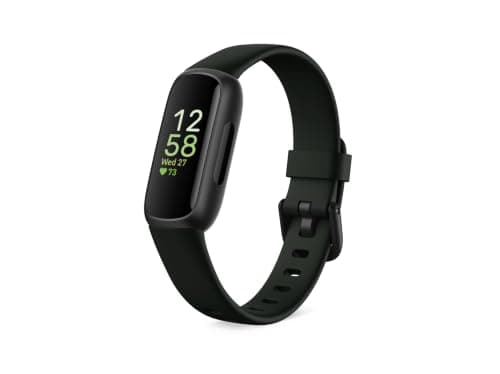
Product image from the Amazon listing.
Our verdict
The Fitbit Inspire 3 is the specific fitness tracker for the person who wants their data — steps, sleep, heart rate — without a smartwatch's ambition or a $400 price. It's not the fanciest wearable, but it does what most people actually need, cheaper and lighter than competitors. For sleep tracking and daily activity monitoring, an easy recommendation.
The short version
The Fitbit Inspire 3 is the small, thin fitness tracker for people who want steps, sleep, and heart rate without a smartwatch's ambition. It's a slim rectangular tracker with a color AMOLED display, 24/7 heart-rate monitoring, SpO2 tracking, sleep stage detection, 10-day battery life, and 20+ exercise modes — all wrapped in a tiny wristband that's more like a jewelry accessory than the wrist computer a Fitbit Charge 6 or Apple Watch is. It doesn't have GPS, doesn't take calls, and doesn't run apps, but it does exactly what most people who want a fitness tracker actually want, at a third of the price of a full smartwatch. If you don't need the smartwatch features, this is a smarter pick.
Pros & cons
Pros
- 10-day battery life — one charge per week + change
- Slim, lightweight — genuinely comfortable to sleep in
- 24/7 heart-rate + SpO2 tracking
- Sleep stage detection with sleep score
- 20+ exercise modes with automatic tracking
- No monthly Fitbit Premium subscription required for basic features
Cons
- No built-in GPS (uses phone GPS for outdoor runs)
- No music storage or Spotify offline
- No LTE — needs phone nearby for smartphone notifications
Why people love it
24/7 wrist-based heart rate
Optical heart-rate sensors measure your pulse continuously — gives you resting heart rate trends, cardio zones during workouts, and heart-rate variability during sleep for recovery insights.
SpO2 blood oxygen monitoring
Overnight blood-oxygen tracking helps identify potential sleep breathing disturbances — useful screening data for people who suspect sleep apnea or just want overnight health trends.
Sleep staging and sleep score
Combines movement, heart-rate, and heart-rate variability to detect light, deep, and REM sleep — outputs a nightly Sleep Score (0-100) that quantifies overall sleep quality.
Who it's for
- First-time fitness tracker buyers
- People wanting sleep + steps without a smartwatch
- Runners on a budget (uses phone GPS)
- Anyone whose watch keeps dying every 2 days
Do fitness trackers actually help you get healthier? What research says.
The evidence on fitness trackers is more encouraging than skeptics often claim. Meta-analyses over the last decade consistently show that wearing a fitness tracker is associated with modest but real increases in daily step count (typically 1,000-2,000 more steps per day) and small improvements in physical activity minutes per week. The mechanism is behavioral: the tracker creates awareness (you notice you sat all afternoon), a small daily goal (10,000 steps or 250-minute movement), and social/self-tracking motivation (streaks, weekly summaries) that nudges baseline behavior in a healthy direction.
But trackers don't work equally for everyone. They work best for people at the sedentary-to-moderately-active end of the spectrum — the person going from 3,000 daily steps to 6,000 gets real benefit; the person going from 8,000 to 10,000 gets minimal additional benefit. They also fade in effect over time: motivation for tracking typically peaks in months 1-3 and declines by month 12. To make a tracker sustainably useful, treat it as a data source not a motivator: check your Sleep Score most mornings, notice trends over weeks, and let the data inform lifestyle changes (bedtime earlier, more walks after dinner) rather than obsessing daily. The Inspire 3's simple approach — tracking without over-gamifying — actually pairs well with this sustainable-use pattern.
Fitbit Inspire 3 vs Amazfit Band 7 vs Xiaomi Mi Band: budget fitness tracker comparison
The sub-$150 fitness tracker market has three major categories. Fitbit Inspire 3 (~$100) has the best US ecosystem, the most-refined sleep tracking, and the cleanest app UX. Amazfit Band 7 (~$50) is the value pick — larger screen, longer battery (14 days), similar heart-rate and sleep features, but a less-polished app and no US-specific ecosystem integration. Xiaomi Mi Band 8 (~$40 imported) is the cheapest legitimate option — surprisingly good hardware for the price, but the app is Chinese-first and translations are rough.
Pick Fitbit Inspire 3 if you want the smoothest US experience, best sleep tracking, and to integrate with the Fitbit ecosystem (which Google now owns). Pick Amazfit if you want the best hardware-per-dollar and don't mind a rougher app. Pick Xiaomi if $40 is your absolute max and you're okay with technical setup. All three deliver the same core functionality (steps, heart rate, sleep, workouts); the differences are software polish, ecosystem, and price. Inspire 3 justifies the $50 premium over Amazfit for most users with better long-term usability.
How to actually build habits from a fitness tracker (and the mistakes that make people quit)
Most people who buy fitness trackers wear them enthusiastically for 3-4 weeks and then let them sit in a drawer. The pattern is predictable: initial excitement about the data, gradual realization that just having the data doesn't change behavior, and eventual abandonment. To make a tracker stick and deliver real value: (1) Pick one or two specific habits to change, not everything. Common wins: 30-minute daily walk added to routine, going to bed 30 minutes earlier, standing/moving during every calendar hour. (2) Use the tracker to measure progress on those specific habits, not as a scoreboard to obsess over. (3) Check the app once daily (morning after sleep, plus a mid-day step check) — not every hour.
Common mistakes: (a) Chasing the daily step goal at 11:30 pm — this is stress, not health. (b) Ignoring recovery signals. When your resting heart rate spikes 5-10 bpm above your baseline for multiple days, or Sleep Score drops for a week, that's the tracker telling you to slow down. (c) Comparing your score to others' — everyone's baseline is different. (d) Wearing it for the first month then not wearing it during travel and losing the streak, which is when many people quit. To sustain long-term, wear the tracker consistently for at least 6 months to normalize the data collection, then use it as a passive health-monitoring tool for years. The Inspire 3's long battery + comfortable form is specifically designed to make consistent wearing easier.
See Fitbit Inspire 3 on Amazon
Check the latest price, photos and buyer reviews on Amazon.
Check Price on Amazon →Sold and shipped by AmazonFrequently asked questions
How accurate is the Fitbit Inspire 3?
For a $100 wrist tracker, genuinely good — and it's the specific area where Fitbit's decade of algorithm work pays off. Heart rate: accurate to within 3-5 bpm of a chest strap for resting and steady-state cardio, less accurate during heavy interval work and weightlifting (typical of any wrist optical sensor). Step count: within 5-10% of a lab-grade pedometer for walking; slightly over-counts during arm-swinging activities like housework and under-counts during pushing a stroller. Sleep tracking: within 15-20% of a medical polysomnogram for total sleep time and reasonably accurate for identifying deep sleep periods (see the sleep-tracking FAQ below for detail). Distance without a phone: estimated from stride length and step count, so accurate for daily walks but not precise enough for training runs — carry your phone for Connected GPS when accuracy matters. Calorie estimates: directionally useful but consumer trackers systemically over-estimate by 15-25%, so treat the number as a trend line, not gospel. Overall: as accurate as any tracker in the sub-$150 range, and more than accurate enough to build real health habits from.
Fitbit Inspire 3 vs Fitbit Charge 6 vs Apple Watch SE: which one should I buy?
They serve three different buyers. Inspire 3 (~$100) is for the person who wants tracking + sleep + heart rate in a slim, week-long-battery form and doesn't care about smartwatch features. Charge 6 (~$160, we also review it) adds built-in GPS, more exercise modes, and better fitness features while still being tracker-shaped. Apple Watch SE (~$250) is a full smartwatch with GPS, notifications, calls, Apple Pay, and app support — but 18-24 hour battery. Rule of thumb: if you want the smallest, longest-battery tracker and only care about health data, Inspire 3. If you want GPS for outdoor runs, Charge 6. If you want a wrist computer that does everything, Apple Watch. Inspire 3 is the honest 'just tracking' choice.
Do I need a Fitbit Premium subscription?
No, for the core features you want. Free (no subscription) includes: 24/7 heart rate, sleep tracking with sleep stages, sleep score, daily activity tracking, exercise modes, SpO2, notifications, and history. Fitbit Premium ($9.99/month) adds: guided programs, advanced sleep insights (like 'wellness reports'), detailed heart-rate zones during workouts, and a health metrics dashboard. For most people, the free features are entirely sufficient — the Sleep Score and 30-day activity trends are enough to build habits. Premium is worth it only if you're using guided fitness programs or heavy sleep analysis; otherwise skip it.
Is the sleep tracking actually accurate?
For overall sleep duration and general staging, yes and it's improved dramatically. The Inspire 3's sleep tracking combines movement (from accelerometer) with heart-rate variability (from optical sensor) to detect awake vs light vs deep vs REM sleep — the same fundamental method as premium sleep trackers like Oura. Compared to a polysomnogram (medical sleep lab), consumer trackers including the Inspire 3 are within 15-20% for total sleep time and reasonably accurate for identifying deep sleep periods. Where they're less accurate: precise sleep-stage boundaries (transitions between stages get missed) and detecting brief awakenings. For everyday sleep tracking, this level of accuracy is fine and delivers useful insights.
Does the Inspire 3 have GPS?
No built-in GPS — this is one of the specific things you trade off for the smaller size and longer battery life. It uses your phone's GPS when you're carrying your phone during an outdoor run (via Connected GPS), which produces accurate distance and pace but requires phone-in-pocket. Without phone, distance is estimated from step count and stride length — okay for daily walks but not accurate enough for serious training. If you run outdoors without a phone regularly, upgrade to the Fitbit Charge 6 (built-in GPS) or a Garmin Forerunner. For most people who run with a phone anyway, no GPS is fine.
How long does the battery actually last?
Fitbit rates it at 10 days, and in real-world use most people get 6-9 days with typical use (heart rate always on, 1-2 workouts per week, notifications enabled). Turn on always-on display and you'll drop to 3-5 days. Turn off SpO2 tracking and you gain about 1-2 days. Compared to Apple Watch (18-24 hours) or Charge 6 (6-7 days), this is a genuine advantage. Charge time from empty is about 2 hours; most people top it up during a shower every few days rather than fully depleting.
Can I use it for swimming?
Yes — the Inspire 3 is 50-meter water-resistant and rated for pool swimming. It tracks swim duration, calories burned, and estimated distance. What it doesn't do: lap counting (needs the more expensive Charge 6 or Garmin Swim for that) or open-water swimming with GPS. For casual pool workouts and shower/beach durability, the 5 ATM rating is fine. Avoid hot tubs (heat can compromise the water seal) and don't press buttons underwater.
As an Amazon Associate, TopCrate earns from qualifying purchases at no extra cost to you. The Inspire 3 is a wellness tracker, not a medical device. See a doctor for cardiac or sleep-breathing concerns. Product image, price, availability and ratings are shown on Amazon and are subject to change.