TRENDING ON AMAZON
Boka Ela Mint Nano-Hydroxyapatite Fluoride-Free Toothpaste Review: Is It Worth It?
The fluoride-free toothpaste that dentists actually recommend — nano-hydroxyapatite remineralizes enamel and desensitizes teeth without SLS, sulfates or parabens.
Quick answer: Yes — Boka Ela Mint is worth it if you want fluoride-free protection that actually works, or if sensitive teeth have made brushing feel like a chore. Nano-hydroxyapatite genuinely remineralizes enamel, seals the dentin tubules that cause cold-and-sweet pain, and gradually polishes teeth brighter — all without SLS irritation or the swallowing anxiety that fluoride paste creates in kids and pregnancy. It costs about 2× a drugstore paste, and you'll notice the non-foaming texture the first few uses. But for anyone with sensitivity, kids in the family, or a general preference for cleaner formulations, Boka is the toothpaste that finally makes the fluoride-free category legitimate. Start with Ela Mint, give it a month, and evaluate.
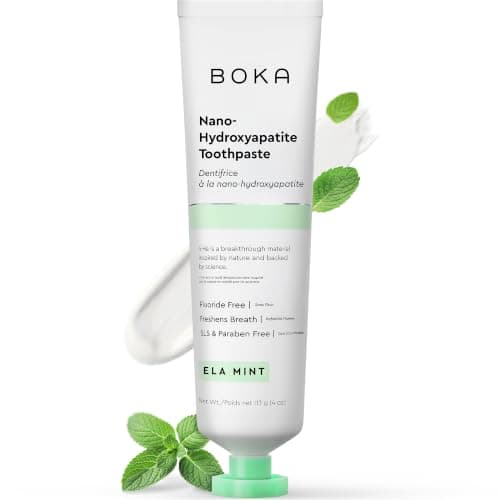
Product image from the Amazon listing.
Our verdict
Yes — Boka Ela Mint is worth it if you want fluoride-free protection that actually works, or if sensitive teeth have made brushing feel like a chore. Nano-hydroxyapatite genuinely remineralizes enamel, seals the dentin tubules that cause cold-and-sweet pain, and gradually polishes teeth brighter — all without SLS irritation or the swallowing anxiety that fluoride paste creates in kids and pregnancy. It costs about 2× a drugstore paste, and you'll notice the non-foaming texture the first few uses. But for anyone with sensitivity, kids in the family, or a general preference for cleaner formulations, Boka is the toothpaste that finally makes the fluoride-free category legitimate. Start with Ela Mint, give it a month, and evaluate.
The short version
Boka's Ela Mint is the toothpaste that got the fluoride-free category out of the crunchy corner of the store and onto real bathroom shelves. Its active ingredient is nano-hydroxyapatite (n-Ha) — a synthetic version of the mineral your enamel is already made of, backed by decades of Japanese clinical use and independent research showing remineralization comparable to fluoride. It's also SLS-free, sulfate-free, paraben-free and non-foaming, with a mild ela-mint flavor from real green tea and menthol rather than the harsh cool of drugstore paste. For sensitive teeth, whitening seekers, and anyone who wants a fluoride-free option that actually protects enamel, this is the daily driver dentists and hygienists have been quietly switching their families to.
Pros & cons
Pros
- Nano-hydroxyapatite remineralizes enamel and reduces sensitivity
- Fluoride-free without giving up cavity protection
- SLS-free, sulfate-free, paraben-free formulation
- Mild ela-mint flavor from real green tea and menthol
- Safe if swallowed — kid- and pregnancy-friendly
- 4.8-star average across tens of thousands of Amazon reviews
Cons
- Non-foaming feel takes a session or two to adjust
- Costs ~2-3× a drugstore fluoride paste
- Some longtime fluoride users don't feel the 'squeaky clean' finish
Why people love it
Nano-hydroxyapatite fills micro-cavities
Tiny particles of hydroxyapatite (the mineral your enamel is made of) settle into micro-etches on the tooth surface, rebuilding the mineral layer that acid, coffee and grinding wear down.
Desensitizes over 2-4 weeks
n-Ha seals exposed dentin tubules — the microscopic channels that carry cold-and-sweet sensations to the nerve. Users typically feel a noticeable drop in sensitivity within a couple of weeks of twice-daily use.
Gentle daily use, morning and night
Brush for two minutes twice a day. Because there's no SLS foaming agent, it feels different from drugstore paste — creamy rather than foamy — but the brushing action itself is what removes plaque.
Who it's for
- Anyone who's been told they have sensitive teeth
- Fluoride-free households (parents, pregnant users, kids)
- Sensitive gums that flare with SLS toothpastes
- Whitening-strip users who need enamel support between rounds
Why nano-hydroxyapatite became the fluoride alternative dentists trust
Fluoride has been the default anti-cavity ingredient in American toothpaste since the 1950s, and it works. But a growing group of dentists — and a much larger group of parents worried about fluoride overdose in young kids, fluorosis, and general chemical exposure — have wanted a real alternative that isn't just 'natural' marketing without science behind it. Nano-hydroxyapatite is that alternative. NASA originally developed it in the 1970s to help astronauts remineralize teeth in zero gravity (bone density including tooth enamel drops in space); Japanese manufacturer Sangi commercialized it into toothpaste in 1980, and it's been the standard fluoride alternative in Japan for over four decades with a robust safety record.
The mechanism is direct: hydroxyapatite is literally what your enamel is made of (~97% of the mineral component), so applying more of it in nanoparticle form lets those particles settle into surface micro-etches and rebuild the enamel layer. Independent 2019-2023 clinical trials — including a widely cited randomized study by Amaechi comparing n-Ha to 500 ppm fluoride toothpaste — found the two produced statistically similar enamel remineralization outcomes. The upshot: for daily home care, an n-Ha toothpaste like Boka is a legitimate fluoride replacement rather than a compromise. It's the reason major dental influencers, biohacker circles and increasingly mainstream family dentists have started recommending it. If you've been on fluoride for years without issues, there's no urgent reason to switch. If you've been quietly wanting a fluoride-free option that actually protects your teeth, Boka is finally that option.
Boka in a real oral-care routine: pairing it with flossers, whitening and dental visits
Toothpaste is only one part of the daily routine, and Boka pairs particularly well with the other tools most people already own. Because it doesn't foam heavily, it works better with a proper electric brush than a manual — the brush's oscillation moves the paste around the teeth in a way manual brushing doesn't. It also plays well with a water flosser like the Waterpik — brush first with Boka to lay down the remineralizing minerals, then flush the interdental spaces with water. Users who add a water flosser to a Boka routine report the cleanest post-brush feel of any combination. And because Boka's non-foaming formula leaves the brush head genuinely wet between uses, a UV cap like the Bril toothbrush sanitizer clips over the bristles to kill the germs a damp brush collects — the small third-piece habit that keeps the tool doing the remineralization job actually clean.
For whitening, the Boka + whitening-strip combo is one of the best-tolerated routines available. Peroxide-based Crest 3D Whitestrips work great but cause sensitivity for a lot of people; Boka's n-Ha directly counters that sensitivity by rebuilding enamel between whitening sessions. The typical protocol: brush with Boka morning and night for two weeks to establish a baseline, then start whitening strips on alternating days while continuing Boka twice daily. Most people report far less sensitivity than using strips with a standard fluoride paste. On dental visits: bring the Boka tube to your next cleaning and mention it. Younger and more current dentists will recognize it and be supportive; older or fluoride-focused practices may push back — that's a conversation to have based on your specific dental history, not an argument to have with a hygienist.
Boka Ela Mint vs Boka Cacao vs Boka Kids: which flavor and how to pick
Boka's lineup has expanded well beyond the original Ela Mint, and the flavors matter more than the marketing suggests because you're using it twice a day for years. Ela Mint (the flagship) is a mild green-tea-and-menthol mint that most adults find pleasantly non-medicinal. It's the safe default and the one to start with. Cacao is a cocoa-based flavor that sounds strange but has a genuine fanbase among people who dislike mint entirely — coffee drinkers, people with menthol sensitivity, and anyone who wants a completely different oral-care experience. Lemongrass is the herbal option, more refreshing than minty, and works well as a morning-brush alternative to a mint you use at night.
For families with kids, Boka's Berry Bubble Kids version is the sub-brand to buy — same n-Ha and safe-if-swallowed formulation with a genuinely kid-appealing berry flavor. It's what most Boka-using parents actually use for their children under 6, since kids that age tend to reject strong mint. For teens and adults sharing a bathroom, keeping one adult tube (Ela Mint or Cacao) and one kids tube (Berry Bubble) covers everyone at reasonable cost. Boka's subscribe-and-save at their DTC site knocks the annual cost down meaningfully for households using 3+ tubes a month; Amazon multi-packs are competitive too and ship next-day. If you're testing whether n-Ha works for your family, buy the smallest Ela Mint tube first, brush with it for a month, and evaluate — most people notice reduced sensitivity within 2-3 weeks and stick with it long-term.
See Boka Ela Mint Toothpaste on Amazon
Check the latest price, photos and buyer reviews on Amazon.
Check Price on Amazon →Sold and shipped by AmazonFrequently asked questions
Does nano-hydroxyapatite really work as well as fluoride?
For remineralization and sensitivity, yes — and Boka's formula sits in the clinically effective 10%+ range. Nano-hydroxyapatite has been the fluoride-alternative standard in Japan since the 1980s, and independent studies (including the widely-cited 2019 Amaechi trial) find n-Ha comparable to 500-1450 ppm fluoride at preventing enamel demineralization and reducing early caries in clinical settings. Where fluoride still edges ahead in some studies is on active/rampant decay in high-risk mouths — if your dentist has flagged specific active cavities, follow their fluoride guidance. For everyone else practicing normal daily care, n-Ha protects enamel effectively without the fluorosis or overdose concerns that make some parents nervous about fluoride paste in young kids.
Is Boka toothpaste safe if swallowed by kids?
Yes — that's one of its biggest selling points for families. Because there's no fluoride, no SLS and no artificial sweeteners, accidentally swallowing a pea-sized amount is genuinely not a concern the way a fluoride paste warns about. Many parents use Boka's kid-flavored version (Berry Bubble) as a training toothpaste for toddlers who haven't mastered spitting yet, and switch adults in the household to Ela Mint or Cacao. Boka still recommends supervised brushing for young kids, but there's no ER-level swallowing risk.
Boka vs Sensodyne vs Colgate: which toothpaste is actually best for sensitivity?
Different mechanisms, both work. Sensodyne uses potassium nitrate (in the ProNamel line and others) to calm the nerves inside teeth — you feel less pain when cold hits. Boka uses nano-hydroxyapatite to physically seal the dentin tubules, so cold doesn't reach the nerve as easily to begin with. Both approaches are backed by research and both take 2-4 weeks to show full effect. Sensodyne is cheaper and available everywhere; Boka is fluoride-free and generally gentler on gums. If you already use Sensodyne and it works, no urgent reason to switch. If you want a fluoride-free option that also whitens gradually (n-Ha polishes the surface), or you've had irritation from SLS-based sensitive pastes, Boka is the smarter pick. Both dramatically outperform standard Colgate at reducing sensitivity.
Will Boka whiten my teeth?
Slightly and gradually, yes — but it's not a whitening toothpaste in the peroxide-strip sense. Nano-hydroxyapatite gently polishes the enamel surface and fills in micro-etches that trap coffee, tea and wine stains, so teeth look brighter and more uniform over 4-8 weeks of twice-daily use. If you want dramatic whitening, pair Boka with a hydrogen-peroxide treatment like Crest 3D Whitestrips — Boka handles the enamel-restoration side while the strips handle the bleaching, and the combination causes noticeably less sensitivity than strips used with a standard fluoride paste. Where Boka can't help — and neither can any toothpaste or whitening product — is on chips, gaps, or a single dark tooth that peroxide will never lift; for those specific cosmetic problems a set of Shiny Smile custom snap-on veneers is the removable overlay that covers them without touching enamel.
How long does one tube of Boka toothpaste last?
A 4 oz (113 g) tube runs one adult about 2 months of twice-daily brushing at a pea-sized dose, or roughly a month for two people sharing. Boka's subscribe-and-save on their site knocks the per-tube cost down meaningfully; on Amazon, the multi-packs bring it closer to $8-9 per tube versus the single-tube price. Compared to drugstore paste at $3-4 you're paying about a $5 monthly premium per person for the ingredient upgrade — genuinely worth it if you deal with sensitivity or want to skip fluoride, less obvious if your teeth are already fine on any paste.
Is it safe during pregnancy?
Yes — fluoride-free toothpaste is one of the safer daily-care swaps during pregnancy, and Boka's ingredients (nano-hydroxyapatite, xylitol, silica, green tea extract, mild menthol from ela flower and mint) are all considered pregnancy-safe. Many OB-GYNs and prenatal-focused dentists specifically recommend n-Ha toothpaste during pregnancy because pregnancy gingivitis and morning-sickness-related enamel erosion are common concerns, and n-Ha directly supports both gum comfort and enamel repair. Confirm with your own care team if you have specific concerns.
As an Amazon Associate, TopCrate earns from qualifying purchases at no extra cost to you. Boka is a cosmetic dental product, not a treatment for active dental disease; follow your dentist's fluoride guidance for high-cavity-risk situations. Product image, price, availability and ratings are shown on Amazon and are subject to change.
More reviews you might like
SKINCARE
Celimax Vita-A Retinal Shot Review: Best K-Beauty Retinal for Sensitive Skin?
SPORTS
Body Glide Original Review: The Anti-Chafe Balm That Actually Works
SKINCARE
Foreo Luna Mini 3 Review: Is the Silicone Cleansing Brush Worth It?
SKINCARE