COMPARISON
The Wand vs Üllo: Single-Use In-Glass Filter vs Reusable Pour-Through Purifier — Which Wine-Headache Fix Is Right for You? (2026)
The Wand by PureWine and Üllo are the two most-searched wine purifiers in 2026, and they take opposite approaches to the same problem — the histamines and sulfites behind wine headaches, flushing and next-day congestion. One is a $25 single-use filter you stir in the glass. The other is a $79-$130 reusable pour-through purifier that filters a whole bottle at once. Here's how they compare on cost per glass, filtration, portability and taste — and which fits your drinking habits.
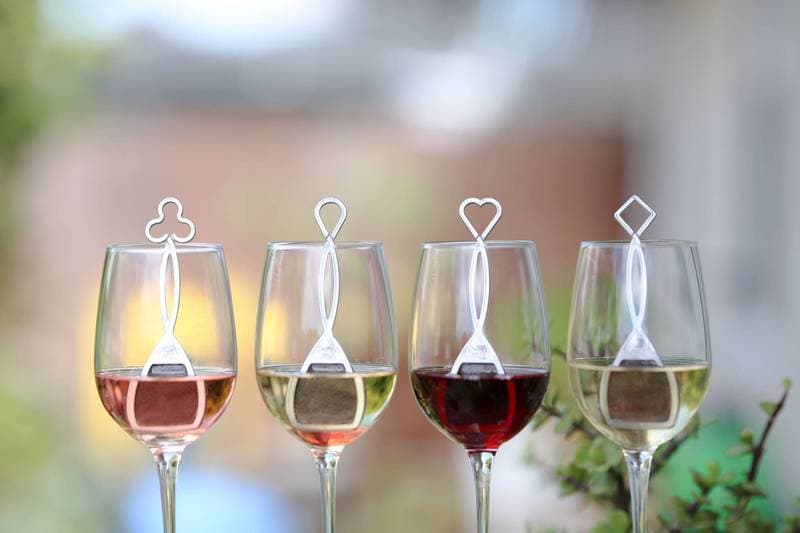
The Wand by PureWine and Üllo are the two most-searched wine purifiers in 2026, and they compete for the same buyer: someone who gets a reliable headache, a flushed face, a stuffy nose or a rough next-morning from a glass or two of wine, and would like the chemistry of the drink fixed rather than their own body medicated with antihistamines. What they aren't is the same product. The Wand is a single-use, in-glass filter from PureWine — individually wrapped, pocket-portable, around $25 for a 10-pack at roughly $2 to $2.50 per glass. Üllo is a reusable pour-through purifier from a Chicago-based company founded by chemist James Kornacki (Northwestern PhD) in 2015 — a tabletop device that sits on top of your wine glass or a dedicated carafe, filters an entire 750 ml bottle at once, and uses a replaceable food-grade polymer filter cartridge at roughly $2 per bottle filtered.
So the right choice depends on where you drink wine, how much you drink, and whether you want portability or household permanence. If you drink wine at restaurants, bars, hotels, dinner parties or on the road — the places where a tabletop pour-through purifier is impractical to carry — The Wand is engineered for exactly that: slip two individually wrapped filters in a jacket pocket or purse, drop one in the poured glass, and the headache-driving compounds come out while the wine stays in. If you drink wine at home nightly, want a permanent fixture on the counter, and prefer to purify a whole bottle in one 10-second pour that doubles as aerating, Üllo is the honest pick. This guide covers how each one actually works, who makes them, the real cost math at different drinking frequencies, how the filtration differs chemically, and which one wins for the specific drinker pattern you're probably trying to decide for.
One disambiguation note before we start: searching "Wand" without the "PureWine" clarifier can blend search results with Solawave's facial microcurrent wand, a totally different cosmetic device from a different company. The Wand we're comparing to Üllo is The Wand by PureWine, a wine purifier that goes in the glass. If you were searching for a skincare microcurrent wand, that is a different product entirely and nothing to do with this review. Our full Wand by PureWine review covers the single-use filter approach in depth.
The Wand vs Üllo at a glance
What each one is: The Wand by PureWine is a small, individually-wrapped single-use filter you stir in a poured glass and hang over the rim for about three minutes. Its filter pouch binds histamines and sulfites (PureWine's testing puts removal at up to 95%) while leaving tannins, aromas and flavor compounds alone. One Wand treats one standard glass of wine; you toss it after and use a fresh one for the next pour. Üllo is a tabletop pour-through purifier — a silicone reservoir on top, a food-grade replaceable polymer filter cartridge in the middle, and a built-in aerator on the bottom — that you set on top of a wine glass or a dedicated Üllo carafe and pour the bottle through. One filter cartridge handles one 750 ml bottle; you drop in a new cartridge for the next bottle. Both are additive-free (nothing is added to the wine) and subtractive — the compounds come out rather than being neutralized by a chemical you add.
Price: The Wand is around $24.99 for a 10-pack of individually-wrapped single-use filters on PureWine's own direct funnel, which works out to roughly $2 to $2.50 per glass treated. Üllo's starter purifier plus four filters runs around $79.99 on the brand's own site; the full-carafe-included kit is around $130 on Amazon. Replacement filter packs for Üllo run roughly $30 for a 10-pack to $59.98 for a 20-pack, which works out to roughly $2 to $3 per bottle filtered. The honest cost math: at a glass a night, Üllo breaks even on The Wand's per-glass cost around month three to five; at only a few glasses a week in restaurants and traveling, The Wand's per-glass pricing stays cheaper indefinitely and you never spend the $80 upfront.
Portability: The Wand wins decisively. Individually wrapped filters slip into a jacket pocket, purse, laptop bag or dopp kit without noticing the weight — the whole point is treating one glass at a time at a restaurant, a bar, a dinner party, a hotel room or on a long flight. Üllo is a tabletop device engineered for household use; you don't carry an Üllo to a restaurant. If restaurant and travel wine is your main drinking context, that single difference closes most of the comparison.
Filtration focus: Both target the two compounds most-blamed for wine side effects. The Wand's filter pouch binds histamines and sulfites — the former produced during fermentation (especially in reds) and tied to the classic flush, stuffy nose and headache in sensitive people; the latter the preservative that keeps wine shelf-stable and bothers a smaller allergy-prone group. Üllo's Selective Sulfite Capture technology, developed by chemist James Kornacki at Northwestern, likewise targets sulfites with a polymer that acts like a magnet rather than a net — the brand positions it as a selective filter that pulls sulfites while leaving aromatic and flavor compounds alone, and the current filter cartridges remove sulfites while reducing histamines. The honest take: both technologies work in the same mechanistic family (selective binding, not just mechanical sieving), both are additive-free, and both leave the wine's taste intact in careful side-by-side blind testing.
Guarantee and warranty: PureWine ships The Wand with a stated money-back guarantee on standard-price pack orders. Üllo ships its purifier with a one-year brand warranty and a stated return window on standard-price orders. Both are consumer products with the usual direct-to-consumer policies — nothing unusual for the category on either side.
The histamine-and-sulfite problem, and what both products are trying to solve
The honest medical framing matters here, because the people buying either product are usually doing it because wine reliably makes them feel bad in a specific, repeating way — a quick-onset headache that a single glass triggers but a cocktail doesn't, a sudden flushed face, a stuffy nose that outruns a tissue, a next-morning rough-ness that doesn't line up with how much they actually drank. Those symptoms, in most sensitive drinkers, trace back to two naturally occurring wine compounds: histamines, which build up during fermentation and are highest in red wines, and sulfites, which are added as a preservative and bother a smaller allergy-prone population. Neither compound is an alcohol issue — which is why fixing the chemistry of the wine itself (rather than slamming an antihistamine or quitting) is the right lever.
Both The Wand and Üllo attack the problem in the glass or in the pour, instead of in your body. Both are subtractive — they remove compounds rather than adding anything to the wine, which is why the taste stays clean rather than taking on the "treated" character some additive drops can introduce. Both work on red, white and rosé; reds carry the most histamines, so histamine-sensitive drinkers typically notice the biggest difference there. Neither is a medical device, neither claims to treat allergies or medical conditions, and neither works on symptoms the alcohol itself is causing — if your bad reaction is to the ethanol, no filter will fix it.
What neither product addresses: the alcohol-dehydration axis (hydrate and pace), the drink-past-your-limit axis (drink less), the tannin-driven headache some sensitive drinkers get from very tannic reds (both reduce it marginally; neither targets it directly), and medical allergies that need a doctor's workup. The right expectation for either product is "the histamine and sulfite loading in a glass of wine, mostly gone, with the wine's taste intact." Hit that framing and both deliver.
What The Wand actually is
The Wand by PureWine is a small, individually-wrapped single-use purifier that works per-glass. The device itself is a plastic stem with a filter pouch at one end and a decorative charm at the other; you unwrap it, drop the filter end into a poured glass of wine, stir for a few seconds to start contact, and hang the stem over the rim so the filter pouch stays submerged for about three minutes. The patented filter media binds histamines and sulfites — PureWine's own testing puts removal at up to 95% — while leaving the tannins, color, aromatics and flavor compounds alone. One filter treats one standard glass; you toss it after and use a fresh Wand for the next pour.
The design is engineered around portability and single-glass treatment. Each Wand is individually sealed in a wrapper that slips into a jacket pocket, a laptop sleeve or a purse without being noticed. The decorative charm tops (heart, clover, diamond) are a small, honest piece of design thinking — at a dinner party or a wine bar where multiple glasses are on the table, the charm marks whose glass is whose, so the shared bottle doesn't force everyone else to use a Wand just because one histamine-sensitive guest at the table wants one. One sensitive drinker, one Wand, one glass — the rest of the table pours wine normally.
The trade-offs are worth naming plainly. Per-glass cost is the biggest: at $2 to $2.50 per glass treated, a nightly glass-of-wine drinker spends more over a year than they would on an Üllo-and-filters setup. Single-use plastic is a real environmental cost, modest per unit but non-zero. The three-minute contact time is a mild friction compared to pouring through Üllo in ten seconds — most Wand users leave it in while they drink and that evens out, but it is a brief wait at the first sip. The wait is small and the design is intentional, but the honest read is that The Wand is optimized for "the wine at this restaurant tonight," not for "the bottle on my kitchen counter every night." Our full Wand by PureWine review covers daily-use in depth.
What Üllo actually is
Üllo is a tabletop pour-through wine purifier designed by chemist James Kornacki, a Northwestern University PhD in chemistry who founded the Chicago-based company in 2015. The device itself is a two-part assembly: a silicone reservoir with a food-grade polymer filter cartridge at the top, and a built-in aerator at the bottom. You set the whole thing on top of a wine glass or a dedicated Üllo decanter, pour the bottle in, and the wine passes through the polymer filter cartridge — Kornacki's patented Selective Sulfite Capture technology, which the brand describes as a magnet-like selective binder rather than a sieving filter — and emerges purified on the way into the glass or carafe below. Full-bottle filtering takes under a minute; the aerator can be twisted open or closed in the pour, so you can purify-only (whites, aged reds) or purify-and-aerate (young reds that benefit from oxygen contact).
The design is engineered around household use. Üllo lives on a kitchen counter, a wine cabinet shelf or a dinner-party sideboard; the carafe version is explicitly furniture-grade and intended to sit out. One filter cartridge handles one 750 ml bottle; you drop a used cartridge in the trash and clip in a fresh one for the next bottle, with 10-, 15-, and 20-pack cartridge refills available at roughly $2 to $3 per bottle filtered. The brand has retail distribution well beyond its own site, which is the mark of a mature kitchen-electronics product.
The trade-offs mirror The Wand's. Portability loses: Üllo is not a device you carry to a restaurant, and the pour-through form factor is impractical for individual glass treatment at bars or dinner parties where the host is pouring. The upfront price is meaningfully higher — $79.99 for the base purifier plus four filters on the brand's site, roughly $130 for the carafe-included kit on Amazon, before the ongoing filter-cartridge cost at $2 to $3 per bottle. Household permanence is the whole value proposition: if that's your drinking pattern, Üllo wins; if your wine-drinking is mostly out of the house, you're paying for a feature you can't use.
Session flow: what each one actually feels like in use
The Wand's 3-minute glass flow: pour your wine glass from whatever bottle is open, unwrap one Wand, drop the filter pouch into the glass, stir for five to ten seconds so the pouch makes thorough contact, then hang the stem over the glass rim so the pouch sits submerged. The decorative charm hangs outside the glass. Wait roughly three minutes — many drinkers leave the Wand in and start sipping around the two-minute mark — and the histamine and sulfite loading is largely gone. Remove and toss the Wand before the last few sips to avoid getting the charm end wet in your mouth. Total active-attention time: unwrap, stir, hang (about fifteen seconds), with the three-minute wait running in the background of normal dinner conversation.
Üllo's 10-second bottle flow: open the wine bottle as usual, place the Üllo purifier on top of a wine glass (or on the dedicated Üllo decanter), hold it stable with one hand, and pour the bottle through in a single steady stream. The wine passes through the filter cartridge, through the optional aerator, and emerges purified on the other side. A standard 750 ml bottle pours through in roughly a minute end-to-end, including the physical pour time. Everyone at the table drinks from the purified pour; nobody at the table has to use their own individual filter, and nobody at the table has to wait three minutes between pouring and drinking.
The practical difference is bigger than the time count suggests. The Wand's flow is a per-sensitive-person tool: at a dinner party where only one guest is histamine-sensitive, one Wand treats that guest's glass while the host pours the rest of the table normally. Üllo's flow is a treat-the-whole-bottle tool: whoever opens the bottle commits the whole bottle to the filtered pour, and everyone at the table drinks the same wine. Neither is better; they're built for opposite social configurations. If you're the one person at every dinner table who needs the fix, The Wand lets you handle it without changing anyone else's drink. If you're hosting a wine-sensitive dinner party or you're the main drinker in your household, Üllo is the one-pour-serves-everyone fix.
Cost math: when each one is cheaper over a year
The honest cost comparison depends on how often you drink wine and the share of that drinking that happens at home versus out. Three honest scenarios:
Scenario A — the restaurant and travel drinker (two to four glasses a week, mostly out of the house): The Wand wins decisively. At $2 to $2.50 per glass treated, three glasses a week is $6-$7.50 a week, or roughly $300-$400 a year, with zero upfront cost and no device to leave at home when traveling. Üllo's $80 upfront buy is wasted most of the time — you can't bring it to a restaurant and most of your drinking context prevents using it.
Scenario B — the nightly home drinker (seven glasses a week, almost entirely at home): Üllo wins. At $2 to $3 per bottle (one bottle feeds roughly 3.5 standard glasses), Üllo's ongoing cost at a bottle every two or three days is around $2-$3 twice a week, or $150-$300 a year, plus the one-time $80 for the purifier. The Wand at the same drinking frequency is roughly $14-$17.50 a week, or $700-$900 a year. Üllo breaks even on The Wand within the first few months and compounds the savings for the rest of the device's life.
Scenario C — the mixed drinker (home three nights a week, out two nights a week): the per-glass math goes either way, but the honest answer is to own both. Keep Üllo on the kitchen counter for home nights, slip two Wands in your pocket on restaurant nights. That's the setup many wine-sensitive drinkers end up with — not a competition, but complementary tools for the two drinking contexts a lot of people actually have. The combined annual cost (Üllo once at $80 plus occasional filter cartridges, plus a $25 10-pack of Wands lasting several months) often lands below the single-tool cost at either extreme while covering both situations.
Where The Wand wins
Portability and context. Restaurants, bars, hotel rooms, dinner parties where the host is pouring, long flights, cruise ships, Thanksgiving at the in-laws' house, a wine tasting at a vineyard that isn't going to let you pour their flight through a $130 device. In every one of those contexts, Üllo is impractical and The Wand is in your pocket in a wrapper the size of a pen cap. The whole individually-wrapped single-use design is engineered for exactly this problem, and nothing about the Üllo form factor can match it.
Low commitment and low upfront cost. The Wand's $25 10-pack is a small enough purchase to justify as an experiment: if the filter helps your reaction to wine, you're reading the right review; if it doesn't, you've spent the price of a bottle of wine finding out. Üllo's $80 upfront is a bigger commitment, and the one-year warranty you buy on a tabletop device assumes you'll be using it regularly enough to justify the purchase. For first-timers trying to establish whether histamines and sulfites are actually what's bothering them, The Wand is the honest low-risk entry point.
The one-sensitive-person-at-the-table use case. At any shared dinner table where only some people are wine-sensitive, The Wand treats one glass without forcing everyone else to drink through a filter. That social configuration is probably the most common one for wine-sensitive drinkers — the person at the dinner party who gets the headache while nobody else at the table does — and The Wand is engineered for it. The decorative charm doubles as a glass marker so the Wand-treated glass doesn't get mixed up with the untreated ones on a shared table.
Where Üllo wins
Cost per glass at nightly home drinking frequency. If a glass or a bottle of wine is part of a daily routine, Üllo's per-bottle filter cost pulls ahead of The Wand's per-glass cost within a few months and compounds the savings for the rest of the device's life. For a household where wine is a daily thing, the math is clear.
Treat-the-whole-bottle convenience. The pour-through form factor is a real convenience advantage at home. Open a bottle, set Üllo on a decanter, pour the whole thing through once, and the entire bottle is purified in a minute — no need to re-dose with a fresh Wand on every refill, no three-minute wait between glass and sip, and every pour from that bottle (dinner, after-dinner, tomorrow night's second half of the bottle) is already treated. If you're hosting a wine-sensitive crowd, this is a serious hospitality advantage.
The aerator function. Üllo's built-in aerator is a genuine side-feature The Wand doesn't offer. For younger, more tannic reds that benefit from oxygen contact, flipping the aerator open during the pour accomplishes the aeration decanting a bottle would otherwise provide, in the same ten seconds the purification is happening. It isn't the main reason to buy an Üllo, but it is a free side-benefit a Wand can't give you.
The brand pedigree. Kornacki's Northwestern chemistry PhD and the Selective Sulfite Capture technology development give Üllo an evidence pedigree in the wine-purification category that The Wand's PureWine testing data doesn't fully match. Both brands' claims are credible and both products do what they say; Üllo just has more academic-chemistry visibility behind its specific filtration approach. Readers who weigh brand pedigree heavily will find more to latch onto on Üllo's story.
Which one to buy for your drinker pattern
Buy The Wand if: you drink wine mostly out of the house (restaurants, bars, dinner parties, travel); you're the only wine-sensitive person at a typical dinner table; you want the lowest-commitment way to test whether histamines and sulfites are what's actually bothering you; or you want a portable fix you can keep two or three of in a jacket pocket without needing to carry a $130 piece of furniture. The Wand's $25 10-pack is the entry point for restaurant-drinker wine-sensitive readers, and our full Wand by PureWine review covers it in depth.
Buy Üllo if: you drink wine at home nightly or near-nightly; you host wine-sensitive dinner guests regularly and want everyone at the table drinking from the same purified bottle; your drinking is almost entirely at home and portability isn't a factor; or the pour-through-the-aerator design appeals as a tabletop fixture rather than a per-glass tool. Order direct from Üllo for the longer warranty or on Amazon for the carafe-included kit if the decanter form factor fits your household use.
Buy both if you have the mixed-drinker pattern. The combined annual cost of an Üllo on the kitchen counter plus a 10-pack of Wands in a jacket pocket often lands below the single-tool cost at either extreme of the home-vs-out drinking split, and it covers both situations with the right tool rather than compromising on one. That's the setup many long-term wine-sensitive drinkers end up with, and it's the honest recommendation for the mixed drinker.
Our verdict
The Wand and Üllo aren't really the same product — they are different form factors solving the same chemistry problem at opposite ends of the home-versus-out drinking spectrum. The Wand is the portable, per-glass, individually-wrapped filter engineered for restaurants, dinner parties and travel: low upfront cost, pocket-portable, built for the one-sensitive-person-at-the-table reality that most wine-sensitive drinkers face at dinner. Üllo is the household, treat-the-whole-bottle, pour-through purifier engineered for nightly home drinking: higher upfront cost but lower per-bottle cost at daily use, a tabletop fixture with an aerator function built in, and a chemistry-pedigree brand story.
If you have to pick one, pick on your drinking pattern, not on which brand is "better" — because at the thing each is optimized for, each is honestly the right pick. If you drink wine mostly out of the house or at other people's dinner tables, buy The Wand. If you drink wine mostly at home every night, buy Üllo. If you do both regularly, buy both and use each in its context. Our full Wand by PureWine review covers The Wand's single-use filter approach, portability math and taste-impact testing in depth, including the realistic scenarios where it fits best and the two or three places it doesn't.
Read our full Wand by PureWine review
Our verdict on the $25 single-use in-glass wine filter from PureWine — how the 3-minute contact time actually fits restaurant and travel drinking, how it compares to Üllo for different drinker patterns, and whether it's the right fix for the histamine-driven wine headaches you're trying to solve.
Read our full Wand by PureWine review →Frequently asked questions
What's the main difference between The Wand and Üllo?
The Wand by PureWine is a single-use, individually-wrapped filter you stir in a poured wine glass for about three minutes to pull histamines and sulfites out — $25 for a 10-pack, roughly $2-$2.50 per glass, pocket-portable, built for restaurants and travel. Üllo is a reusable tabletop pour-through purifier ($79.99 base kit on the brand's site, around $130 for the carafe-included Amazon kit) with a replaceable food-grade polymer filter cartridge; you pour an entire 750 ml bottle through it in about a minute, treating the whole bottle at once. Both are additive-free and subtractive; the choice is about where you drink wine (out → The Wand, home → Üllo), not about which filter is "better."
Which one filters more effectively — The Wand or Üllo?
Both target the same two compounds (histamines and sulfites) using selective-binding polymer-filter technology — The Wand's filter pouch binds both and PureWine's testing puts removal at up to 95%; Üllo's Selective Sulfite Capture polymer, developed by chemist James Kornacki at Northwestern, acts like a magnet rather than a sieve and the current cartridges remove sulfites while reducing histamines. In side-by-side blind taste tests, both leave the wine's taste, color and aromatics intact and both measurably reduce the compounds most drinkers are reacting to. The honest take: both work, both are credible, and the chemistry category is mature enough that filtration efficacy is not the main thing differentiating them. Choose on form factor and drinking context, not on filter chemistry.
Which is cheaper over a year — The Wand or Üllo?
Depends entirely on how often you drink wine and the share of that drinking that happens at home. At nightly home drinking (one bottle every two or three days), Üllo wins decisively — the $80 upfront pays back in roughly three to five months, and the ongoing filter-cartridge cost ($2-$3 per bottle) is far below The Wand's per-glass cost ($2-$2.50 per glass, which is $7-$9 per bottle). At two to four glasses a week mostly out of the house (restaurants, travel, dinner parties), The Wand wins — no $80 upfront, perfectly portable, and the per-glass cost is the whole cost. For mixed drinkers, owning both is often the cheapest option that covers both drinking contexts honestly.
Can I use Üllo at a restaurant?
Realistically, no. Üllo is a tabletop pour-through device designed for household use — it sits on top of a wine glass or decanter while you pour an entire bottle through it. It isn't engineered for restaurant use, bar use, dinner parties where the host is pouring, or travel, and the pour-through form factor doesn't fit any of those contexts. If restaurant wine is a significant share of your drinking, The Wand by PureWine is the correct tool for that context — individually-wrapped single-use filters that slip into a pocket, drop into a poured glass, and treat one glass without needing to pour anything through anything. Many wine-sensitive drinkers own both: Üllo at home, Wands in the pocket for out of the house.
Do The Wand or Üllo change how the wine tastes?
No, that's the design intent for both products. The Wand's filter is selective — it binds histamines and sulfites while leaving tannins, color, aromas and flavor compounds alone. Üllo's Selective Sulfite Capture polymer works on the same selective-binding principle rather than as a sieving filter, so flavor compounds and aromatics pass through unaffected. In practice, both leave the wine's taste, mouthfeel and aroma intact in careful side-by-side blind testing, and neither adds anything to the wine (both are subtractive rather than additive, which is why neither introduces a "treated" character the way some additive-drop products can). The specific thing that goes away is the compounds that drove the headache or the flush, not the taste.
Do The Wand or Üllo work on red, white and rosé?
Yes, both work on red, white, rosé and sparkling wines. Reds carry the highest histamine load during fermentation and tend to show the biggest side-effect-reduction difference for histamine-sensitive drinkers, so that's where most buyers of either product notice the most dramatic effect. On whites and rosés, the main compound being reduced is sulfites (the preservative), and the effect is subtler but still measurable for sulfite-sensitive drinkers. Neither product works on side effects caused by the alcohol itself — that's a drink-less-and-hydrate issue, not a histamine-and-sulfite issue, and no filter will fix it.
TopCrate is reader-supported. When you buy through links on our site we may earn an affiliate commission, at no extra cost to you. Content is for general information and isn't a substitute for professional advice.