CLEANING 101
How to Fold a Fitted Sheet: The Corner-Pocket Method, Explained So It Actually Works
Exact hand positions for the corner-pocket fold, a flat-surface version for beginners, a rolled shortcut for days when you're done pretending, and the pillowcase trick that keeps sheet sets together.
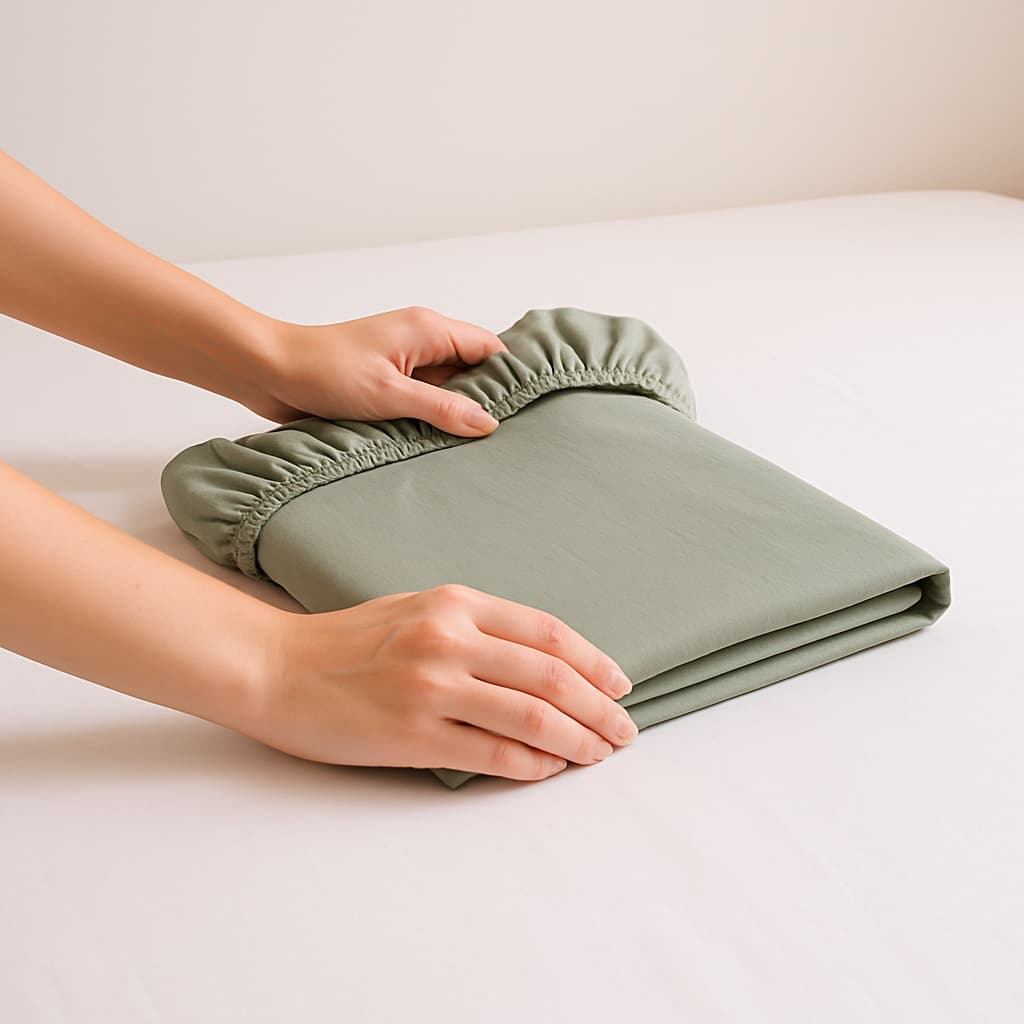
Everyone has a fitted-sheet strategy, and most of them are surrender: the angry wad, the closet-shelf stuff, the ball that gets ironed flat by the linen stack above it. The corner-pocket fold — the one where the sheet ends up as a genuinely flat rectangle — is real, it works, and it takes about ninety seconds once your hands learn it. The reason most tutorials fail is that they're vague about the only thing that matters: exactly where your hands go.
So this one is precise. Below: why fitted sheets are engineered to defeat you, the corner-pocket method step by step with actual hand positions, a flat-surface version for the first few attempts, a rolled shortcut for don't-care days, and the pillowcase trick that keeps whole sheet sets from scattering across the closet.
Why Fitted Sheets Fight You
A flat sheet folds easily because it's a rectangle, and rectangles cooperate: straight edges meet straight edges, halves match halves. A fitted sheet is a rectangle that was surgically altered into a shallow box — four sewn corner pockets, curved seams, and an elastic hem that contracts every edge into a pucker. It has no straight lines anywhere, so the usual fold-in-half instinct just produces a smaller, angrier version of the original problem.
The corner-pocket method wins by removing the geometry problem instead of fighting it. Nest all four corner pockets inside one another and the elastic gathers into a single tamed edge — what's left in your hands behaves almost exactly like a flat sheet. That's the entire trick. Every step below is just a controlled way of getting corner into corner.
The Corner-Pocket Method, Step by Step
Step 1 — Hold the sheet inside out by the two corners of one short end, with one hand slipped inside each corner pocket like oven mitts, seams facing you and the rest of the sheet hanging down. Step 2 — Bring your hands together and flip the right-hand corner over the left, so the right pocket swallows the left one; the corner that was inside out is now right side out, draped over your left hand. Give it a shake so the nested pair sits smooth. Step 3 — With your free right hand, trace down the hanging edge on the right side until you hit the third corner, slip your hand inside it, bring it up, and flip it over the pair on your left hand — three pockets nested, and your left hand is now wearing most of the sheet.
Step 4 — Find the last corner, run your hand into its pocket, and flip it over everything, same move as before. All four pockets are now stacked on one hand, and the elastic gathers into a rough L along two sides. Step 5 — Lay it on a flat surface (a bed is perfect) and square it up: fold the curved elastic edge inward on itself so the blob becomes a rectangle with four reasonably straight sides. Take ten seconds here; the squaring is what makes the final result look store-folded. Step 6 — Fold the rectangle into thirds lengthwise, then into thirds again. You now have a flat, stackable packet, and the elastic is buried in the middle where it can't cause any more trouble.
The Flat-Surface Version for Beginners
The standing version fails beginners for one reason: you're managing geometry in midair with a sheet hanging over your arms like a defeated ghost. So put it down. Spread the sheet on a bed inside out, elastic facing up — it will look like a shallow box. Reach into the two corners on the right side and flip each one over its neighbor on the left, so both right pockets nest into both left pockets. You've done the same corner-into-corner move as the standing method, just one pair at a time with the mattress holding everything still.
Now smooth the doubled sheet flat, fold the top half down over the bottom half so all four pockets stack in one corner, and tuck that gathered elastic in on itself to square things up. From there it's the same finish: thirds, then thirds again. This version takes a minute longer and works the first time you try it. After a few loads of laundry you'll find your hands doing the standing version without being asked.
The Rolled Shortcut for Don't-Care Days
Some laundry days are not corner-pocket days, and that's fine — the goal is a closet that closes, not a merit badge. The rolled shortcut: lay the sheet out flat-ish, elastic side up, and fold the two long edges in toward the middle so the elastic is trapped inside. You now have a long, lumpy runner. Fold or roll it from one short end into a burrito, and the tension of the roll holds it closed.
A rolled fitted sheet won't stack like a folded one, but it stores neatly in a bin or basket, and it beats the wad on every metric: it takes thirty seconds, it doesn't avalanche off the shelf, and it comes out with soft creases instead of deep wrinkle scars. It's also the honest choice for jersey and flannel sheets, which are too stretchy and grippy to square up crisply no matter how good your technique is.
Store the Whole Set Inside a Pillowcase
Here's the move that makes the folding pay off: fold the fitted sheet, the flat sheet, and one pillowcase, then slide all of them inside the second pillowcase and fold its open end over. Each sheet set becomes one soft, labeled-by-its-own-fabric package — no orphaned pillowcases, no excavating the closet for the flat sheet that matches, no re-folding things that toppled. Changing the bed becomes a one-grab operation.
This trick is also the great equalizer for mixed linen closets, where thick and thin sets never stack politely — we keep our Bedsure sheets bundled this way and the shelf stays civilized. And since you're on a linen-closet roll: the pillows those cases go on need attention a few times a year too, and our guide on how to wash pillows covers that job settings-by-settings, including the yellow-stain fix.
Read our Bedsure sheets review
We tested the internet's favorite budget sheet set for softness, pilling, and whether the fitted corners actually stay on the mattress.
Read our Bedsure sheets reviewFrequently asked questions
What is the easiest way to fold a fitted sheet?
The corner-pocket method: with the sheet inside out, put a hand inside each corner pocket along one short end, flip one corner over the other, then work down and nest the remaining two corners onto the same hand. With all four pockets stacked, square the sheet into a rectangle on a flat surface and fold it in thirds twice.
How do you fold a fitted sheet by yourself?
The standard corner-pocket method is a one-person job — your hands act as the two corners a partner would hold. If the midair version keeps collapsing, use the flat-surface variant: spread the sheet inside out on a bed, nest the right corners into the left corners one pair at a time, then square it up and fold in thirds.
How do you fold a fitted sheet with elastic all the way around?
Same method — all-around elastic just makes the squaring step matter more. After nesting all four corner pockets, lay the sheet down and fold the gathered elastic edge inward on itself until you have four straight sides. Trapping the elastic inside the rectangle before you fold in thirds is what keeps the packet flat.
Do you really need to fold fitted sheets?
No — you need them stored so they don't wrinkle badly or avalanche off the shelf. The rolled shortcut (long edges folded in over the elastic, then rolled from one end) takes thirty seconds and stores neatly in a bin. Folding earns its keep when sheets stack on open shelves or share a small closet.
How do you store sheet sets so they stay together?
Fold the fitted sheet, flat sheet, and one pillowcase, then tuck all three inside the remaining pillowcase and fold its open end over. Each set becomes one grab-and-go bundle, nothing gets separated, and the outer pillowcase shows you exactly which fabric you're grabbing.
TopCrate is reader-supported. When you buy through links on our site we may earn an affiliate commission, at no extra cost to you. Content is for general information and isn't a substitute for professional advice.