COMPARISON
GuardHouse Camera vs Tapo C400: Which No-Subscription Battery Camera Should You Buy? (2026)
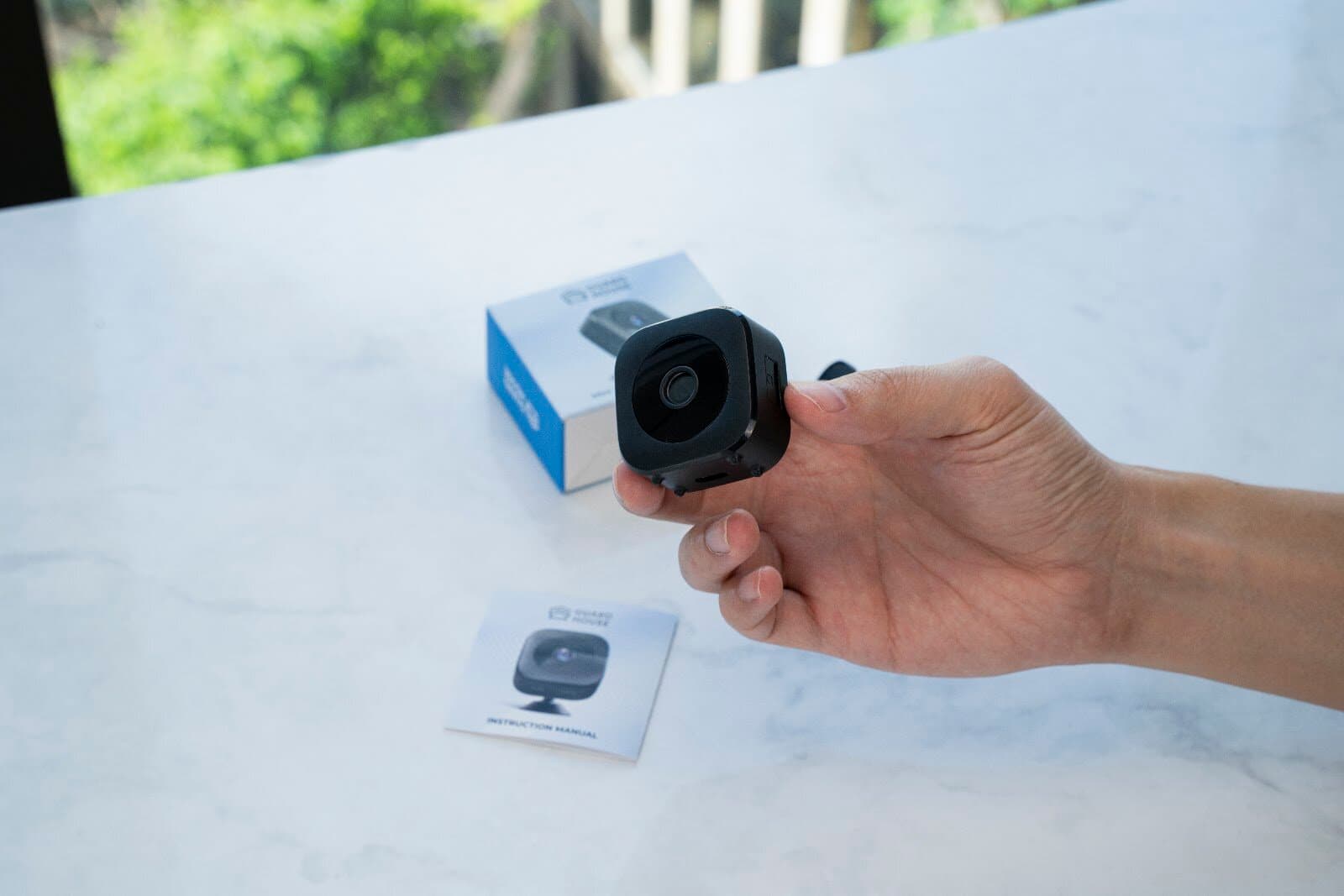
Two wire-free 1080p cameras that save to a card instead of the cloud, both $99.99 for a three-pack. GuardHouse is the more portable indoor-and-porch camera with a wider lens; TP-Link's Tapo C400 adds two-way audio, a siren, person detection and an IP65 rating. Here's the side-by-side.
GuardHouse vs Tapo C400 comes down to where the camera is going: the GuardHouse camera is the better pick if you want a palm-sized camera you can set on a shelf or snap to a magnetic base anywhere in the house, while TP-Link's Tapo C400 is the stronger outdoor camera on paper, with two-way audio, a siren, person detection and a published IP65 weatherproof rating. Both record 1080p video to a memory card, run on a rechargeable battery and need no monthly subscription. On price they're nearly even: on November 14, 2026, one GuardHouse camera was $44.43 and one Tapo C400 was $39.99, and three of either cost $99.99.
We compared the two using GuardHouse's own order page, homepage and setup support site, and TP-Link's official Tapo C400 product and specification pages plus the Tapo US store. We picked the Tapo C400 because it's one of the most widely recommended budget battery cameras with local microSD storage, which makes it the closest mainstream match for what GuardHouse sells.
For the full breakdown of the GuardHouse camera alone, see our GuardHouse camera review. If your first question is whether the GuardHouse store is trustworthy, start with is GuardHouse camera legit.
GuardHouse vs Tapo C400 at a glance
Price: GuardHouse is $44.43 for one, $88.88 for two, $99.99 for three and $122.21 for four (order page, November 14, 2026). The Tapo C400 is $39.99 for one (listed against $59.99) and $99.99 for a three-pack (listed against $179.97) on TP-Link's Tapo US store the same day.
Video and lens: both record 1080p. GuardHouse advertises a 150° wide-angle lens. TP-Link lists the Tapo C400's field of view as 116.7° diagonal and 99.7° horizontal, with video at 15 frames per second.
Night vision: GuardHouse uses infrared night vision. The Tapo C400 has two 850 nm infrared LEDs rated to 32.8 feet, plus two white lights for color night vision.
Storage: GuardHouse saves to an SD/TF card (FAT32, U1/Class 10 or faster recommended), with an optional third-party cloud plan in its app. The Tapo C400 takes a microSD card up to 512GB, sold separately, with optional Tapo Care cloud storage by subscription.
Power: GuardHouse claims up to 6 months per charge, recharged by USB. TP-Link rates the Tapo C400 at up to 180 days per charge, based on its lab test of 250 seconds of use per day, with an optional solar panel sold separately.
Extras: the Tapo C400 adds two-way audio with noise cancellation, a 70 dBA siren, person detection, activity zones, and Alexa, Google Assistant and SmartThings support. The GuardHouse pages we read don't list two-way audio, a siren or smart-home integrations.
Where the GuardHouse camera wins
Placement. GuardHouse is built to go anywhere: the box includes a magnetic base and a mount for desks, tables or walls, and the camera is small enough to sit on a bookshelf or tuck under an eave. TP-Link lists the Tapo C400's mounting option as wall-mounted, which suits an exterior wall better than a shelf. For renters, a nursery or a quick look at the dog while you're at work, GuardHouse is the easier fit.
Field of view. GuardHouse's advertised 150° lens is wider than the Tapo C400's listed 116.7° diagonal, so one GuardHouse camera can take in more of a room or porch. Neither brand says how the other measured, so treat this as a guide, not a lab result.
Everything in the box. GuardHouse ships with its USB-A charging cable, base and mount. TP-Link's specs say the power adapter isn't included with the Tapo C400 (it charges over USB-C), which won't matter if you have a phone charger, but it's worth knowing.
One price for all of it. A single GuardHouse camera works on its own with the free app, and so does a Tapo C400, but GuardHouse's bundles bring the four-pack down to about $31 per camera at $122.21, cheaper per camera than any Tapo C400 pack we saw listed.
Where the Tapo C400 wins
Outdoor toughness on paper. TP-Link publishes an IP65 weatherproof rating and an operating range of -4°F to 113°F for the Tapo C400. GuardHouse says its camera is built to withstand rain, heat and snow, but its own setup guide advises placing it in a sheltered area outdoors and using a weatherproof mount if necessary, and it doesn't publish an IP rating.
Talking back and scaring people off. The Tapo C400 has a built-in mic and speaker for two-way audio and a 70 dBA siren. That's useful for telling a delivery driver where to leave a package or startling someone in the yard. GuardHouse's pages focus on video, night vision and alerts.
Smarter alerts. TP-Link says the Tapo C400's AI person detection and custom activity zones cut down on alerts from irrelevant motion. GuardHouse offers motion detection with adjustable sensitivity in its app.
Brand and transparency. The Tapo line comes from TP-Link and ships with a full published spec sheet, down to the image sensor, encryption and frame rate. GuardHouse is a direct-response brand with fewer published specs, and its order page says the 90-day guarantee while its written terms give 30 days. If you want the most documented product, Tapo wins.
Battery claims you can check. TP-Link explains exactly how it gets its 180-day figure (250 seconds of use per day in its lab). GuardHouse's "up to 6 months per charge" comes without a test basis. Real life will be shorter for both if they record often.
Storage and monthly fees: GuardHouse vs Tapo C400
This is where the two are most alike. Neither camera needs a subscription to record. GuardHouse saves clips to an SD/TF card and starts recording automatically once one is inserted, and the Tapo C400 records to a microSD card up to 512GB. TP-Link estimates a 64GB card holds roughly 104 hours of Tapo C400 recordings.
Both also offer cloud storage as an option. GuardHouse's app offers a cloud plan run by a third-party provider and billed through your phone's app store, though GuardHouse recommends the SD card. Tapo sells Tapo Care, and TP-Link's spec sheet notes that alert snapshots in notifications need a Tapo Care plan. If you want zero monthly cost, both work fine with just a card.
The extra cost to watch with GuardHouse is at checkout, not in the app: the order page offers a Savvy VIP membership that the terms bill at $29.99 a month until cancelled. Decline it if you don't want it. The checkout also sells a 64GB GuardHouse memory card, and neither camera includes a card in the base price.
Setup and Wi-Fi
Both cameras connect to 2.4 GHz Wi-Fi only, so neither works on a 5 GHz-only network. GuardHouse's setup guide has you hold the power button for 2 seconds, hold the MODE button for 6 seconds until the blue light blinks, then add the camera in the GuardHouse app. It suggests placing the camera within about 5 meters of your router. GuardHouse also has a hotspot mode for places without Wi-Fi, but motion alerts don't work in that mode.
The Tapo C400 connects straight to your Wi-Fi with no hub required, though TP-Link says it's also compatible with its Tapo H200 and H500 hubs if you have one. It's set up and managed in the Tapo app, which handles activity zones, privacy areas and notifications.
Either camera is a 10-minute job for most people. The real difference is where you put it afterward: GuardHouse on a shelf or magnet, Tapo on a wall.
Price, guarantee and where to buy
On November 14, 2026, the GuardHouse order page listed $44.43, $88.88, $99.99 and $122.21 for one to four cameras. The Tapo US store listed the Tapo C400 at $39.99 for one and $99.99 for three. So the single camera is about $4 cheaper from Tapo, the three-pack costs the same, and GuardHouse's four-pack is the lowest per-camera price we found.
GuardHouse's order page advertises a 90-day money-back guarantee, but its written terms say returns last 30 days from delivery, packaging must be intact, you pay return shipping, and refunds can take up to 45 working days. We'd plan around 30 days. Our GuardHouse camera review covers the return steps in detail.
A note on our interest: TopCrate earns a commission on GuardHouse orders through our links. We don't earn on the Tapo C400. That's why we've been specific about where the Tapo is the better buy.
Which should you buy?
Buy the GuardHouse camera if you want a small, wire-free camera you can move around the house: on a shelf facing the front door, snapped to its magnetic base by the back door, in a nursery or a garage. Its wider advertised lens and flexible base suit indoor and sheltered-porch use, and the four-pack is the cheapest way to cover several rooms. Read the checkout carefully and decide within 30 days.
Buy the Tapo C400 if the camera is going on an exterior wall and staying there. The IP65 rating, two-way audio, siren, person detection and smart-home support make it the more complete outdoor camera for the money, and TP-Link's documentation is far more detailed.
Plenty of households will be happy with either, since both skip the monthly fee. If you're still deciding, our guide to is GuardHouse camera legit walks through the seller, the add-ons and the return policy, and our Sight Bulb review covers a camera that screws into a light socket instead.
Read our full GuardHouse review
How the $44.43 GuardHouse WatchEye performs, who it suits, and the add-ons and return terms to check before you buy.
Read our full GuardHouse review →Frequently asked questions
Is GuardHouse better than the Tapo C400?
It depends on placement. GuardHouse is more portable, with a magnetic base and desk or wall mount and a wider advertised 150° lens, so it suits indoor and sheltered spots. The Tapo C400 is better equipped for outdoor walls, with an IP65 rating, two-way audio, a siren and person detection.
GuardHouse vs Tapo C400: which is cheaper?
On November 14, 2026, one Tapo C400 was $39.99 and one GuardHouse camera was $44.43. Three of either cost $99.99. GuardHouse's four-pack at $122.21 works out to about $31 per camera, the lowest per-camera price we found.
Do GuardHouse and Tapo C400 need a subscription?
No. Both save video to a memory card, so you can use them with no monthly fee. Both offer optional cloud plans, and GuardHouse's checkout also shows a Savvy VIP membership billed at $29.99 a month, which you can decline.
Does the GuardHouse camera have two-way audio like the Tapo C400?
The GuardHouse pages we read list 1080p video, a 150° lens, night vision, motion alerts, a live view and SD card storage, but not two-way audio or a siren. The Tapo C400 lists both. See our GuardHouse camera review for everything the GuardHouse does include.
Is the GuardHouse camera weatherproof?
GuardHouse says it's built to withstand rain, heat and snow and suggests porches, garages and backyards, but it doesn't publish an IP rating, and its setup guide recommends a sheltered spot outdoors. The Tapo C400 is rated IP65.
Do GuardHouse and Tapo C400 work with 5 GHz Wi-Fi?
No. Both connect to 2.4 GHz Wi-Fi only. Most home routers broadcast both bands, so check that a 2.4 GHz network is available before setup.
TopCrate is reader-supported. When you buy through links on our site we may earn an affiliate commission, at no extra cost to you. Content is for general information and isn't a substitute for professional advice.