PET SAFETY
Are Essential Oil Diffusers Safe for Cats and Dogs? (The Honest 2026 Answer, by Diffuser Type)
The question isn't 'are essential oils safe for pets' — it's 'which delivery method aerosolizes them into the air your cat breathes.' The answer changes everything about which diffuser is safe on the counter.
The essential-oil-and-pets question is one of the most-asked and worst-answered on the internet, and the reason is that almost every article treats it as a single yes-or-no about oils in general. The honest answer is that it isn't about the oils in general — it's about the delivery method. A closed reed diffuser on a shelf a cat can't reach behaves nothing like an ultrasonic diffuser aerosolizing eucalyptus mist over a cat asleep on the couch, and the risk to the cat is orders of magnitude different. Same oil. Completely different exposure. That's the whole story.
This guide separates the pet-safety question into the two variables that actually determine it: which oils are dangerous to which animals, and which diffuser format puts those oils into the air a pet breathes and the fur it later licks. Cats and dogs are covered separately — they metabolize oil compounds very differently, which is the single piece of context most articles skip. The result is a practical decision framework: what to avoid entirely, what's fine, and the format that lets a pet household enjoy scent at all without the anxiety.
The cat problem: why cats are the special case (and it's a metabolism thing)
Cats are not small dogs, and their essential-oil sensitivity is a genuine biochemistry difference — not overcaution. Cats lack a specific liver enzyme (glucuronyl transferase) that mammals use to break down phenols, monoterpenes, and several other compounds that are extremely common in essential oils. Dogs have the enzyme; humans have it. Cats don't. The practical consequence is that oils containing those compounds accumulate in a cat's system in ways they don't in other animals, and even modest exposure can produce real toxicity: lethargy, drooling, vomiting, tremors, difficulty breathing, and in serious cases liver failure. The ASPCA Animal Poison Control Center and the Pet Poison Helpline both treat feline essential-oil exposure as a recurring emergency category, and they trace most of the cases they see to airborne exposure from ultrasonic diffusers rather than direct application.
The specific oils cats cannot metabolize safely — kept as a working list, not exhaustive — include tea tree (melaleuca), eucalyptus, peppermint, wintergreen, citrus oils (lemon, orange, grapefruit — all high in d-limonene), pine, cinnamon, clove, oregano, thyme, ylang-ylang, and pennyroyal. That list covers a large fraction of every essential-oil blend sold as 'refreshing,' 'invigorating,' or 'clean' scents, which is why the safe answer for cat households isn't 'pick nice oils' — it's 'don't aerosolize oils into shared air at all.' The exposure route is what matters more than the oil identity. Even lavender and chamomile, both often described as 'cat-safe,' are only safe at ambient exposure levels a cat can walk away from, and become risky in an enclosed room with an ultrasonic diffuser running for hours.
The dog picture: safer than cats, but 'safer' isn't 'safe'
Dogs metabolize essential-oil compounds much more competently than cats do, which is why the internet argues about dog safety in a way it mostly doesn't about cats. The honest position: dogs tolerate ambient airborne exposure to most oils in most households without acute problems, and lower-concentration diffusion of well-tolerated oils (lavender, chamomile, frankincense) is generally uneventful. That doesn't make every oil safe for every dog, and it doesn't make every delivery method equivalent.
The specific risks that stand up in veterinary practice: tea tree oil is toxic to dogs even topically at surprisingly small amounts (the classic emergency is a dog who licked an owner's just-applied tea tree lotion); pennyroyal is dangerously hepatotoxic; wintergreen and clove contain methyl salicylate and eugenol at concentrations that can hurt a dog with enough exposure; and small dogs, brachycephalic breeds (pugs, bulldogs, French bulldogs), puppies, seniors, and dogs with respiratory conditions like asthma or chronic bronchitis are all more vulnerable than a healthy adult retriever. If the household has one of those dogs, treat the safety question closer to the cat rules than the average-dog rules. Also: dogs may drink diffuser water if left in reach — an ultrasonic tank of oiled water is essentially concentrated oral exposure, which is a different and worse category than airborne.
The delivery method matters more than the oil — a ranked safety hierarchy
Every diffuser category puts oils into the environment differently, and the difference is what determines real-world pet exposure. Here they are, ranked from safest to riskiest for pet households.
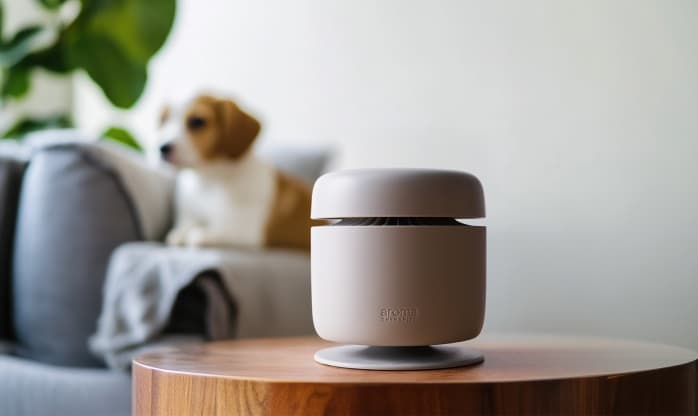
**Safest: fan-driven dry diffusion.** A quiet fan pushes room air across a solid fragrance disc or refill, releasing scent molecules without aerosolizing oil into a breathable mist. Nothing lands wet on fur; nothing sits in a puddle a pet can drink; nothing produces the fine oil-droplet inhalation that ultrasonics do. The Aroma Amplifier is the specific product in this category most reviewed and most sold — a fan-driven diffuser with swappable AromaPucks, no water, no mist, no flame. That combination (no aerosolized oil, no puddle, no flame) is why fan diffusion is the format vet-conscious pet households can genuinely relax with. Its own FAQ makes the safety framing explicit: safe around kids, pets, curtains and bookshelves.
**Safer if positioned smart: reed diffusers.** A reed diffuser is a bottle of oil-in-carrier with wooden reeds wicking scent into the room passively. There's no aerosolization at all — molecules diffuse into the air through evaporation, so airborne concentration stays low. The whole risk is the bottle: a cat can tip it, a dog can knock it over and lick spilled oil, so keep them well out of reach on a high shelf. Elevated + inaccessible + non-toxic oil selection = one of the calmer choices.
**Moderate risk: heated wax warmers, plug-ins, and candles.** These heat oils or synthetic fragrances into the room without misting them. Airborne exposure is real but the delivery is gentler than an ultrasonic; the specific risks are combustion (candles = open flame around fur and knocked tails), plug-in outlet heat at pet-height, and residue that lands on nearby surfaces the pet can lick. Not the worst offender, not blameless.
**Highest risk for cats specifically: ultrasonic mist diffusers.** These aerosolize a water-oil mixture into a fine visible mist that hangs in the room air and settles on every surface, including a cat's fur, which the cat then grooms — turning airborne exposure into oral exposure. This is the format Pet Poison Helpline flags most often in feline essential-oil cases. If the household has cats, the vet-conscious answer is 'not this one, ever.' A dog household with well-tolerated oils and a well-ventilated room can use one with care; a cat household should treat it as off the counter.
Signs your pet is reacting to a diffuser (and what to do)
Acute essential-oil toxicity in a pet doesn't always look dramatic in the first hour, which is why owners often miss the connection. In cats, watch for drooling or foaming at the mouth, wobbliness or unsteady walking, muscle tremors, vomiting, panting or difficulty breathing, redness or irritation around the lips, unusual lethargy, or the specific tell of the cat trying to leave the room whenever the diffuser is on. In dogs, similar signs plus watery eyes, pawing at the face, sneezing fits, wheezing (especially in brachycephalic breeds), or refusing food after previously being interested. Any of those signs in the same room as a running diffuser is a real signal to turn it off, ventilate the room, and move the pet out.
What to do if a pet may have been exposed: turn the diffuser off, move the pet to fresh air (outdoors, or a room with open windows), and don't try home remedies — no induced vomiting, no bathing in dish soap, nothing internet forums suggest, because with essential-oil toxicity the interventions vary by oil and species. Call the ASPCA Animal Poison Control Center (1-888-426-4435, 24/7, small consultation fee) or the Pet Poison Helpline (1-855-764-7661, 24/7, similar fee) — both are veterinary-staffed and can tell you in five minutes whether the exposure is one to observe at home or one to drive to the emergency vet for. Bring the diffuser bottle or refill packaging with you; the specific oil ingredient list is the single most useful piece of information the vet will ask for.
A safe fragrance routine for a pet household (the practical rules)
Not 'give up on scent' — 'give up on the risky delivery formats' and get the ambient life you wanted from the outset. The rules, from most important to least: keep any diffuser in a room with an open door and airflow (never a sealed bedroom with the pet inside); never diffuse in a small enclosed space like a bathroom or a walk-in closet the pet can enter; avoid the oils on the toxicity lists above entirely for cats and case-by-case for dogs; and give the pet a documented ability to leave — if the cat consistently exits the room when you turn the diffuser on, that's the cat's opinion of the exposure and it's worth respecting.
Format-wise, the low-anxiety setup for a pet household is a fan-driven dry diffuser like the Aroma Amplifier on a countertop or shelf, run in scheduled bursts (an hour before waking, an hour before guests) rather than continuously, in a room with normal airflow. That eliminates the mist route, the puddle route, and the flame route all at once. Pair it with a HEPA-style purifier if the house has multiple pets and general odor is the actual problem you were trying to solve — pulling odor out of the air is what a purifier does, and it's a different job from adding fragrance. The result is a home that smells nice, on your schedule, without spending the whole time watching the cat for symptoms — which is a fair definition of 'safe' as most pet owners really mean it.
Related reads for the pet-conscious household
For the other end of the air-quality problem in a pet home — the litter box, the wet dog, the general baseline funk — our take on the Aroma Amplifier covers dry-diffusion economics vs. candles and ultrasonics in more detail. And if the specific concern is the pet hair the diffuser question sits alongside, how to get pet hair off clothes in the laundry is the everyday version of the same 'gentler method beats brute force' philosophy that this article's diffuser hierarchy is built on.
Read our Aroma Amplifier review
The fan-driven dry diffuser most pet-conscious households land on — no water, no mist, no flame, safe to leave running around cats and dogs, with swappable fragrance pucks that let you change scents in seconds.
Read our Aroma Amplifier reviewFrequently asked questions
Are essential oil diffusers safe for cats?
It depends far more on the diffuser type than on the oil. Cats lack a liver enzyme (glucuronyl transferase) that breaks down many essential-oil compounds, so aerosolized exposure from ultrasonic mist diffusers is genuinely risky and Pet Poison Helpline treats it as a recurring emergency category. Fan-driven dry diffusers (like the Aroma Amplifier) don't aerosolize oil into breathable mist, so they eliminate the main exposure route that hurts cats. Reed diffusers kept out of reach are also low-risk. Ultrasonics and candles are the categories to avoid in a cat household.
Are essential oil diffusers safe for dogs?
Dogs metabolize essential oils much better than cats do, and healthy adult dogs generally tolerate ambient diffusion of well-chosen oils (lavender, chamomile, frankincense) without acute problems. Exceptions matter: small dogs, brachycephalic breeds like pugs and French bulldogs, puppies, seniors, and dogs with asthma or chronic bronchitis are all more vulnerable and should be treated closer to cat rules. Tea tree oil is toxic to dogs even topically; pennyroyal is hepatotoxic; wintergreen and clove contain concentrated compounds worth avoiding. Keep any diffuser out of a dog's drinking reach — an ultrasonic tank of oiled water is direct oral exposure if a dog laps at it.
What essential oils are toxic to cats?
The list vets treat as most concerning includes tea tree (melaleuca), eucalyptus, peppermint, wintergreen, citrus oils (lemon, orange, grapefruit — all high in d-limonene), pine, cinnamon, clove, oregano, thyme, ylang-ylang, and pennyroyal. That list covers a large share of every 'clean' or 'invigorating' essential-oil blend on the market, which is why the practical rule in a cat household is to avoid aerosolizing any oil into the shared air rather than trying to memorize a safe-oils list. Even lavender is only safe at low ambient concentrations a cat can walk away from.
Which type of diffuser is safest around pets?
Fan-driven dry diffusion, by a wide margin. A fan-driven diffuser pushes room air across a solid fragrance disc without aerosolizing any oil into mist, without a water tank a pet can drink from, and without an open flame. Nothing lands wet on fur, nothing gets inhaled as an oil-droplet cloud, and the room isn't sharing airborne oil the way an ultrasonic mist diffuser makes it share it. The Aroma Amplifier is the current mainstream example: no water, no mist, no flame, safe around kids and pets. Reed diffusers on a high shelf are the next tier down; heated wax warmers are moderate; ultrasonic mist diffusers are the format that generates most feline essential-oil emergency calls.
Can I use my ultrasonic diffuser if I have a cat?
The vet-conscious answer is no — it's the format Pet Poison Helpline flags most often in feline essential-oil cases, because it aerosolizes oil into breathable mist that then settles on fur the cat grooms, converting airborne exposure into oral exposure. If you love the scent-in-the-air routine and have a cat, swap to a fan-driven dry diffuser (no mist, no puddle) or a reed diffuser kept well out of reach. If you're determined to keep the ultrasonic, at minimum use it only in a room the cat is not in and cannot enter, run water-only sessions without added oils, and keep the tank out of drinking reach — that removes the main exposure paths but not all of them.
What are the signs that a pet is reacting to a diffuser?
In cats: drooling or foaming at the mouth, wobbliness or unsteady walking, muscle tremors, vomiting, panting or difficulty breathing, redness around the lips, unusual lethargy, or the cat consistently leaving whenever the diffuser is on. In dogs: watery eyes, pawing at the face, sneezing fits, wheezing (especially in brachycephalic breeds), or refusing food after previously being interested. If you see any of those with a diffuser running, turn it off, ventilate the room, move the pet to fresh air, and call the ASPCA Animal Poison Control Center (1-888-426-4435) or Pet Poison Helpline (1-855-764-7661) — both are veterinary-staffed 24/7 and can tell you in five minutes whether it's an observe-at-home situation or an emergency vet trip. Bring the diffuser bottle's ingredient list with you.
Are candles safer than diffusers for pets?
Not really — candles trade one set of risks for another. There's no aerosolized oil misting into the air, which is a real win, but candles add open flame around fur and knocked tails (a genuine household-fire risk with pets), soot that films the room and gets inhaled, and heated wax that pets can burn themselves on if they investigate. The safest scent format for a pet household is fan-driven dry diffusion — no flame, no mist, no water — which removes both the candle risks and the ultrasonic risks in one format. The Aroma Amplifier is built around exactly that trade.
TopCrate is reader-supported. When you buy through links on our site we may earn an affiliate commission, at no extra cost to you. Content is for general information and isn't a substitute for professional advice.