HANDS-ON REVIEW
TIBO Titanium Cutting Board Review: Is It Worth It?
A lightweight titanium cutting board that won't scar, stain, harbor bacteria or shed microplastics into your food like plastic and wood boards do.
Quick answer: Once you've seen the research on microplastics shedding off scarred plastic boards, it's hard to unsee. TIBO is the fix: a non-porous titanium surface that won't trap bacteria, stain, or contaminate your food, and unlike wood it needs zero babying. It costs more than a plastic board, but as a daily-use hygiene upgrade it's well worth it.
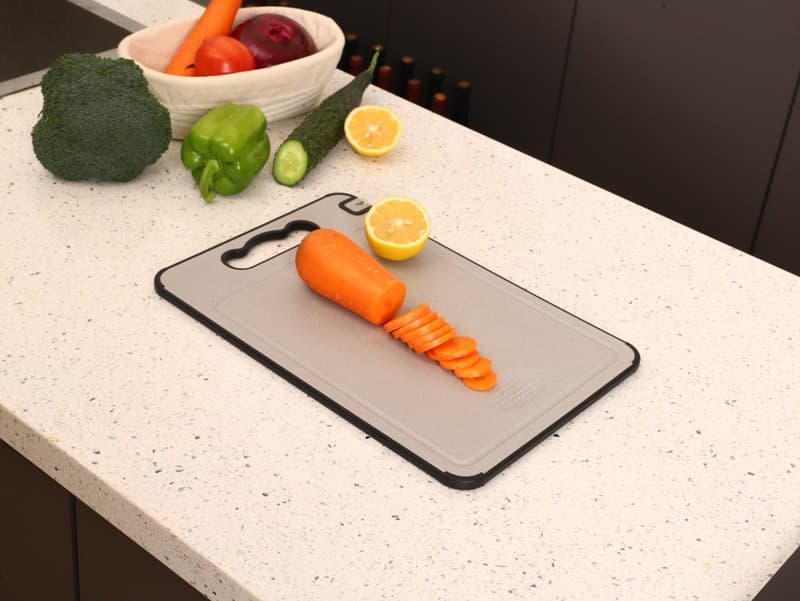
TIBO's non-porous titanium surface resists knife grooves and bacteria. Photo: TIBO
Our verdict
Once you've seen the research on microplastics shedding off scarred plastic boards, it's hard to unsee. TIBO is the fix: a non-porous titanium surface that won't trap bacteria, stain, or contaminate your food, and unlike wood it needs zero babying. It costs more than a plastic board, but as a daily-use hygiene upgrade it's well worth it.
The short version
Plastic boards shed microplastics and trap bacteria in every knife groove; wood boards soak up moisture and need babying. TIBO is a non-porous titanium board that wipes clean, resists knife scarring, won't hold onto odors or bacteria, and is light enough to handle easily — a genuinely hygienic upgrade for your kitchen.
Pros & cons
Pros
- Non-porous — won't trap bacteria like plastic or wood
- Doesn't shed microplastics into your food
- Resists knife grooves, stains and odors
- Lightweight titanium with a built-in handle
- Easy to rinse clean; no oiling like wood boards
Cons
- Premium price versus a basic plastic board
- Harder surface is less forgiving on knife edges
- Can slide if you skip the non-slip edge contact
How it works
Prep like normal
Chop, slice and carve on the smooth titanium surface just like any board.
Nothing soaks in
The non-porous metal won't absorb juices, odors or bacteria into grooves the way plastic and wood do.
Rinse and done
A quick rinse wipes it clean — no deep scrubbing, no oiling, no lingering smells.
Who it's for
- Home cooks worried about microplastics in food
- Anyone tired of stained, grooved plastic boards
- People who don't want to oil and baby a wood board
- Hygiene-focused kitchens and meal preppers
Titanium vs. plastic vs. wood cutting boards: which is most hygienic?
Every cutting surface has a hygiene weakness. Plastic boards develop deep knife grooves over time, and those grooves both trap bacteria that scrubbing struggles to reach and shed microplastic particles into your food as the surface degrades. Wood is naturally more forgiving but it's porous, soaking up juices and moisture, which is why it needs regular oiling and careful drying to stay sanitary. TIBO sidesteps both problems with non-porous titanium: nothing soaks in, knife marks don't open up into bacteria-harboring grooves, and there are no plastic particles to shed.
The practical upshot is a board you can actually trust after cutting raw meat. A quick rinse clears the smooth metal surface because there's nowhere for juices, odors, or bacteria to hide, whereas a scarred plastic board can hold onto contamination even after washing. Titanium is also naturally corrosion-resistant and doesn't absorb stains or smells the way the alternatives do. For a hygiene-focused kitchen, especially one worried about microplastics, titanium is the most genuinely low-risk of the three surfaces.
Will a titanium cutting board dull my knives?
This is the fair objection to any hard cutting surface, and the honest answer is that titanium is firmer than a soft plastic board, so it's less forgiving on knife edges than the cushiest options. Cutting on any firm surface, including glass, stone, or bamboo, asks more of your edge than plastic does. That said, normal everyday chopping on TIBO is perfectly fine; the board won't instantly ruin a knife, and most home cooks won't notice a dramatic difference in their routine.
The simple fix is to keep your knives sharp the way you should anyway. A sharp knife glides and needs less force, which means less wear regardless of the board, and honing regularly plus occasional sharpening keeps your edges in good shape. If you own a single irreplaceable high-end chef's knife you baby on a soft board, you can keep doing that for delicate work and use TIBO for everyday prep. For the hygiene benefits it delivers, the modest extra demand on your edges is a reasonable trade.
How to care for your TIBO titanium board
Maintenance is the easiest part of owning a titanium board, which is much of the appeal. After use, a quick rinse with soap and water clears the non-porous surface, and because nothing soaks in there's no deep scrubbing, no lingering odors, and no oiling ritual the way wood demands. It won't warp, crack, or absorb moisture, so you don't have to worry about drying it perfectly or storing it flat to keep it from splitting.
A couple of small habits get the most out of it. Make sure the board has good contact with your counter or sits on its non-slip edge so it doesn't slide while you work, and use the built-in handle to move it or pour from it cleanly. The titanium surface stands up to daily use without staining, and you can give it a more thorough wash whenever you've cut raw meat, confident that the metal isn't hiding anything in grooves. Compared with babying a wood board, this is close to maintenance-free.
The microplastic research on plastic cutting boards — what a 2023 study actually found
The reason so many home cooks are reconsidering plastic cutting boards isn't marketing — it's a specific 2023 peer-reviewed study in Environmental Science & Technology that measured microplastic release from ordinary polyethylene and polypropylene cutting boards during regular chopping. The finding, roughly: a household using a plastic board for typical chopping releases somewhere between 14 million and 71 million microplastic particles per year into food, depending on the board's material, hardness, and how aggressively you chop. Those particles end up in what you eat. The specific compounds are the same polyethylene and polypropylene that make up most disposable food packaging, and their long-term biological effects on humans are still being characterized — the honest answer today is 'we don't fully know,' which is exactly why the precautionary case for switching surfaces has strengthened.
TIBO's argument sits directly on top of that research. Titanium sheds no plastic — full stop — because there's no plastic in it. It's the same reason people who care about microplastics have been swapping plastic food storage for glass and stainless steel: the cutting board is one of the largest daily plastic-particle-into-food contact surfaces in an average kitchen, and replacing it removes one specific well-documented exposure route. Wood boards don't shed plastic either and are the traditional alternative, but they add porosity to worry about instead. If your specific concern is minimizing the plastic that ends up in your food without giving up the wipe-clean simplicity that made plastic popular, titanium is a legitimate answer — and it's the one specific hygiene story TIBO's whole product is built to tell.
Frequently asked questions
Why titanium instead of plastic or wood?
Titanium is non-porous, so it doesn't trap bacteria in knife grooves, doesn't shed microplastics into your food, and doesn't absorb odors or stains the way plastic and wood do.
Will it dull my knives?
Any firm surface is harder on edges than a soft plastic board. Normal cutting is fine; you'll just want to keep your knives sharp as usual.
How do I clean it?
A quick rinse is usually all it needs. It's far lower-maintenance than wood, which requires regular oiling.
Is it heavy?
No — titanium is prized for being strong yet light, and the board has a built-in handle for easy moving and pouring.
Is the TIBO board dishwasher safe?
Titanium is corrosion-resistant and non-porous, so it handles water and detergent without absorbing moisture or warping the way wood can. A quick rinse by hand is usually all it needs and is the simplest way to clean it, but check the product instructions for the manufacturer's specific dishwasher guidance. Because nothing soaks into the surface, hand-washing takes seconds anyway.
Does the titanium surface make noise or feel cold when cutting?
A hard metal surface can sound a little different from soft plastic or wood, with a firmer feel under the knife and a slight ring on heavy chops. Most people adjust quickly and don't find it bothersome in everyday use. The non-slip edge contact helps keep it stable and quieter, and the trade-off comes with the hygiene and durability benefits of a non-porous board.
How does TIBO compare to a serious wood or bamboo cutting board on hygiene?
Wood and bamboo boards handle the microplastic problem the same way TIBO does — they don't shed any, because there's no plastic to shed. Where they differ is porosity: wood absorbs moisture, juices, and (with poor care) bacteria into the grain, which is why proper wood-board ownership requires oiling every month or so and never soaking or dishwashing. Bamboo is slightly less porous but adds trace amounts of a food-safe glue used to bind its strips. TIBO's advantage over both is maintenance rather than hygiene ceiling: a well-cared-for end-grain walnut board is genuinely sanitary, but 'well-cared-for' is doing a lot of work in that sentence. A titanium board reaches the same hygiene endpoint by being non-porous instead of well-tended, which is the right trade for most home kitchens that want the low-risk surface without the ritual.
When you buy through links on this page, TopCrate may earn an affiliate commission at no extra cost to you. Prices accurate as of publish time.