TRENDING ON AMAZON
Squatty Potty Toilet Stool Review: Is It Worth It?
The 7-inch toilet stool that puts you into the anatomically correct squat position — the fix for constipation and straining nobody talks about.
Quick answer: The Squatty Potty is the rare 'as-seen-on-TV' product that's backed by real anatomy and published research — a $30 stool that solves a problem billions of people didn't know they had. If constipation, straining, or hemorrhoids are part of your life, this is the single cheapest, most effective fix.
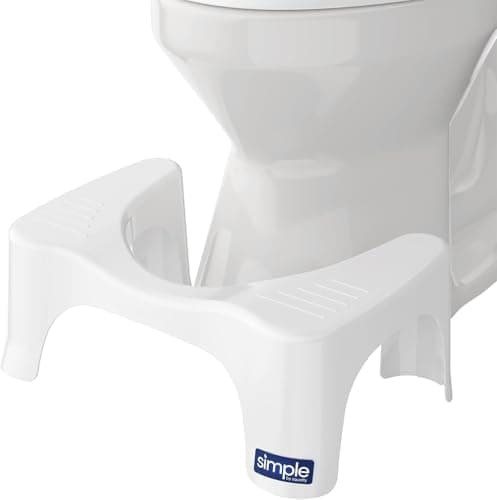
Product image from the Amazon listing.
Our verdict
The Squatty Potty is the rare 'as-seen-on-TV' product that's backed by real anatomy and published research — a $30 stool that solves a problem billions of people didn't know they had. If constipation, straining, or hemorrhoids are part of your life, this is the single cheapest, most effective fix.
The short version
The Squatty Potty is a curved 7-inch or 9-inch stool that fits around the base of a toilet and lifts your knees above your hips into a squat position — which relaxes the puborectalis muscle and straightens the colon, letting things move on their own instead of straining. Every gastroenterologist quietly agrees this is anatomically better than sitting upright, and it's the single cheapest fix for constipation, hemorrhoids, and prolonged bathroom time. If you've never tried it, the difference on the first use is genuinely startling.
Pros & cons
Pros
- Puts you into anatomically correct squat position
- Relaxes puborectalis muscle for effortless elimination
- Fits any standard toilet
- Sturdy plastic — supports full body weight
- Tucks under toilet when not in use
- Comes in 7" (standard) or 9" (taller people)
Cons
- Takes 1-2 weeks to feel natural
- Visible in the bathroom (though tucks away)
- Not glamorous decor
Why people love it
Lifts knees above hips
The 7-inch height brings your thighs into a 35-degree squat angle — the position humans evolved to use before flush toilets.
Relaxes the puborectalis
Sitting upright kinks the colon closed via a muscle called the puborectalis. Squatting relaxes it, straightening the colon and letting elimination happen without strain.
Slips around the toilet base
The curved design hugs the base of standard toilets, so it stays out of the way and looks intentional.
Who it's for
- Anyone with constipation or straining
- Hemorrhoid sufferers
- People who spend too long in the bathroom
- Pregnancy and postpartum comfort
Why sitting on a toilet is anatomically wrong (and what happens when you squat)
The flush toilet was invented in 1596 and popularized in the 1800s — a blink of evolutionary time. For every one of the roughly 300,000 years before that, humans squatted. The result: our anatomy is designed for the squat position, and sitting upright works against it in specific ways. The puborectalis muscle wraps around the rectum in a sling and stays partially contracted when we sit or stand — its job is to prevent leakage during normal upright activity. When you squat, this muscle relaxes fully, letting the colon straighten and elimination happen with essentially no muscular effort.
This is why sitting on a modern toilet requires straining for many people — you're literally fighting the puborectalis muscle. Chronic straining is the primary cause of hemorrhoids, contributes to pelvic-floor dysfunction over decades, and correlates with diverticular disease. The squat position doesn't just feel better; it eliminates the mechanical cause of these very common conditions. The Squatty Potty isn't a wellness gimmick — it's a stool that lifts your knees enough to re-create the position anatomy actually expects.
Squatty Potty vs a stack of books, a step stool, or a bidet
You can absolutely fake a Squatty Potty with a stack of books or an ordinary step stool — the benefit is in the height and position of your feet, not the specific product. If you have a solid 7-inch step stool that fits around your toilet, use it and save the money. The Squatty Potty's advantages over improvised solutions are: (1) the curved base fits under the toilet so it doesn't get kicked, (2) it's shaped so your feet sit at the right angle, (3) it's stable enough to lean weight on without tipping. If you already have something that works, don't overthink it — but a $30 tool that fits perfectly for a decade is a better long-term choice than a wobbly makeshift.
A bidet solves a completely different problem — cleanliness after using the toilet, not the elimination position itself. They complement each other (many people install both), and a bidet attachment costs about the same as a Squatty Potty. If you can only afford one and you have constipation issues, get the Squatty Potty. If cleanliness is the priority, get the bidet. For under $100 total you can have both, and it's genuinely the best bathroom upgrade most people can make — round it out with a pre-flush spray like Poo-Pourri Before-You-Go and you've addressed position, cleanliness and odor for the price of a single restaurant meal.
How to use a Squatty Potty (and why the first week feels weird before it feels amazing)
Set the stool around the base of your toilet and step your feet onto it before sitting — knees should end up about 3-4 inches above your hips. Lean forward slightly, resting your forearms on your thighs; this position further relaxes the puborectalis and further straightens the colon. Breathe normally, don't hold your breath (which strains the pelvic floor), and let things happen on their own timing. Most people notice within the first two or three uses that they're finishing faster and straining less.
The first week can feel odd because your body has learned decades of muscle patterns around sitting upright and pushing. It takes a couple of days to un-learn the reflex to strain and re-learn to let the muscles relax. Give it at least two weeks of every-use consistency before evaluating. After that, most people can't imagine going back — some report that not using the Squatty Potty on a work trip suddenly makes them realize how much easier daily elimination has been at home. If you have hemorrhoids or chronic constipation, the improvement can be dramatic within the first month.
See Squatty Potty on Amazon
Check the latest price, photos and buyer reviews on Amazon.
Check Price on Amazon →Sold and shipped by AmazonFrequently asked questions
Does the Squatty Potty actually work? What does the research say?
Yes, and there's real published research — the most-cited study from The Ohio State University (Sikirov 2003 replication) showed that squatting posture significantly reduced defecation time, straining, and sensation of incomplete evacuation compared to sitting. The mechanism is well-established anatomy: the puborectalis muscle wraps around the rectum and stays partially contracted when you sit (it evolved to prevent leakage during standing/walking). Squatting relaxes it and straightens the anorectal angle. This is why gastroenterologists have quietly recommended it for years.
7-inch or 9-inch: which Squatty Potty height should I get?
7-inch is the standard and works for the majority of adults (5'0" to about 6'0"). 9-inch is designed for taller people — over about 6'0" — where the standard height doesn't quite lift the knees above the hips because their femurs are longer. Rule of thumb: if you're 5'11" or shorter, the 7-inch is right. If you're 6'0" or taller, or if you're of average height but the 7-inch doesn't feel quite high enough, upgrade to the 9-inch (Squatty Potty makes both sizes).
Will it fit my toilet?
Almost certainly yes. The curved cutout accommodates virtually all standard American residential toilets (both round-front and elongated bowls). The exception is a small number of very ornate pedestal-style toilets with unusual base shapes — if your toilet base is a simple rounded oval, the Squatty Potty will fit. It sits on the floor around the toilet base without touching it, so it doesn't interfere with cleaning or plumbing.
Do I need to keep it out all the time?
You can use it either way. Most people leave it out permanently — it slides under the toilet bowl when not in use and takes up almost no floor space. Guests figure it out immediately (it's not embarrassing anymore; the product has been mainstream for a decade). If you prefer to keep it hidden, it stacks or slides behind the toilet. Once you start using it daily, taking it away for guests is more work than leaving it out.
Is it good for hemorrhoids and constipation specifically?
Yes — these are two of the most common reasons doctors recommend it. Hemorrhoids often result from repeated straining, which the squat position dramatically reduces (less straining = less pressure on rectal veins = less hemorrhoid recurrence). For constipation, the straightened colon angle and relaxed puborectalis let stool pass with much less muscular effort. Many people who used stool softeners or laxatives for years find they no longer need them once they use a Squatty Potty daily. It's not a medical treatment, but the mechanism is real and consistent.
Is there a downside to using it every day?
None that's medically documented. Squatting is the position humans used for elimination for millions of years before the flush toilet was invented (1596) and it's still the norm for the majority of the world's population — squat toilets remain standard in much of Asia, the Middle East, and Africa. Adopting the squat position via a stool is anatomically returning to the default, not doing anything experimental. The 'downside' is aesthetic (a plastic stool in your bathroom) and habit (takes a week or two to feel automatic).
As an Amazon Associate, TopCrate earns from qualifying purchases at no extra cost to you. Squatty Potty is a positioning aid, not a medical device. If you have chronic constipation, bleeding, or symptoms of pelvic-floor disorders, see a doctor. Product image, price, availability and ratings are shown on Amazon and are subject to change.