TRENDING ON AMAZON
Lodge Pre-Seasoned Cast Iron Skillet (10.25") Review: Is It Worth It?
A heavy, pre-seasoned American-made skillet for around $25 that sears, bakes, fries and grills — and outlives most kitchens.
Quick answer: The Lodge skillet is the rare kitchen tool that's actually cheap AND a lifetime buy. It cooks better the longer you own it and will easily outlast your current kitchen. If you don't have one, fix that — and while you're upgrading, swap your knife-scarred plastic prep surface for a non-porous [TIBO titanium cutting board](/reviews/tibo) so the sear you're building isn't undone by microplastics carved off a plastic board seconds before the pan.
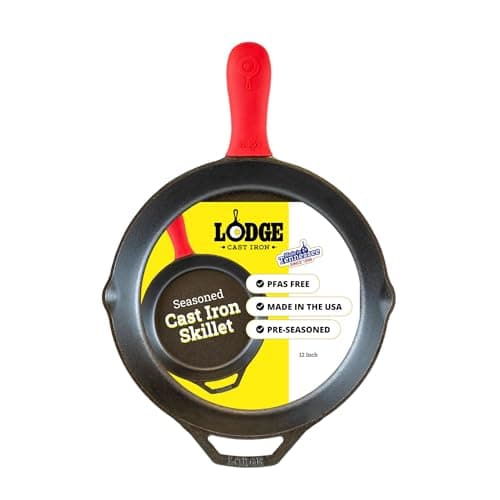
Product image from the Amazon listing.
Our verdict
The Lodge skillet is the rare kitchen tool that's actually cheap AND a lifetime buy. It cooks better the longer you own it and will easily outlast your current kitchen. If you don't have one, fix that — and while you're upgrading, swap your knife-scarred plastic prep surface for a non-porous [TIBO titanium cutting board](/reviews/tibo) so the sear you're building isn't undone by microplastics carved off a plastic board seconds before the pan.
The short version
Nothing in your kitchen will out-cook or out-last a Lodge cast iron skillet. It arrives already seasoned, gets better the more you use it, and handles steaks, eggs, cornbread, pizza, roast vegetables and pan sauces equally well. It can go from stovetop to oven to grill to campfire and back. With basic care — hot water, a brush, dry, light oil — it lasts for generations. For the price of a nice takeout meal, you get the most versatile pan in the kitchen.
Pros & cons
Pros
- Heavy, even heat for restaurant-quality sears
- Pre-seasoned and ready to use
- Stovetop, oven, grill and campfire safe
- Naturally improves with use
- Truly forever — generations long
- Made in the USA
- Under $30
Cons
- Heavy — not for weak wrists
- Hand-wash only
- Needs occasional re-oiling to maintain seasoning
Why people love it
Preheat
Heat empty over medium for a few minutes — cast iron rewards patience.
Cook hot
Sear steaks, fry eggs, bake cornbread, roast vegetables — the heavy iron holds steady heat.
Care for it
Rinse with hot water, scrub with a brush, dry on the stove, rub with a drop of oil. Done.
Who it's for
- Steak, burger and cornbread cooks
- Anyone replacing a flaking nonstick
- Campers and grill cooks
- First-apartment kitchens
Why one Lodge skillet replaces half your pans
A cast iron skillet is the most versatile single pan you can own because it does things no nonstick pan can. It holds and radiates heat evenly, so it delivers a deep, restaurant-style sear on steaks, burgers and chops that a thin nonstick simply can't. It's equally happy frying eggs, baking cornbread or a deep-dish cookie, roasting chicken thighs, blistering vegetables, or shallow-frying — and it goes straight from the stovetop into a screaming-hot oven and then to the table as a serving dish.
Because it works on the stove, in the oven, on the grill and over a campfire, one skillet quietly covers what a frying pan, a baking dish and a grill pan would otherwise do. For a first apartment or a pared-down kitchen, it's the highest-leverage pan you can buy.
Seasoning and care: easier than the internet makes it sound
The care reputation scares people off, but the routine is genuinely simple. After cooking, rinse with hot water and scrub with a stiff brush or a chainmail scrubber — a little mild soap is fine on modern seasoning despite the old myth. Then dry it completely (a minute on a warm burner guarantees it), rub in a very thin layer of neutral oil, and wipe off the excess. That's it.
Seasoning is just thin layers of oil polymerized onto the iron, and it builds up the more you cook, getting more nonstick over time. If food ever sticks badly or you see dull grey spots, you don't ruin anything — scrub it, dry it, and bake it upside down at around 450°F with a wiped-on coat of oil for an hour to rebuild the surface. Cast iron is almost impossible to permanently destroy, which is why these pans get handed down for generations.
Lodge vs enameled and premium smooth cast iron
Lodge's bare cast iron has a slightly pebbly cooking surface from its sand-casting process. Premium brands like Smithey or Stargazer machine their surfaces glass-smooth and look gorgeous, but they cost five to ten times as much and cook fundamentally the same once your Lodge is well seasoned — the smoothness becomes a non-issue with use. For most people the value gap is impossible to justify.
Enameled cast iron (think Dutch ovens) is a different tool: the enamel coating means no seasoning and easy cleanup, and it handles acidic braises and tomato sauces without complaint, but it doesn't take a hard sear as well and costs far more. The move for most kitchens is a cheap Lodge skillet for searing and frying, plus an enameled Dutch oven if you braise often — not an expensive boutique skillet.
See Lodge Cast Iron Skillet on Amazon
Check the latest price, photos and buyer reviews on Amazon.
Check Price on Amazon →Sold and shipped by AmazonFrequently asked questions
Do I have to season a Lodge before using it?
No — it comes pre-seasoned. You just maintain the seasoning with a light layer of oil after each clean.
Is cast iron really nonstick?
With a built-up seasoning layer it becomes very nonstick for eggs and fish — it just takes a few months of regular use to get there.
Can I put it in the dishwasher?
No — soap and a dishwasher strip the seasoning. Hot water, a brush and a dry on the stove is the move.
What size should I buy?
The 10.25" is the do-everything size that fits most stoves and ovens; go bigger only if you cook for a crowd.
Can you use cast iron on an induction or glass-top stove?
Yes — cast iron is magnetic so it works on induction, and it's fine on glass tops too. Just lift it rather than sliding it on glass to avoid scratches.
What shouldn't you cook in cast iron?
Very acidic dishes like a long-simmered tomato sauce can strip seasoning and pick up a faint metallic taste, especially early on. Use those sparingly until your seasoning is well established, then it's much less of an issue.
As an Amazon Associate, TopCrate earns from qualifying purchases at no extra cost to you. Product image, price, availability and ratings are shown on Amazon and are subject to change.