TRENDING ON AMAZON
Instant Vortex Plus 6-Quart Air Fryer Review: Is It Worth It?
The 6-in-1 air fryer from Instant Pot's parent company — air fry, roast, broil, bake, reheat, and dehydrate in a 6-quart basket that feeds a family.
Quick answer: The Instant Vortex Plus is the smart-money 6-quart air fryer — cleaner design than the Ninja, more features than the Cosori, and the see-through window is genuinely useful. If you cook wings, roasted vegetables, or weeknight family dinners, this is the pick.
Product image from the Amazon listing.
Our verdict
The Instant Vortex Plus is the smart-money 6-quart air fryer — cleaner design than the Ninja, more features than the Cosori, and the see-through window is genuinely useful. If you cook wings, roasted vegetables, or weeknight family dinners, this is the pick.
The short version
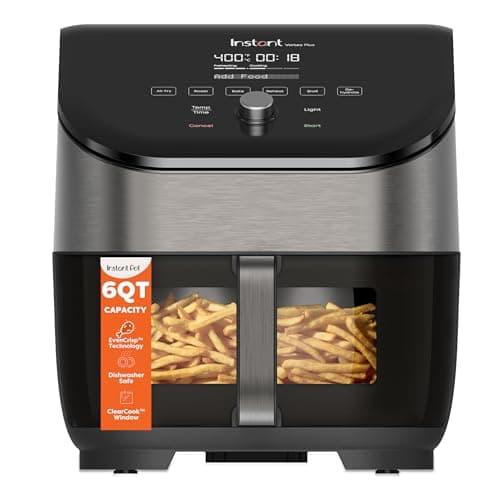
The Instant Vortex Plus is Instant Brands' answer to the Ninja Foodi in the air-fryer wars, and it's the smart-money pick for most families. A 6-quart basket fits a whole 5-lb chicken or 2 lbs of wings, one-touch presets cover the main use cases (air fry, roast, broil, bake, reheat, dehydrate), and a clear window plus interior light let you watch food crisp without opening the drawer. Where it beats the Ninja: cleaner control panel, dishwasher-safe basket, and slightly quieter operation. Where the Ninja beats it: two-basket dual-zone versions for cooking sides and mains simultaneously. For most single-basket buyers, the Vortex Plus is the more thoughtful design.
Pros & cons
Pros
- 6-quart basket fits whole chicken or dinner for 4
- Six functions in one appliance
- Clear window + interior light — watch without opening
- Dishwasher-safe basket and tray
- Quieter than most air fryers
- Under $130 street price
Cons
- Single basket (not dual-zone like Ninja DualZone)
- Countertop footprint is meaningful
- Presets are conservative — most food needs 2-3 extra minutes
Why people love it
Convection heat + rapid airflow
A 1700-watt heating element combined with a high-speed fan creates convection cooking that crisps food like a deep fryer using little or no added oil.
6-in-1 preset modes
One-touch buttons for air fry (400°F crisping), roast (350°F even cook), broil (top-down browning), bake (whole meals), reheat (gentle warm-through), and dehydrate (low slow drying).
See-through window + interior light
A translucent basket window and interior LED let you monitor browning without pulling the drawer out and losing heat — a small but genuinely useful convenience.
Who it's for
- Families cooking 4-person weeknight dinners
- Anyone replacing a deep fryer or toaster oven
- People who batch-cook wings, drumsticks, or roasted vegetables
- Small-kitchen cooks combining functions
Is an air fryer actually worth the counter space?
The 'do I need an air fryer' question depends on what you cook and how often. For people who cook wings, drumsticks, French fries, tater tots, chicken tenders, broccoli or Brussels sprouts frequently (say, 2+ times per week), an air fryer is genuinely transformative — food crisps in 15 minutes instead of 30, comes out browner than an oven produces, and doesn't heat up the whole kitchen in summer. If those foods are common in your kitchen, the counter space is worth it.
For people who cook large family dinners, roasts, casseroles, or entertain frequently, the air fryer supplements the oven rather than replacing it. Six quarts sounds large but only fits a 5-6 lb chicken or 4-6 servings of vegetables at once. For a Sunday dinner for 10, you're back to using the oven. The other honest reality: air fryers displace deep fryers effectively (you're not deep-frying at home if you own an air fryer), but they don't fully replace a stovetop or oven — they're a specialized rapid convection oven for specific foods, not a replacement for all cooking gear.
Instant Vortex Plus vs Instant Pot Duo: sorting out the Instant Brands lineup
Instant Brands' product line is confusing because everything is called 'Instant Something' and multiple products serve overlapping needs. The Instant Pot Duo (their flagship pressure cooker) does pressure cook, slow cook, rice, sauté and yogurt in a bowl-shaped unit — perfect for beans, stews, and one-pot meals. The Instant Vortex Plus (this review) does air fry, roast, bake, broil, dehydrate and reheat in a basket-shaped unit — perfect for wings, roasted vegetables, and crispy dinners. They complement each other well.
There's also the Instant Pot Pro Crisp (a hybrid pressure cooker + air fryer with two lids to swap) and the Instant Vortex Pro Air Fryer Oven (a larger toaster-oven-shaped countertop with air fry functions). The Pro Crisp is the space-saver — one appliance doing both jobs — but heavier and pricier than buying both separately. The Vortex Pro Oven is larger for bigger families and can toast bread + air fry. Most kitchens are best served by owning the Instant Pot Duo + the Vortex Plus as separate appliances; the Pro Crisp is the right pick only if counter space is severely limited.
How to actually cook well in an air fryer (recipes and technique that make results consistent)
The right recipes make an air fryer earn its counter space. The winners: bone-in chicken wings (400°F for 20-25 minutes, tossing halfway — better than a deep fryer's crisp), frozen tater tots and fries (no oil needed, 20 minutes at 400°F), roasted vegetables (Brussels sprouts halved, broccoli florets, cauliflower — coat with oil and salt, 15 minutes at 400°F), crispy chickpeas (drained and dried, toss with spices, 15 minutes), leftover pizza reheat (2 minutes at 350°F, better than a microwave), and salmon fillets (12 minutes at 380°F with a lemon slice). Weekday meal-prep chicken breasts (14 minutes at 375°F) come out juicy inside with crisp exterior.
Technique tips that make results consistent: (1) Don't overcrowd — one layer of food, some airflow between pieces. Overcrowded baskets steam instead of crisp. (2) Preheat 2-3 minutes for browning-critical foods. (3) Shake or flip halfway through for even cooking. (4) Increase preset temperatures by 25°F for extra crispness — most default presets are conservative. (5) Small amount of oil (spritz or brush) still helps crisping — 1-2 teaspoons for a batch is enough. (6) Line the basket with parchment air fryer liners (perforated) for saucier foods to speed cleanup. Follow these and you get restaurant-quality results at home in a fraction of the oven time.
See Instant Vortex Plus on Amazon
Check the latest price, photos and buyer reviews on Amazon.
Check Price on Amazon →Sold and shipped by AmazonFrequently asked questions
Instant Vortex Plus vs Cosori Pro II vs Ninja Foodi Air Fryer: which one should I actually buy?
They're the three best-selling air fryers, and they're all genuinely good. The Vortex Plus is the newcomer catching up — cleaner UI, better window, quieter, six functions. The Cosori Pro II air fryer is the reliable classic — 5.8-quart, extremely simple controls, excellent presets, cheapest of the three. The Ninja Air Fryer (any version, including the DualZone) has better browning (specific heating element geometry) and offers dual-zone versions with two baskets. Pick Cosori if you want the simplest cheapest option; pick Vortex if you want the best window and features per dollar; pick Ninja if you specifically want dual-basket for cooking sides + mains simultaneously. All three deliver similar cooking results on the same food.
What can you actually cook in an air fryer? Is it a scam or a real cooking method?
Real cooking method — air frying is essentially compact convection oven cooking, and it does specific things better than a traditional oven: crispy exteriors on wings, drumsticks, chicken tenders, French fries (from frozen), tater tots, broccoli, Brussels sprouts, cauliflower, and frozen appetizers. It preheats in 2-3 minutes vs a conventional oven's 10-15. It uses less energy for small portions. Where it doesn't excel: any liquid-heavy cooking (soups, sauces, stews), large cuts that need long slow cooking, bread baking (rises don't develop well), or delicate items like fish that need lower temperatures. The best mental model: it's a rapid convection oven for portions serving 2-4 people, not a replacement for your oven.
Do I still need a regular oven?
For most households, yes — but you'll use it much less. A common pattern for air-fryer-adopting households: full oven for weekend roasts, pizzas, and casseroles (things over 6 quarts); air fryer for weeknight portions of wings, vegetables, and reheating pizza. Some smaller households (1-2 people, small kitchen) find the air fryer eventually replaces the oven for 90% of use — pizzas cook fine at 8-inch sizes, small casseroles work in the basket, whole 5-lb chickens fit. Full oven becomes useful mainly for entertaining. The air fryer isn't a full oven replacement, but for many kitchens it dramatically reduces reliance on the oven.
Do I need to preheat? And do I need to shake or flip food?
Preheat: yes, but briefly. Set to the target temperature and let it run 2-3 minutes empty before adding food (most models don't require this in the manual, but food browns better with a preheated basket, especially for frozen items). Shake/flip: usually yes, once halfway through. The basket concentrates hot air on the top of food, so flipping halfway ensures even browning on both sides. Some newer 'no-flip' Vortex models have improved airflow enough to skip this, but shaking still improves fries and small pieces. This 30 seconds of active work is the trade-off for hot-oil-free frying.
How loud is it during cooking?
Quieter than most air fryers but not silent. The Vortex Plus's fan runs at around 60-65 dB — noticeable if you're in the same room but not disruptive (comparable to a low-volume TV). Ninja Foodi air fryers are typically 65-70 dB; Cosori is closer to 60 dB. If you have an open kitchen-to-living-room layout, you'll hear it during cooking, but it's not the kind of loud that makes conversation impossible. The fan does slow to a low hum during 'keep warm' cycles.
How do you clean it? Is it really dishwasher safe?
The basket and tray are dishwasher-safe (top rack), which is a legitimate practical advantage. In real use, most people rinse the basket and tray in the sink after use because dishwasher cycles are overkill for one dish. The interior needs occasional wipe-downs (splatter builds up over weeks); use a damp cloth with mild soap, or a slightly damp brush for stubborn residue. The heating element on top can accumulate residue over months — periodically wipe with damp cloth (unplugged, fully cooled). Don't submerge the main unit. With normal care, expect 5-7 years of daily use before the basket's nonstick coating starts to wear.
As an Amazon Associate, TopCrate earns from qualifying purchases at no extra cost to you. Product image, price, availability and ratings are shown on Amazon and are subject to change.