TRENDING ON AMAZON
Garmin Forerunner 55 GPS Running Watch Review: Is It Worth It?
The most popular entry-level running watch — proper GPS, daily wear comfort, two-week battery, and Garmin's coaching baked in.
Quick answer: The Garmin Forerunner 55 is the right answer to 'I want a real running watch but don't want to spend $500.' Accurate GPS, two-week battery, Garmin Coach training plans, and a comfortable lightweight build that doesn't feel like a smartwatch lump on your wrist. For new runners or anyone training for their first 5K-to-marathon, this is the smart buy.
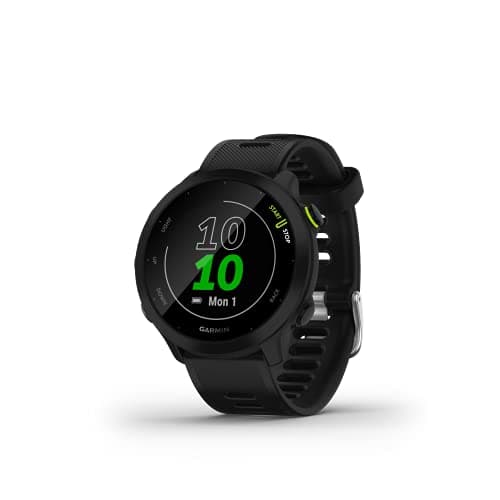
Product image from the Amazon listing.
Our verdict
The Garmin Forerunner 55 is the right answer to 'I want a real running watch but don't want to spend $500.' Accurate GPS, two-week battery, Garmin Coach training plans, and a comfortable lightweight build that doesn't feel like a smartwatch lump on your wrist. For new runners or anyone training for their first 5K-to-marathon, this is the smart buy.
The short version
The Garmin Forerunner 55 is the entry-level Garmin that finally makes a real GPS running watch affordable to everyone. Built-in GPS that locks fast, accurate distance and pace tracking, heart rate at the wrist, two-week battery life in everyday use (20 hours in GPS mode), comfortable enough to wear 24/7, and Garmin's free coaching plans built right in. It's lighter and less intimidating than the higher-tier Forerunners while delivering the same core running-watch experience — and at roughly a third of the price of a Garmin Fenix.
Pros & cons
Pros
- Built-in GPS — no phone needed for runs
- 2-week battery in smartwatch mode, 20+ hours GPS
- Lightweight (37g) and comfortable to wear all day
- Free Garmin Coach training plans built in
- Heart rate, sleep, stress and steps tracking
- Far cheaper than higher-tier Garmin Forerunners
Cons
- No music storage (relies on phone)
- No contactless payments
- Plastic build feels less premium than higher models
Why people love it
Strap on, sync with Garmin Connect
Pair the watch with the free Garmin Connect app on your phone — setup takes under 5 minutes and the app becomes your training dashboard.
Press start, run
Hit start to begin a run — GPS locks in seconds and the watch tracks your pace, distance, heart rate and route in real-time on the wrist.
Follow Garmin Coach plans
Pick a free training plan from beginner 5K through marathon — daily workouts sync to the watch with prompted pace zones, rest intervals and progress tracking.
Who it's for
- New runners and 5K/10K trainers
- Anyone graduating from a basic Fitbit
- Runners who don't want to carry a phone
- Budget-conscious Garmin first-time buyers
Why a real GPS running watch beats a Fitbit or Apple Watch for serious training
Once you're running regularly, the limits of a phone or fitness tracker for run data become annoying fast. Carrying a phone on every run is a pain (bouncing in arm bands, weighing down running belts, dying in cold weather), and Fitbit-tier wrist GPS estimated by step cadence isn't accurate enough for serious pace work. A dedicated GPS running watch like the Forerunner 55 fixes all of this: real built-in GPS gives you accurate, real-time pace and distance on the wrist, you can run phone-free, and the battery lasts long enough that you genuinely forget about charging.
Beyond accuracy, the running-specific features matter. Customizable data screens that show exactly the metrics you want (pace, distance, heart rate zone, lap pace), automatic lap splits every mile or kilometer, audio/vibration alerts for pace zones, and built-in workouts that prompt you through intervals — none of this exists in a meaningful way on a general-purpose smartwatch. Garmin Connect, the app that pairs with it, is also dramatically better for runners than Fitbit's app — more detailed analysis, free training plans by event distance, and the ability to plan/upload structured workouts. For anyone who's moved from 'running for fitness' to 'training for a race,' the Forerunner 55 is the watch that meaningfully helps you improve.
Garmin Coach: the free training plan feature that justifies the watch by itself
One of the Forerunner 55's underrated features is Garmin Coach — free, personalized training plans built into Garmin Connect that automatically push workouts to your watch. Choose your event distance (5K, 10K, half marathon), set your goal and target date, and the plan generates a multi-week schedule of runs with specific pace targets, recovery days and progression. The plans are written by real coaches (Greg McMillan, Amy Parkerson-Mitchell, Jeff Galloway) and adapt based on your performance — if you nail a workout, the next gets harder; if you struggle, it eases back.
Following a structured plan is the single biggest factor in actually improving as a runner, and Garmin Coach removes the friction of figuring one out yourself or paying for an online coach. Workouts appear on the watch each morning with the day's targets, prompt you through the run, and log results back to your dashboard. After a 12-week half-marathon plan, runners regularly see meaningful pace improvements and consistency benefits they wouldn't get freelancing their training. For new runners especially, this feature alone is worth the watch — it replaces hundreds of dollars of online coaching programs.
How to set up the Forerunner 55 for the best data and longest battery life
Out of the box, the Forerunner 55 has decent defaults but a few settings make a big difference. First, set up your user profile in Garmin Connect (age, weight, max heart rate, resting heart rate) — this calibrates heart rate zones, calorie burn calculations and training load metrics. Second, customize the data screens for running: open the running profile, edit the data fields, and put the metrics you actually use (current pace, lap pace, heart rate, distance, total time) on the main screen. Skip the metrics you don't read mid-run; cluttered screens are slower to glance at.
For battery life, the biggest factors are GPS use (obviously) and smartphone notifications. If you want max battery, turn off Bluetooth notifications and the always-on heart rate (set heart rate to 'workout only'). For most users, leaving notifications on and heart rate continuous is fine — 10-12 day battery life is still excellent, and you don't lose the everyday data. The setting that genuinely drains battery is GPS, so if you're going on a long trip with limited charging, save GPS for actual runs rather than walks. Charge with the proprietary Garmin cable (USB-A on one end, magnetic puck on the other) — it's not USB-C, but the cable is included and only needs to come out about once a week.
See Garmin Forerunner 55 on Amazon
Check the latest price, photos and buyer reviews on Amazon.
Check Price on Amazon →Sold and shipped by AmazonFrequently asked questions
Garmin Forerunner 55 vs Forerunner 165 vs 265: which one should I buy?
The 55 is the cheapest and the right call for new runners and casual training — it does GPS, heart rate, basic workouts and Garmin Coach without the premium price. The Forerunner 165 (a step up) adds a much sharper AMOLED display, music storage, contactless payments and slightly more advanced metrics. The 265 adds dual-frequency GPS for crowded urban or trail accuracy, training load and recovery metrics, and the brightest display of the three. If you're a beginner-to-intermediate runner who just wants accurate pace/distance and training plans, the 55 is genuinely all you need. Step up to the 165 if you want a nicer screen and music on the wrist; go 265 only if you're a serious runner who'll use the advanced metrics.
Garmin Forerunner 55 vs Apple Watch SE: which is better for running?
For pure running, the Forerunner 55 wins on every metric runners care about: 2-week battery vs 18 hours, better GPS accuracy, more granular pace data, Garmin Coach training plans, and a watch that doesn't die mid-marathon. For everything else (calls, texts, apps, Apple Pay, music streaming), the Apple Watch SE is dramatically more capable. The right answer depends on whether you bought the watch primarily to run with or primarily for general smartwatch use. Dedicated runners overwhelmingly pick Garmin; people who want a smartwatch that also tracks runs pick Apple Watch.
How accurate is the GPS on the Forerunner 55?
It uses standard single-frequency GPS (not the newer dual-frequency on higher-tier Garmins), which is accurate to within 1-3% on open routes — perfectly fine for everyday training, 5K/10K races and longer road runs. In tricky environments (downtown with tall buildings, dense tree cover) accuracy degrades slightly, which is true of all single-frequency GPS watches. For serious trail or urban running where every meter matters, step up to the 165 or 265 with dual-frequency. For 99% of training, the 55's GPS is excellent.
Can the Forerunner 55 track other sports besides running?
Yes — it has dedicated profiles for running (outdoor, indoor, treadmill), cycling (outdoor, indoor), pool swimming, cardio, yoga, strength training, and other activities. The wrist heart rate monitor works across all of them. It doesn't have triathlon mode (no auto-switching between sports), open-water swim tracking, or trail-specific features like maps — those are reserved for higher-tier Garmins. For runners who also bike or swim casually, the 55 covers the basics; for serious multi-sport athletes, look at the Forerunner 255 or Fenix series.
What's the battery life like in real-world use?
Garmin rates it at 2 weeks in smartwatch mode (just tracking steps, heart rate, sleep, notifications) and 20 hours in GPS mode (active run tracking). Real-world: most users get 10-12 days in smartwatch mode with a few runs per week, and a 20-hour GPS quote is enough for a slow marathon plus all your training runs that week. Compared to an Apple Watch that needs nightly charging, the Garmin's 'charge it once a week' rhythm is a major lifestyle upgrade — you genuinely stop thinking about charging.
Does the Garmin Forerunner 55 track sleep?
Yes — it tracks total sleep duration, sleep stages (light, deep, REM) and gives you a Sleep Score in the Garmin Connect app each morning. The data is reasonably accurate for trend tracking, especially over weeks — single nights are noisy on any wearable. Sleep tracking is more comfortable to wear overnight than higher-end watches because the 55 is so light (37g) and the silicone band is breathable. Many runners use it specifically for the combo of running data and overnight recovery insights.
As an Amazon Associate, TopCrate earns from qualifying purchases at no extra cost to you. Product image, price, availability and ratings are shown on Amazon and are subject to change. Health and fitness features are wellness aids, not medical devices. Consult a doctor for health concerns.