HANDS-ON REVIEW
FlightPath Performance Golf Tees Review: Is It Worth It?
The tournament-legal FlightPath golf tees use an angled, nearly-unbreakable crown to cut spin and drag at impact — robot-tested for longer, straighter drives.
Quick answer: Yes — FlightPath golf tees are worth it if you want a tournament-legal tee that shaves spin off your driver: robot tests show measurably lower backspin and side spin plus a small ball-speed bump, which adds up to straighter, slightly longer drives. The gains are incremental, but they're the cheapest incremental gains in your bag, and the nearly-unbreakable build means one 8-pack genuinely replaces a season of snapped wood.
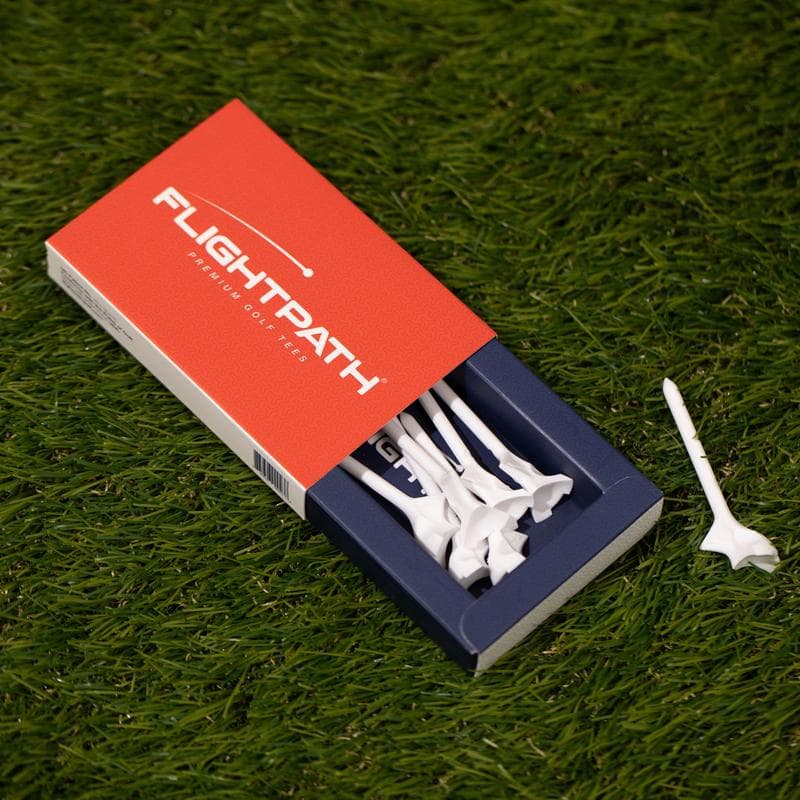
FlightPath's angled crown minimizes contact at impact. Photo: FlightPath
Our verdict
Yes — FlightPath golf tees are worth it if you want a tournament-legal tee that shaves spin off your driver: robot tests show measurably lower backspin and side spin plus a small ball-speed bump, which adds up to straighter, slightly longer drives. The gains are incremental, but they're the cheapest incremental gains in your bag, and the nearly-unbreakable build means one 8-pack genuinely replaces a season of snapped wood.
The short version
A wooden tee snaps, deflects your ball with a flat crown, and costs you a fraction of a degree you never see. FlightPath is a one-piece molded tee with an angled, winged crown that minimizes contact at impact — robot testing shows reduced ball spin and side spin and higher ball speed, which on the course means longer, straighter drives. It's tournament legal, nearly unbreakable, and one pack outlasts a season of wooden tees.
Pros & cons
Pros
- Angled crown reduces contact for less spin and drag at impact
- Robot-tested: less side spin means straighter drives
- Nearly unbreakable — one tee lasts rounds, not holes
- Conforms with the Rules of Golf — tournament legal
- Built-in alignment arrow for aiming your drive
- Made in the USA, in white and high-vis colors
Cons
- Costs more upfront than a bag of wooden tees
- Easier to lose than to break — bright colors help
- Gains are real but incremental; it won't fix a slice by itself
How it works
Tee it with the arrow
Push FlightPath in like any tee and point its embossed alignment arrow down your target line.
Less tee, more ball
The angled, winged crown holds the ball on minimal contact points, so the club meets ball — not tee — at impact.
Longer, straighter, again
Reduced spin and drag mean more ball speed and less curve. Pick it up and play it again — it doesn't snap.
Who it's for
- Golfers chasing a few more yards off the tee
- Players whose drives leak right or left from excess side spin
- Anyone tired of buying (and snapping) wooden tees
- Gift shoppers — it's the golf stocking-stuffer that gets used
Do performance tees actually work?
It sounds like marketing until you look at what a tee does at impact: a traditional cupped wooden tee grips the ball across a full ring of contact, and that contact — for a fraction of a millisecond — adds friction and drag that costs spin consistency and a touch of speed. Low-resistance tees like FlightPath hold the ball on a minimal, angled crown so the ball leaves cleaner, and FlightPath's robotic swing testing measured reduced backspin, reduced side spin and increased ball speed versus standard tees.
Be honest about scale: this is a marginal-gains product. A few hundred RPM less side spin and a bit more ball speed translates to yards and tighter dispersion, not a new swing. But golfers pay hundreds for marginal gains in a driver head — a pack of tees that nudges the same numbers for twenty dollars is the cheap end of the same math.
Is FlightPath tournament legal?
Yes — and this is where a lot of gimmick tees fail. The USGA's equipment rules cap tee length at four inches and prohibit designs that unduly influence ball movement or indicate line of play in a non-conforming way. FlightPath is explicitly designed to conform with the Rules of Golf, so you can play it in club events, tournaments and posted rounds without a thought.
The embossed alignment arrow sits within what the rules allow for a tee. If you've been using an alignment-heavy practice tee that's technically non-conforming, FlightPath is the version you don't have to pocket on competition day.
Durability math: one pack vs a season of wooden tees
Wooden tees are consumables — a driver swing snaps them, and a busy season chews through bags of them. FlightPath is one-piece molded engineering plastic; drives glance off the flexible crown instead of snapping the shaft, so a single tee routinely survives many rounds. The 8-pack is realistically a season's supply for most golfers.
The real attrition isn't breakage, it's losing them — a tee that flies a few feet on a big swing is easy to leave behind. The high-visibility colorways exist for exactly that reason, and at roughly $2.50 a tee, building the pick-it-up habit is worth it. Net cost over a season usually beats wood, with better impact behavior thrown in.
Frequently asked questions
How is FlightPath different from a normal tee?
Its one-piece molded design has an angled, winged crown that holds the ball on minimal contact points, reducing friction, spin and drag at impact. Robot testing showed less backspin and side spin and more ball speed than a standard wooden tee.
Is it legal for tournaments?
Yes — FlightPath conforms with the Rules of Golf, so it's legal in tournaments, club events and handicap-posted rounds.
Will it really add distance?
Testing shows more ball speed and less spin, which typically means a modest distance gain and straighter flight. It's a marginal-gains product — real, measurable, but it won't replace a good swing.
How long does one tee last?
They're nearly unbreakable in normal use — the flexible crown gives instead of snapping. One tee commonly survives many rounds; the usual way to lose one is leaving it on the tee box, not breaking it.
What height and sizes do they come in?
The standard is a 2.75-inch tee sold in 8-packs — the height most drivers tee at — with multiple colorways including high-visibility options that are harder to lose.
Does the alignment arrow help?
It gives you a consistent visual cue to aim your drive down the target line, the same trick as drawing a line on your ball. Small, free consistency — point it and commit.
Are FlightPath golf tees legit or just a gimmick?
Legit, within honest limits. FlightPath publishes robot-swing data showing measurably lower backspin and side spin and slightly higher ball speed versus a standard wooden tee, which on the course translates to a small distance bump and tighter dispersion. It won't fix a slice on its own, but the numbers are real and it's cheaper than every other 'few more yards' upgrade in your bag.
How do FlightPath tees compare to Zero Friction, 4 Yards More and other performance golf tees?
The category all chases the same idea: minimize how much the tee grips the ball at impact. Zero Friction uses a three-prong crown, 4 Yards More uses a small cup on a flexible stem, and FlightPath uses an angled, winged crown with a built-in alignment arrow. FlightPath's edge is its robot-tested data and its tournament-legal one-piece build — it flexes instead of snapping, so an 8-pack lasts most golfers a season rather than a few rounds.
Are FlightPath premium golf tees robotically tested, and what did the robot data show?
Yes — FlightPath is one of the few tee brands to publish results from a swing-robot comparison against a standard wooden tee, and the specific gains they document are lower ball backspin, meaningfully lower side spin, and a small increase in ball speed at the same club head speed. On the course, the practical translation is a tighter dispersion window (drives that leak less right or left) and a modest yardage bump — exactly the kind of marginal-gains upgrade a robot can measure clearly but that gets muddied by human swing variance. The point of robot testing isn't that you'll match those exact numbers; it's that the tee's effect on ball flight is isolated from swing noise and shown to be real.
When you buy through links on this page, TopCrate may earn an affiliate commission at no extra cost to you. Performance figures reflect the manufacturer's robotic testing; on-course results vary by swing. Prices accurate as of publish time.