TRENDING ON AMAZON
Cosori Original 1.7L Electric Glass Kettle Review: Is It Worth It?
The 1.7L borosilicate glass kettle where no plastic touches the water — boils a full pot in under six minutes, cleans in seconds, and looks better on the counter than any plastic kettle.
Quick answer: Yes — the Cosori electric kettle is worth it, and the 1.7L glass version is one of the best-value kitchen buys on Amazon right now. No plastic touches your water, it boils a full 1.7L in under six minutes at under 70 dB, and the wide-mouth glass body is genuinely easier to keep clean than any narrow plastic kettle. It's not the pick if you need precise temperatures for pour-over coffee or matcha, but for everyone else — French press, tea, hot chocolate, oatmeal, quick boiled water — this is the kettle to buy and stop thinking about. Just remember it's glass: fill it on the base, don't drop it, and descale every couple of months.
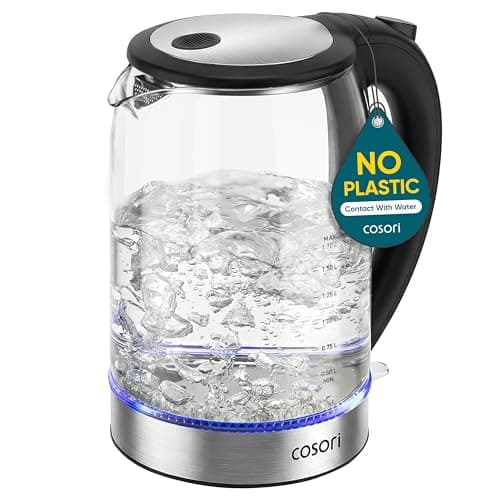
Product image from the Amazon listing.
Our verdict
Yes — the Cosori electric kettle is worth it, and the 1.7L glass version is one of the best-value kitchen buys on Amazon right now. No plastic touches your water, it boils a full 1.7L in under six minutes at under 70 dB, and the wide-mouth glass body is genuinely easier to keep clean than any narrow plastic kettle. It's not the pick if you need precise temperatures for pour-over coffee or matcha, but for everyone else — French press, tea, hot chocolate, oatmeal, quick boiled water — this is the kettle to buy and stop thinking about. Just remember it's glass: fill it on the base, don't drop it, and descale every couple of months.
The short version
If you've been drinking hot water that tastes vaguely plastic, this is the fix. The Cosori Original electric kettle uses a borosilicate glass body and a 304 stainless steel lid and base, so nothing plastic ever contacts your water. It boils a full 1.7-liter pot in about 5:50 — fast enough for a French press or a big pot of tea in one go — and stays under 70 dB while doing it. The wide-mouth opening means you can actually get a hand and a sponge inside to clean out mineral scale, which any long-time kettle owner will tell you is the feature that decides how long a kettle lasts. Auto shut-off, boil-dry protection and a satisfying blue interior LED round out a genuinely great $25 kettle.
Pros & cons
Pros
- No plastic contact with water — borosilicate glass + 304 stainless
- Boils 1.7L in about 5:50
- Under 70 dB — noticeably quieter than most cheap kettles
- Wide-mouth opening for easy cleaning and descaling
- Auto shut-off and boil-dry protection
- Blue interior LED lights up during boil
- 360° cordless base
Cons
- No variable temperature control — it's a straight boil
- Glass carafe loses heat faster than double-walled metal — no keep-warm
- Some users report a small water leak from the spout if overfilled
Why people love it
Fill through the wide top
Lift the lid, fill anywhere from 500ml to 1.7L, and set on the cordless base. The wide opening means you can fill from a sink without gymnastics.
Press the switch
One switch on the handle starts the boil. The blue LED inside the glass lights up so you can see the water rolling.
Auto shut-off
The kettle beeps and cuts power the moment the water hits a rolling boil, and boil-dry protection kicks in if you accidentally switch it on empty.
Who it's for
- Anyone tired of the plastic taste from cheap kettles
- French press and pour-over drinkers
- Tea drinkers who boil multiple times a day
- Small apartments where the kettle sits on the counter
Why a no-plastic-contact glass kettle is worth choosing over a cheap plastic one
Every plastic electric kettle you've ever used had a faintly plastic taste in the first pour, and often for many pours after that. The reason is that hot water is a solvent for the plasticizers and residual monomers in the polymer, and even 'BPA-free' plastic kettles typically use polypropylene or polycarbonate parts that leach detectable, if small, amounts into boiling water. The Cosori sidesteps this entire category of concern: the borosilicate glass body doesn't leach anything into water at 212°F, and the stainless steel lid and inner base are food-grade 304, the same alloy used in restaurant kitchens. What you get in the mug is water that tastes exactly like the water you poured in.
The secondary benefit of glass is that you can see what's in your kettle. Mineral scale buildup, sediment, and any residue from the last brew are visible instead of hidden inside an opaque plastic wall. That visibility changes behavior — you actually descale the kettle when you can see it needs it, rather than discovering years-old buildup only when the heating element finally fails. Borosilicate is also the same glass used in laboratory Erlenmeyer flasks, so it handles the rapid heating and cooling that would crack ordinary soda-lime glass over time. Cosori is the reason this design went from a $75 specialty product to a $25 mass-market kettle.
Cosori Glass Kettle vs a variable-temperature kettle vs a stovetop kettle
The right kettle depends on what you actually brew. For anyone who makes French press coffee, black tea, herbal tea, hot chocolate, oatmeal, or instant noodles, the straight-boil Cosori is genuinely the correct tool — you want water at a full boil, and adding temperature control is paying for a feature you'll never use. Its 1.7-liter capacity handles a full French press plus a cup on the side, or a large teapot for a group. The 1500W wattage boils that full pot in about 5:50, competitive with any kettle at any price point on a US outlet.
Variable-temperature kettles (Fellow Stagg EKG, Cosori Original Pro, Bonavita Interurban) matter if you brew pour-over coffee, green or white tea, or matcha — those preparations use water below boiling (170-200°F) and the difference between the correct temperature and boiling is genuinely tasteable. If that's you, spend the extra $50-150 for temperature control. Stovetop whistle kettles are the third option, and they still work fine, but they take roughly twice as long, use gas or electricity less efficiently, and require you to actively watch them or listen for the whistle. For a general kitchen kettle, the electric Cosori is a straight upgrade over stovetop and a reasonable step-down from a specialty variable-temp model.
How to make a Cosori Electric Glass Kettle last for years (and what to watch out for)
The three things that kill electric kettles are mineral scale, dry-boiling, and dropped glass. Cosori handles two of them — the wide-mouth opening makes descaling easy, and the boil-dry protection cuts power if you accidentally switch on an empty kettle. Your job is the third: this is a glass kettle, and glass breaks if it hits the counter or the sink edge from a foot up. Fill it on the base (safer than lifting it off), use both hands when it's full and hot, and don't leave it perched on the edge of a counter. Users who baby their glass kettle typically get many years of daily use out of one.
On maintenance, run a vinegar-and-water descale every 1-2 months if you have hard water, monthly if you have very hard water, and quarterly if you're on a soft-water system. The rinse-and-boil-fresh cycle afterward is important — leftover vinegar in the kettle will absolutely make the next mug of tea taste terrible. If the kettle starts making unusual crackling sounds during boil, that's typically scale buildup on the heating element (a shorter descale schedule fixes it). Some users report a small water leak from the spout when overfilled past the 1.7L max line — don't overfill. Watch that MAX line; the glass makes it easy to see.
See Cosori Glass Kettle on Amazon
Check the latest price, photos and buyer reviews on Amazon.
Check Price on Amazon →Sold and shipped by AmazonFrequently asked questions
Is the Cosori electric kettle actually good — and how does it hold up long-term?
Yes. After tens of thousands of Amazon reviews, the Cosori Original electric kettle averages 4.7 stars, and the pattern in the reviews is consistent: people buy it to escape plastic-tasting cheap kettles, and they keep it for years. The three long-term wins: (1) borosilicate glass doesn't leach anything into water at 212°F, so what comes out tastes exactly like what went in; (2) the wide-mouth opening means you can actually clean out mineral scale before it kills the heating element (the #1 reason cheap kettles die); (3) boil-dry protection saves it from the classic 'switched it on while empty' user error. It's not glamorous or feature-rich — no variable temperature, no keep-warm — but for a $25-30 daily-use kitchen appliance, it's genuinely one of the best-value buys on Amazon.
Is the Cosori Original Electric Glass Kettle actually all-glass?
The parts that touch the water are: the body is borosilicate glass and the lid, spout collar and inner base are 304 food-grade stainless steel. There's plastic on the exterior handle and the outer base assembly (which houses the electrical components), but no plastic ever contacts your water. That's the specific feature people buy this kettle for — cheap kettles with plastic reservoirs are the ones that leave a faint plastic taste in tea and coffee.
How fast does it boil a full 1.7L?
A full 1.7L pot boils in about 5:50 in real-world testing (roughly 3 minutes for a single mug of water). That's competitive with any 1500W kettle in this price range — the wattage sets the ceiling, and Cosori runs the full 1500W available on a standard US outlet.
Is it loud?
Not for a kettle. Peak noise sits around 66 dB during the rolling simmer, which is significantly quieter than the ~80 dB many cheap plastic kettles hit. If you're used to a whistling stovetop or a loud electric kettle, the Cosori is noticeably calmer.
Does it have variable temperature control for tea or pour-over coffee?
No — this is a straight boil-and-shut-off kettle. If you want 175°F for green tea or 205°F for pour-over coffee, you'll need either a Cosori variable-temperature model (they make one) or a dedicated gooseneck kettle like the Fellow Stagg EKG. For French press, boiled black tea, hot chocolate and instant noodles, the straight boil is exactly what you want.
How do you descale a Cosori glass kettle?
Fill halfway with equal parts water and white vinegar, boil, let sit for 15-20 minutes, then rinse thoroughly and boil a fresh pot of water to clear any vinegar smell. Do this every 1-2 months if you have hard water. The wide-mouth opening is why this actually works — you can get a hand and a sponge inside to wipe out any residue afterward, unlike narrow-neck electric kettles where mineral scale eventually chokes the spout screen.
Is it safe to use with a French press or a Cosori-style [Carote nonstick cookware](/reviews/carote-cookware) household?
Yes to both. Boiled water from a glass kettle is exactly what French press and pour-over recipes call for, and there's no interaction with any cookware you're using elsewhere in the kitchen. The one thing to avoid: pouring boiling water directly onto a cold glass surface or a frozen sink basin — thermal shock can crack glass. Pour into a mug or carafe first if the destination is a cold surface.
How does the Cosori compare to a stovetop kettle or a variable-temperature Fellow Stagg?
Three tiers, three price points. Stovetop kettles ($20-40) work fine but require an active burner, take longer, and whistle. The Cosori ($25-30) plugs in, boils in about half the time, and adds auto shut-off and boil-dry protection. A variable-temperature gooseneck like the Fellow Stagg EKG ($165+) adds the precise pour and temperature control that specialty coffee brewers need — worth it for pour-over enthusiasts, overkill for anyone else. For general home use, the Cosori hits the value sweet spot.
As an Amazon Associate, TopCrate earns from qualifying purchases at no extra cost to you. Product image, price, availability and ratings are shown on Amazon and are subject to change.