TRENDING ON AMAZON
Breville BES870XL Barista Express Espresso Machine Review: Is It Worth It?
Bean-to-cup espresso with a built-in conical burr grinder, 15-bar pump and steam wand — the gateway machine that's launched a million home baristas.
Quick answer: If you drink espresso daily and want cafe-quality drinks at home, the Breville Barista Express is the machine to buy. Real grinder, real pump, real steam wand, and a learning curve worth climbing. After two decades on the market it's still the most-recommended starter espresso setup — and that's earned.
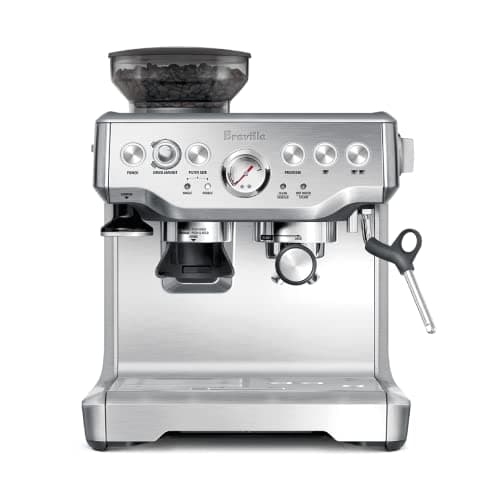
Product image from the Amazon listing.
Our verdict
If you drink espresso daily and want cafe-quality drinks at home, the Breville Barista Express is the machine to buy. Real grinder, real pump, real steam wand, and a learning curve worth climbing. After two decades on the market it's still the most-recommended starter espresso setup — and that's earned.
The short version
If you want real espresso at home without buying $1,500 of separate gear, the Breville Barista Express is the answer almost every coffee forum lands on. It packs a 54mm conical burr grinder, a 15-bar Italian pump, a 1600W heating system with PID temperature control, and a manual steam wand into one stainless-steel countertop unit. You get a freshly-ground, freshly-pulled double shot in under a minute, and the steam wand makes microfoam good enough for latte art with a little practice. It's not a pod machine that hides everything — it's a manual machine that teaches you espresso while making excellent drinks.
Pros & cons
Pros
- Built-in 54mm stainless conical burr grinder — fresh-ground every shot
- 15-bar Italian pump with PID temperature control
- Dose, grind size, tamp and shot length all adjustable
- Steam wand makes real microfoam for latte art
- Stainless steel build that lasts a decade-plus
- Compact for a prosumer machine — fits under most cabinets
Cons
- Steam wand requires technique to master
- Single boiler — you steam after you pull, not simultaneously
- Needs descaling every 2-3 months in hard-water areas
Why people love it
Grind, dose, tamp
Beans go in the hopper. The integrated burr grinder doses into the included portafilter; you tamp with the magnetic tamper that lives on the machine.
Pull the shot
Lock the portafilter into the group head, press the 1- or 2-cup button. A 15-bar pump and PID-controlled temperature pull a balanced 25-30 second double shot.
Steam your milk
Switch to the steam wand and froth cold milk into glossy microfoam in under a minute — pour straight into the espresso for a latte, cappuccino or flat white.
Who it's for
- Couples drinking 2+ espresso drinks daily
- Anyone who hates pod waste but wants convenience
- Home baristas who want to learn the craft
- Espresso lovers who travel and miss good shots
Breville Barista Express vs Nespresso vs De'Longhi: which espresso machine to buy
The fundamental decision is convenience vs craft. The Nespresso Vertuo (or OriginalLine) wins on simplicity — pop in a pod, press a button, get acceptable coffee in 20-30 seconds. The downsides are recurring pod cost, limited bean variety, and you'll never pull a truly great shot. De'Longhi's super-automatics (Magnifica, Eletta) sit in the middle: bean-to-cup grinding and brewing with one button, decent quality, but you can't dial in the grind or pressure for great espresso and they cost almost as much as the Barista Express.
The Barista Express is the right answer when you want real espresso and you're willing to spend 60-90 seconds making it. Fresh-ground beans, dial-in adjustability, manual steam wand — the gap in cup quality is huge, and it's not subtle. The learning curve is one weekend; after that you'll never go back to pods. Buy the Nespresso Vertuo if convenience trumps everything; buy the Barista Express if you want a drink as good as your local cafe and the joy of making it yourself.
How to pull a great espresso shot on the Breville Barista Express
Start with fresh whole beans roasted within the last 4 weeks (check the roast date on the bag — not the best-by date). For a safe first bean that pulls consistently on any Breville, most owners land on Lavazza Super Crema, the Amazon best-selling Italian medium-roast blend that's forgiving on grind and made for exactly this style of machine. Set the grinder dial somewhere around 5-8 to start, dose into a single-wall double basket, distribute with a tap and tamp evenly to a level surface. Lock in the portafilter and start the 2-cup shot — you're aiming for a 1:2 ratio (18g of grounds yielding about 36g of liquid espresso) over 25-30 seconds. Faster than 25 seconds means grind finer; slower than 30 seconds means grind coarser. That single adjustment loop is most of espresso skill.
Two upgrades pay off quickly. A simple bathroom scale lets you weigh your dose and yield instead of eyeballing — instantly more consistent shots. And a metal precision basket (VST or IMS) drops in where the stock basket goes and gives more even extraction. Don't waste money on a fancy tamper yet; the included Breville magnetic tamper is fine for years. Spend on beans first, equipment second.
Daily maintenance and descaling: keeping the Barista Express running for a decade
The Barista Express is built to last 10-15 years if you treat it well, and most failures we've seen come from neglect. After every session: wipe and purge the steam wand (milk hardens fast in there), knock out the puck, and run a blank water shot through the group head to flush coffee oils. Wipe the drip tray and group head gasket weekly. Backflush with a blind portafilter disk and a Cafiza detergent tablet weekly — this removes the oily residue that gradually clogs the brew valve.
Descale every 2-3 months with the Breville descaler or food-grade citric acid (about 2 tablespoons per liter of warm water). Hard-water areas may need monthly descaling — if you see calcium spotting around the group head or steam tip, you've waited too long. Replace the water filter cartridge in the reservoir every two months. These ten-minute habits are the difference between a Barista Express that lasts five years and one that lasts fifteen.
See Breville Barista Express on Amazon
Check the latest price, photos and buyer reviews on Amazon.
Check Price on Amazon →Sold and shipped by AmazonFrequently asked questions
Is the Breville Barista Express worth it for a home espresso setup?
For most people who drink 1-2 espresso drinks a day and would otherwise spend $5-7 at a cafe, yes — the math closes within a year. More importantly, it's the right tool for the learning curve: the integrated grinder, PID temperature control, and dial-in adjustability mean you can actually pull a great shot with practice. A cheap espresso machine plus a cheap grinder will frustrate you; this is the entry point that doesn't cap your skill ceiling for years.
Does the built-in grinder produce good enough espresso grounds?
Yes — the 54mm conical burr grinder inside the Barista Express is rated specifically for espresso fineness, with 16 grind settings and dose control. It's not as good as a $500+ standalone grinder (the Eureka Mignon or Niche Zero are noticeably better), but it produces consistent, fine-enough grounds for excellent home espresso. Most owners never feel the need to upgrade the grinder; those chasing maximum quality eventually add a standalone grinder for delicate single-origin beans.
How long does the Barista Express take to warm up?
About 30-45 seconds from cold to ready-to-pull, thanks to the 1600W ThermoCoil heating system rather than a slower traditional boiler. Some users let it warm for an extra minute or two for steam temperature stability, and pulling a blank shot of hot water through the group head before brewing further preheats the portafilter for the best extraction.
Can I make lattes and cappuccinos with the steam wand?
Yes — the manual steam wand is one of the Barista Express's biggest features. With about an hour of practice you can pour glossy microfoam suitable for latte art. The wand has a powerful enough steam output to handle cold milk in 30-45 seconds. Tips: use cold whole milk in a cold stainless steel pitcher, position the wand tip just below the surface to introduce air for the first 5-10 seconds, then submerge to swirl and texture.
How often do I need to clean and descale it?
Daily: wipe the steam wand, knock out the portafilter, and run a blank shot of water. Weekly: backflush with the included blind disk and detergent tablet. Every 2-3 months (sooner in hard-water areas): run a descale cycle with citric acid or Breville's descale solution. The machine has a descale-alert light that triggers based on shot count. Treat it like a car — small regular maintenance prevents big-ticket failures and keeps espresso quality consistent.
What's the difference between the Barista Express and the Barista Pro or Touch?
Same espresso quality across the line. The Pro upgrades to a faster ThermoJet heating element (3-second warm-up vs 30 seconds) and a digital LCD with shot timer; the Touch adds a touchscreen with one-touch milk drink presets but loses the manual feel. The Express is the cheapest entry point and the most popular because the manual control teaches you espresso; the Pro is worth it if 30 seconds feels too long; the Touch suits people who want push-button drinks. All three share the same grinder and brew group.
As an Amazon Associate, TopCrate earns from qualifying purchases at no extra cost to you. Product image, price, availability and ratings are shown on Amazon and are subject to change.