TRENDING ON AMAZON
Blueair Blue Pure 411i Air Purifier Review: Is It Worth It?
The Swedish-designed 185 sq ft air purifier that clears bedroom air of pollen, smoke and dust with almost no sound — the quietest one in its class.
Quick answer: The Blueair Blue Pure 411 is the quietest, best-looking small-room purifier in its price range — the specific fix for someone who wants clean bedroom air without a whirring plastic box on the nightstand. If a bedroom or nursery under 200 sq ft is your target, this is the one to buy.
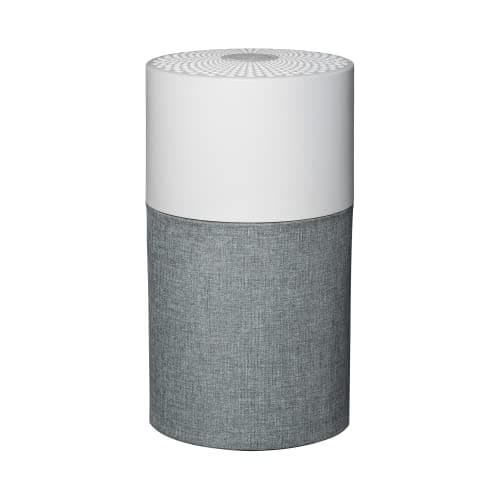
Product image from the Amazon listing.
Our verdict
The Blueair Blue Pure 411 is the quietest, best-looking small-room purifier in its price range — the specific fix for someone who wants clean bedroom air without a whirring plastic box on the nightstand. If a bedroom or nursery under 200 sq ft is your target, this is the one to buy.
The short version
The Blueair Blue Pure 411i is the small-room air purifier that quietly earned dermatologists' and allergists' recommendation without any of the smart-home hype. It uses Blueair's HEPASilent technology — a combination of mechanical filtration plus electrostatic charging that captures 99.97% of particles down to 0.1 microns, at less than 25 dB on low (quieter than a whisper). The washable fabric pre-filter comes in five color options that let it blend into a bedroom or nursery instead of announcing 'medical device.' For 185 sq ft rooms (a standard bedroom or nursery), this is the quietest, most attractive, most whisper-approved purifier under $200.
Pros & cons
Pros
- HEPASilent captures 99.97% of particles down to 0.1 microns
- Under 25 dB on lowest setting — quieter than most bedrooms
- Washable fabric pre-filter in five color options
- No app required — one button, three speeds
- Only 12 W on low — leave running 24/7 without energy guilt
- Compact cylinder footprint (8" diameter) fits nightstand or floor
Cons
- Rated for 185 sq ft — too small for open living rooms
- Filter replacements are proprietary Blueair cartridges
- No air-quality sensor or auto mode on base 411
Why people love it
HEPASilent electrostatic + mechanical filtration
Air passes through a particle charger before hitting the filter, so particles stick to fibers electrostatically as well as physically — captures the same 99.97% as a HEPA but with less air resistance, which means less fan noise.
360° air intake, top exhaust
Air pulls in from all sides of the cylinder and exhausts clean air out the top — no need to point it at a specific direction like flat-panel purifiers.
Washable pre-filter in five colors
The removable fabric pre-filter (in colors like Diva Blue, Dark Shadow, Buff Yellow) catches pet hair and large dust before the main filter, extending main-filter life, and doubles as room decor.
Who it's for
- Bedrooms and nurseries under 200 sq ft
- Allergy and asthma sufferers wanting overnight relief
- Households with pets producing dander
- Wildfire and seasonal smoke defense in small rooms
Do air purifiers actually work? The evidence behind HEPA filtration
Air purifiers with true HEPA filtration are one of the few 'wellness' categories with strong published evidence. Multiple randomized controlled trials over the last 15 years show that HEPA purifiers running in bedrooms produce measurable reductions in indoor PM2.5, allergen concentrations (dust mite, pet dander, mold spores), and asthma symptoms in sensitive individuals. A 2018 Environmental Health Perspectives meta-analysis found that HEPA air cleaners were associated with clinically meaningful improvements in allergic rhinitis and asthma outcomes.
The mechanism isn't a mystery. HEPA filters mechanically capture particles as they pass through a dense mat of fibers — the 99.97% at 0.3 microns rating is the industry standard, and Blueair's HEPASilent technology matches or exceeds it for particles down to 0.1 microns. What air purifiers don't do: remove gases without a carbon filter, kill viruses in the air with any reliability (HEPA captures viruses but the aerosol-transmission story is more complicated), or make outdoor air pollution disappear at whole-house scale from a bedroom-sized unit. But for the specific goal of cleaning particulate matter from a small room where you sleep or work, HEPA purifiers reliably deliver.
Blueair Blue Pure 411 vs Levoit Core 300 vs Coway AP-1512HH: the small-room three-way
These three are the small-room HEPA champions that dominate every 'best air purifier' list, and they've stayed on top because they're all genuinely good. Levoit Core 300 (~$100) is the value pick — true HEPA, decent CADR for 219 sq ft, three fan speeds, three-year lifespan, and readily available Amazon-basic filter replacements. Coway AP-1512HH (~$200) is the enthusiast pick — highest CADR in the group, Auto mode with a real particle sensor, Eco mode that shuts off when air is clean, and a 4-color LED air-quality indicator on the top. Blueair Blue Pure 411 (~$120) is the design/quiet pick — quieter than both competitors, more attractive with color pre-filter options, and dedicated bedroom application.
Pick Levoit for cheapest true-HEPA. Pick Coway for feature-rich automation. Pick Blueair for a bedroom where noise and aesthetics matter. All three deliver clean air at the same fundamental level; the differences are cost, features and noise. If you're allergic and need one for your bedroom, honestly go Blueair. If you want one for your home office and don't mind slightly more sound, Coway is worth the extra $80. If you want the cheapest genuine HEPA, Levoit.
Where to place your purifier (and mistakes that waste 40% of its performance)
The single biggest mistake with air purifiers is placement. Most people put them in a corner or against a wall, which restricts airflow on the intake and exhaust sides. HEPA purifiers work by pulling room air through the filter and returning clean air — they need clearance on all sides to move enough volume. The Blueair 411 has 360° intake, so it should sit at least 6 inches from any wall or furniture; giving it a foot of clearance measurably improves CADR. Place it near where you spend time (near the bed, near the crib, near the desk) rather than tucked in a corner across the room.
Also crucial: run it continuously, not just when you notice bad air. Air purifiers work by maintaining a lower particulate baseline in the room; if you turn it on only during smoke days, you're starting from a dirty baseline every time and it takes hours to catch up. On the lowest setting, the 411 uses about 12 W — running 24/7 costs about $1-2/month in electricity. Set it on low, forget it exists, replace the filter every 6 months. That's the routine that delivers the health benefit. Keep windows closed during smoke or high-pollen days to prevent the purifier from constantly fighting new pollution.
See Blueair Blue Pure 411 on Amazon
Check the latest price, photos and buyer reviews on Amazon.
Check Price on Amazon →Sold and shipped by AmazonFrequently asked questions
Blueair Blue Pure 411 vs 411+ vs 411i vs Auto: what's the difference?
The 411 lineup evolves in small steps. The base 411 is the original — three fan speeds, no sensor, cheapest. The 411+ is the same body with a slightly upgraded particle+carbon filter (better for VOCs and cooking odors). The 411i adds Wi-Fi and app control while keeping the same purification specs. The 411i Max is a slightly larger fan for 219 sq ft. And the 411 Auto adds an automatic air-quality sensor that adjusts fan speed. For most people the base 411 or 411+ is the smart-money pick — the sensor and app on higher tiers are convenient but not essential. The purification performance is essentially the same across the line.
Is it really quieter than other purifiers?
Yes, materially. On the lowest setting, the Blue Pure 411 measures around 17-23 dB — quieter than a whisper (30 dB) and quieter than every popular small-room competitor including the Levoit Core 300 (25-28 dB on low) and the Coway AP-1512HH (24.4 dB). This matters for bedrooms. The higher settings are louder — around 47 dB on high — but you rarely need high in a small room. The HEPASilent electrostatic-plus-mechanical filtration is what enables the low airflow resistance that lets the fan be so quiet.
How does it compare to the Levoit Core 300?
The Levoit Core 300 (which we also review) is the biggest direct competitor at a similar price point. Levoit's advantage: true HEPA labeling, slightly higher CADR ratings for 219 sq ft, and a lower entry price. Blueair's advantage: quieter operation at every fan speed, more attractive design with color pre-filter options, and the HEPASilent technology captures particles down to 0.1 microns (vs Levoit's 0.3 micron rating). For a bedroom where noise matters, Blueair. For a home office or living room where you want maximum CADR at the lowest price, Levoit. Both are excellent — pick based on aesthetics and noise sensitivity.
How often do I replace the filter?
Every 6 months of continuous use, per Blueair's recommendation. Filters are proprietary — you'll need to buy Blueair's Blue Pure 411 replacement filter, which runs $20-25 each. That's roughly $40-50/year in filter costs, which is comparable to a Levoit Core 300 or a Coway AP-1512HH. The washable fabric pre-filter should be vacuumed or washed monthly and can be replaced with any of the five color options if you want to refresh the look. Set a phone reminder for the 6-month mark; Blueair doesn't have a filter-change indicator on the base 411.
Will it help with wildfire smoke or urban pollution?
Yes, dramatically — for the small room it covers. The 411's HEPASilent filtration captures the PM2.5 particles that make wildfire smoke and urban pollution harmful (smoke particles are typically 0.4-0.7 microns; the 411 captures down to 0.1). On wildfire smoke days, close windows, run the 411 on max, and the room will noticeably clear within 30-60 minutes. The limit is room size: 185 sq ft is one bedroom or one small living space. For whole-home wildfire defense, you need multiple units or a larger 6i/7i model, or a whole-house HVAC HEPA filter.
Does it produce ozone?
Trace amounts, well below FDA and CARB (California Air Resources Board) safety limits. Blueair's HEPASilent uses a charged-particle stage that can produce very small amounts of ozone as a byproduct, but the 411 is certified for indoor use by CARB (which sets the strictest ozone limits in the US) and independent testing consistently measures ozone output at less than 5 ppb (parts per billion) — well under the 50 ppb safety threshold. If you have severe ozone sensitivity or asthma triggered by ozone, a pure mechanical HEPA (like the Levoit Core 300) may be marginally safer, but for the vast majority of users the 411 is genuinely safe for continuous operation.
As an Amazon Associate, TopCrate earns from qualifying purchases at no extra cost to you. Product image, price, availability and ratings are shown on Amazon and are subject to change.