TRENDING ON AMAZON
Birkenstock Boston Suede Clog Review: Is It Worth It?
The suede clog that became a modern classic — a shaped cork footbed that molds to your foot, a closed toe box, and an outfit-with-anything silhouette.
Quick answer: Yes — Birkenstock clogs (the Boston specifically) are comfortable and worth the money, provided you'll wear them a lot and you're willing to give the shaped cork footbed one to three weeks to mold to your foot. Real arch support instead of foam cushion, closed toe box that works spring through fall, outfit-with-anything silhouette from jeans to midi dresses, and a resoleable build that turns a $160 pair into a decade shoe. Endure the break-in, spray the suede on day one, order the right European size (most people size down half from between-sizes), and you've bought the clog that podiatrists recommend for plantar fasciitis and standing-all-day workers use for shifts.
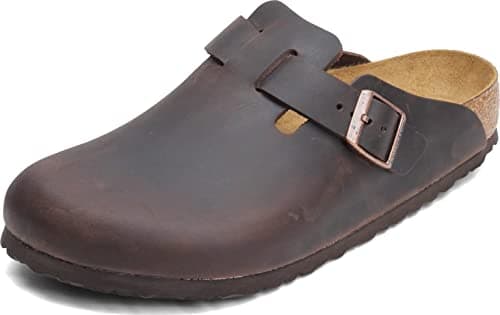
Product image from the Amazon listing.
Our verdict
Yes — Birkenstock clogs (the Boston specifically) are comfortable and worth the money, provided you'll wear them a lot and you're willing to give the shaped cork footbed one to three weeks to mold to your foot. Real arch support instead of foam cushion, closed toe box that works spring through fall, outfit-with-anything silhouette from jeans to midi dresses, and a resoleable build that turns a $160 pair into a decade shoe. Endure the break-in, spray the suede on day one, order the right European size (most people size down half from between-sizes), and you've bought the clog that podiatrists recommend for plantar fasciitis and standing-all-day workers use for shifts.
The short version
Birkenstock's Boston clog started as a workshop shoe in 1979 and, five decades later, is the it-shoe. It's the sandal formula in a closed-toe silhouette — a contoured cork footbed that supports your arch and forms to your foot over a couple of weeks, a soft suede upper with a single buckle strap, and a rubber sole with real grip. It goes with jeans, wide-leg trousers, dresses, and everything in between, works from summer to shoulder-season, and is comfortable enough to wear all day once it's broken in.
Pros & cons
Pros
- Contoured cork footbed molds to your foot
- Closed toe box works spring through fall
- Genuinely versatile — jeans, dresses, work-from-home
- Suede uppers age beautifully
- Real arch support, not just cushion
- Replaceable soles — a pair can last 10 years
Cons
- Two-to-three week break-in period
- Suede shows water spots — needs protection spray
- Premium price versus foam clog alternatives
Why people love it
Break them in gradually
Wear them an hour or two a day for the first week — the cork softens and molds to your foot.
Buckle to your fit
Adjust the single strap so your heel sits at the shaped heel cup with a thumb-width of space at the toe.
Protect the suede
A quick spray of suede protector before first wear keeps water and dirt from setting in.
Who it's for
- Anyone who wants an arch-supportive everyday clog
- People replacing worn-out sandals with a fall-ready shoe
- Style-conscious wearers who also want comfort
- Frequent flyers who need slip-on-and-off practicality
Are Birkenstock Bostons worth it, and why did they take over?
The Boston went from an obscure Birkenstock model to the shoe you couldn't buy without a waitlist in a few short years. There are two real reasons behind the hype. The first is genuine comfort: the shaped cork footbed supports the arch instead of flattening it, and once you break the shoe in over a couple of weeks, it molds to your specific foot in a way foam clogs don't. Podiatrists like them, plantar-fasciitis sufferers rely on them, and standing all day in a broken-in pair is much easier than it looks.
The second reason is versatility. The closed toe and adjustable buckle turn a Birkenstock from summer sandal to shoulder-season shoe — jeans, wide-leg trousers, midi dresses, sweat sets, all of it. Combine that with suede uppers in colors like taupe, black, and mocha that look better as they age, and a sole that can be replaced instead of tossed, and you have a shoe that is expensive up front but earns its price out over years. If you'll wear them a lot — and most owners do — Bostons are one of the safest premium footwear investments you can make.
Birkenstock Boston vs. Crocs Classic vs. Blundstone vs. Clogs
The Boston competes with a specific triangle. The Crocs Classic Clog is the foam-cushioned, waterproof, cheap option — better for garden, pool, quick errands and standing on wet floors, but a completely different aesthetic. Blundstone Chelsea boots cover a similar 'casual-plus' outfit slot with an all-weather rubber sole, but they're a full boot and lose the slip-on convenience. Traditional wooden Swedish clogs (Sanita, Troentorp) are stiffer and less forgiving on the foot despite similar look.
Among Birkenstock's own line, the Arizona is the two-strap open-toe sandal, the Zurich a similar look with more toe coverage, and the London a fully-enclosed clog with a laced-look upper. The Boston is the sweet spot — closed toe for cool weather, single-strap for easy on/off, and the silhouette that took over. If you already own an Arizona and want to keep wearing Birkenstocks into fall, the Boston is the natural next buy.
Break-in, sizing and taking care of Bostons for the long haul
The break-in period is the number-one thing new Boston owners underestimate. The cork footbed is intentionally firm; wear them an hour or two on carpet the first few days, build up slowly, and expect the fit to soften and shape over one to three weeks. Trying to wear a brand-new Boston on a 10,000-step day will not go well. Once molded, they support your foot better than most shoes on the market.
Sizing is European whole sizes — you order your EU equivalent, with a thumb-width in front of the longest toe. When between sizes, most people size down. Suede Bostons want a suede protector before the first wear and a suede brush for cleaning. The oiled leather versions are more forgiving in weather. Save the box; when the sole eventually wears out (many years for most wearers), Birkenstock and specialist cobblers can rebuild them. That's why a $150 pair often becomes a decade shoe.
See Birkenstock Boston on Amazon
Check the latest price, photos and buyer reviews on Amazon.
Check Price on Amazon →Sold and shipped by AmazonFrequently asked questions
Are Birkenstock clogs comfortable?
After a real break-in, genuinely yes — and that's the answer for the Boston, the closed-toe London and the two-strap Arizona alike, because all three ride on the same shaped cork-and-latex footbed. Straight out of the box every Birkenstock clog feels firm; the footbed is engineered to mold to your specific foot rather than compress under it like foam, so it needs one to three weeks of an-hour-or-two-a-day wear before it warms up, softens and takes the shape of your arch, heel and ball of foot. Once molded, the same clog that felt hard becomes a support you can wear standing eight hours — which is why Birkenstocks are the specific casual clog podiatrists recommend for plantar fasciitis and long shifts. The people who say 'Birkenstock clogs hurt' almost always wore them all day out of the box, bought the wrong European size, or missed the width option their foot needed (narrow vs regular). Give the footbed time and pick the right size and width, and Birkenstock clogs are among the most all-day-comfortable clogs on the market.
Why are Birkenstock Bostons so expensive?
Three real reasons, not just brand markup. First, materials: the uppers are genuine suede or oiled leather (not synthetic), and the footbed is real cork-and-latex bonded to jute canvas — natural materials that cost meaningfully more than the injection-molded foam competitors use. Second, construction: Bostons are made largely in Germany and Portugal with a traditional welt-and-sole build, which is what makes them re-solable — that's the specific feature that lets a $160 pair last a decade instead of two years. Third, demand outstripping supply: the Boston has been an it-shoe for five straight years, and Birkenstock has kept production tightly controlled rather than mass-scaling. Whether they're 'worth' the premium comes down to how often you'll wear them — for daily-rotation wearers, the cost-per-wear beats $50 foam clogs easily. For occasional wear, honestly no.
Are Birkenstock Bostons comfortable?
After the break-in period, yes — genuinely so, and that's why they've become the it-shoe for anyone on their feet all day. Straight out of the box they feel FIRM (not painful, but noticeably unyielding) because the cork-and-latex footbed is designed to mold to your specific foot rather than compress under it like foam. Wear them one to two hours a day for the first week, gradually extending, and the footbed warms with your body heat and reshapes to your arch, ball-of-foot and heel over 10-21 days. Once molded, the shoe supports your foot in the exact places you need it — podiatrists recommend Birkenstocks for plantar fasciitis specifically for this reason. The people who complain 'Bostons hurt' almost always tried to wear them all day from day one, or bought the wrong size. Give them a proper break-in and Bostons become one of the most all-day-comfortable clogs on the market.
How should Birkenstock Bostons fit — size up or true to size?
Bostons come in European whole sizes. Aim for your true EU size — a rough US-to-EU chart is on the Birkenstock site — with your longest toe about a thumb's width from the front of the footbed and your heel sitting in the shaped heel cup. If you're between sizes, the shoe runs on the roomier side of true, so most people size down. Narrow and regular widths are available; check which fits your foot before ordering.
How long is the break-in period, and does it really get more comfortable?
Yes — this is the defining Birkenstock experience. The cork footbed is intentionally firm out of the box; over the first one to three weeks of gradual wear, it warms with your body heat and molds to the exact shape of your foot. Wear them an hour or two a day at first, not all day. After break-in, the same shoe that felt hard becomes a custom-shaped support you can wear for hours. If they still feel hard after a month, they may be the wrong size.
Can I wear Birkenstock Bostons in the rain, and how do I clean the suede?
Suede Bostons are not waterproof, and light rain will spot them. A pre-emptive spray of suede/nubuck protector before the first wear is worth doing. For cleaning, brush off dry dirt with a suede brush, use a suede eraser for scuff marks, and let mud dry completely before brushing rather than wiping. For wet weather, the oiled leather Boston and the taupe waterproof Boston Shearling are better suited.
Are Boston clogs comfortable enough for standing all day?
After break-in, yes — the whole design philosophy is arch support and evenly distributed weight, which is why Birkenstocks are recommended for plantar fasciitis and long standing. Compared to a foam clog like the Crocs Classic, the Boston is firmer but more supportive; you feel more of the floor but your arches feel better at the end of the day. For a hospital or restaurant floor, add an insole and consider the professional-grade Birkenstock work models.
Can Birkenstock Bostons be resoled or repaired?
Yes, and it's what makes them a real long-term buy. Birkenstock and specialist cobblers can replace the soles and, in many cases, the footbed once it's worn out. A well-cared-for pair can genuinely last a decade with one or two rebuilds. Save the box and check for a repair program in your region.
What socks work with Birkenstock Bostons in fall and winter?
Cozy midweight socks — chunky ribbed, wool blend, or plain crew — became a defining fall look with Bostons over the last few years. Because the closed toe traps heat, you don't need thick winter socks, and a slim-to-midweight sock lets the strap sit comfortably. Avoid super-thick boot socks that force the buckle open.
As an Amazon Associate, TopCrate earns from qualifying purchases at no extra cost to you. Product image, price, availability and ratings are shown on Amazon and are subject to change.
More reviews you might like
SKINCARE
Celimax Vita-A Retinal Shot Review: Best K-Beauty Retinal for Sensitive Skin?
SPORTS
Body Glide Original Review: The Anti-Chafe Balm That Actually Works
SKINCARE
Foreo Luna Mini 3 Review: Is the Silicone Cleansing Brush Worth It?
SKINCARE