TRENDING ON AMAZON
BAGSMART 6-Piece Compression Packing Cubes for Travel Review: Is It Worth It?
The compression packing cubes with a second zipper that shrinks a week of clothes into a carry-on — six sizes, mesh tops, and the specific trick that turns overpackers into single-bag travelers.
Quick answer: Yes, BAGSMART compression packing cubes are worth it and they're the specific product that finally makes carry-on-only travel realistic for 7-10 day trips. Six sizes, a real compression zipper, mesh tops for visibility, and durable polyester that lasts years of trips — all for less than one checked-bag fee. If you overpack, they impose a physical limit. If you underpack, they add organization. Either way, they're on the very short list of travel accessories that pay for themselves the first time you use them.
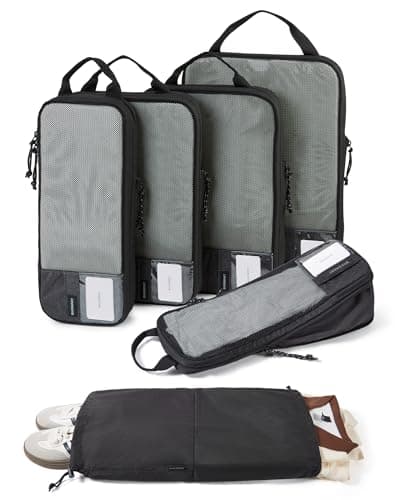
Product image from the Amazon listing.
Our verdict
Yes, BAGSMART compression packing cubes are worth it and they're the specific product that finally makes carry-on-only travel realistic for 7-10 day trips. Six sizes, a real compression zipper, mesh tops for visibility, and durable polyester that lasts years of trips — all for less than one checked-bag fee. If you overpack, they impose a physical limit. If you underpack, they add organization. Either way, they're on the very short list of travel accessories that pay for themselves the first time you use them.
The short version
BAGSMART's compression cubes are the reason 'packing cubes' went from a boring travel accessory to a Reddit obsession. Each cube has two zippers — one to close, one to compress — and pulling the compression zip literally halves the height of a packed cube. Six pieces cover a full trip: one large for pants and dresses, two medium for shirts, two small for underwear/accessories, and a double-sided shoe bag. Mesh tops let you see what's inside, sturdy polyester holds up to years of travel, and the whole set costs less than an airline bag fee. The specific product that lets you skip checked bags on 7-day trips.
Pros & cons
Pros
- Dual-zipper compression genuinely halves cube height
- Six sizes cover an entire trip in one set
- Mesh tops let you find things without unpacking
- Durable polyester shell + reinforced zippers
- Fits inside carry-on, checked and duffel bags
- Costs less than a single checked-bag fee
Cons
- Compression works best on soft clothes — bulky items compress less
- Zipper pulls can pinch if you overstuff
- Cubes take up ~5% of bag volume when empty
Why people love it
Sort clothes by cube
Put pants and dresses in the large cube, shirts in the two mediums, underwear and socks in the two smalls, and shoes in the double-sided bag with a divider between clean and dirty.
Roll, then zip closed
Roll clothes rather than folding — rolled clothes compress better and wrinkle less. Zip the top of each cube closed with the outer zipper.
Pull the compression zip
Grab the second zipper (a different color from the first) and pull it around the cube. The cube visibly flattens by roughly half its height, and everything stays put inside.
Who it's for
- Anyone trying to travel carry-on only
- Frequent travelers rotating shared drawers or closets
- Family travelers keeping each person's stuff separate
- People whose 'just in case' packing style needs a physical limit
Why BAGSMART compression cubes changed the carry-on-only conversation
Packing cubes existed for decades before BAGSMART, but they were mostly just fabric boxes — nice for organizing, useless for saving space. What BAGSMART added, and what turned the category viral, is the compression zipper. It's a simple mechanical trick — a second zipper that pulls the top of the cube down and holds it there — but the effect on a packed suitcase is dramatic. A rolled-and-compressed cube of shirts takes about 60% of the space it did uncompressed, and multiply that by six cubes and you've unlocked roughly the difference between a 22-inch carry-on and a 25-inch checked bag.
The people who care most about this are travelers who've decided that checked bags are the enemy. Airline bag fees, waiting at the carousel, and lost-luggage risk have pushed a huge share of frequent flyers to try carry-on-only travel, and packing cubes with real compression are the specific tool that makes 7-10 day trips possible in a legal carry-on. Combine BAGSMART cubes with a good structured carry-on (or a soft weekender like the Béis Weekender) and you're carrying two weeks of clothes to the gate for free. The math on avoided bag fees pays for the cubes on the first trip. Once you're in that carry-on-only mode, the space you saved is worth spending on comfort — a folded-flat Sondur travel seat cushion slots into the small cube and repays itself on the first long-haul flight where you land able to walk instead of stiff and sore.
How to actually pack a suitcase with BAGSMART cubes (the routine that works)
The mistake most first-time cube users make is treating each cube as a random bucket and stuffing whatever fits. The routine that actually saves space is category-based. Large cube: pants, jeans, dresses, one nice outfit that shouldn't be rolled tight. Medium cubes: shirts, one for casual (T-shirts, henleys) and one for structured (button-downs, polos). Small cubes: underwear/socks in one, accessories (belts, chargers, small toiletries) in the other. Shoe bag: two pairs, sole-in-sole to save length. Roll everything but the delicate outfit; rolling compresses better than folding and dramatically reduces wrinkles.
In the suitcase, place cubes flat rather than on-edge: heaviest on the bottom (large cube with pants), lightest on top (shirts and underwear). Shoes go in their bag along one wall of the suitcase. Toiletry bag and electronics slot into gaps. When unpacking at the hotel, you leave clothes in the cubes and put the whole cube in a drawer — you never fully unpack, which means you never leave anything behind. On the way home, dirty clothes go back into a designated cube, compressed. The whole system reduces packing time from an hour to 15 minutes and turns arriving home into 'unzip cube, put in laundry basket, done.'
BAGSMART compression cubes vs vacuum bags, roll-up compression bags and no cubes at all
The three main alternatives each have a specific weakness compression cubes fix. Vacuum bags (like Ziploc's or dedicated travel vacuum bags) compress more aggressively than cubes, sometimes by 70-80%, but they require either a vacuum pump or hand-rolling the air out and they leave clothes deeply wrinkled. They work for a single-direction trip where you'll re-vacuum-seal on the way home, but many travelers give up after one trip. Roll-up compression bags (a single big bag you roll to squeeze air out) work well for a week's worth of laundry but offer zero organization — everything gets mixed together, and finding one specific shirt means unrolling the whole bag.
No cubes at all is what most people start with and quietly hate. Suitcase contents shift in transit, you unpack everything at each destination, dirty clothes mix with clean ones, and you always overpack because there's no physical limit. Compression cubes are the middle-ground answer: 60% space savings without wrinkles, organization by category, no unpacking at destinations, and dirty-vs-clean separation. For most travelers they're the highest-payoff sub-$50 upgrade to the entire experience of travel — the kind of purchase people wish they'd made ten trips earlier.
See BAGSMART Packing Cubes on Amazon
Check the latest price, photos and buyer reviews on Amazon.
Check Price on Amazon →Sold and shipped by AmazonFrequently asked questions
Do BAGSMART compression cubes actually compress clothes, or is it marketing?
They actually compress — noticeably. The trick is the second zipper: it pulls the top of the cube down into itself, and because the material is stiff polyester rather than mesh, it holds the compressed shape rather than springing back. In practice a stuffed medium cube shrinks from about 5 inches tall to about 3 inches, which is enough to fit an extra outfit or two in the same suitcase. It's not vacuum-bag magic (no air removed), but for regular clothes the space savings are real and repeatable.
How many days of clothes fit in a BAGSMART cube set?
A rough rule that works for most travelers: the 6-piece set fits 7-10 days of clothes for one person if you roll and use compression. The large holds 4-5 pairs of pants or 2-3 dresses, each medium holds about 5-7 shirts rolled, each small holds a week of underwear and socks, and the shoe bag holds two pairs of standard shoes. For two people on a shorter trip, split the set between you (one person takes large + medium + small, the other takes the same). Business travelers who wear the same trousers multiple days can easily do a full week carry-on.
BAGSMART vs Bagail vs Eagle Creek: which packing cubes should I buy?
BAGSMART is the best-value pick with true compression — sub-$40 for six cubes with the dual-zipper design. Bagail is the budget lookalike at slightly lower prices with slightly thinner materials; performance is 90% of BAGSMART but longevity is shorter. Eagle Creek is the premium heritage brand — better fabric quality, higher warranty, no compression zipper on most sets, at 3-4× the price. For most travelers, BAGSMART hits the sweet spot: compression works, materials last for years of trips, and the price is low enough to replace when they eventually wear out.
Do the cubes fit in a standard carry-on suitcase?
Yes — the 6-piece set is sized to fit a standard 22" carry-on. The large cube (15" x 10.5" x 6" uncompressed) is deliberately sized to be the longest dimension inside a typical carry-on. Compressed, the whole set leaves noticeable room around it for shoes, toiletry bags and jackets. If you use an underseat-only personal-item bag (like a Béis Weekender), the medium and small cubes fit; the large cube usually doesn't unless the bag is unusually deep.
Can I put dirty clothes back into the cubes?
Yes, and this is one of the reasons the shoe bag has a divider — one side for clean shoes on the outbound, the other for dirty shoes on the return. For clothes, most travelers keep one small cube designated 'dirty' and compress it separately so odors don't spread to clean items. The polyester shell resists smell absorption and can be spot-cleaned or hand-washed if something leaks.
Are BAGSMART cubes worth it if I already pack well?
Even efficient packers benefit — but for different reasons. If you already fit a week in a carry-on, you probably don't need the compression, but you do get organization (find things without unpacking) and cross-trip consistency (same cube = same category every trip). If you overpack, the cubes are transformational — they impose a physical limit that stops the 'I'll bring three more shirts just in case' spiral. Almost everyone who buys them keeps them, but the payoff is bigger for overpackers than for minimalists.
As an Amazon Associate, TopCrate earns from qualifying purchases at no extra cost to you. Product image, price, availability and ratings are shown on Amazon and are subject to change.