COMPARISON
OlumiRing vs Lume Cube Panel Mini: Which Pocket Light Makes You Look Better on Camera? (2026)
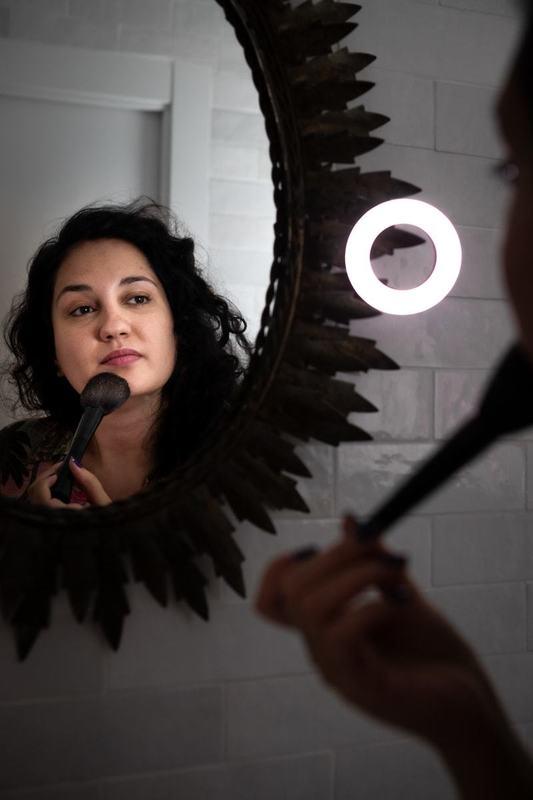
OlumiRing is a $25 clip-on ring light built for calls and selfies. The Lume Cube Panel Mini is a $70 bi-color LED panel built for creators who want control. Here's where each one wins, including the places the Lume Cube is clearly better.
OlumiRing vs Lume Cube Panel Mini is a choice between simplicity and control: OlumiRing is a $24.99 clip-on ring light with one button that you snap onto a phone or laptop for instantly better video calls and selfies, while the $69.99 Lume Cube Panel Mini is a brighter, more color-accurate LED panel with a dial-in color temperature range, made for people who film. For everyday calls, OlumiRing is the easier and cheaper pick. For content creation, the Lume Cube wins on almost every technical measure.
Below we compare them on light quality, color, brightness, battery, mounting and price, explain why a ring and a panel light a face differently, and cover the free options, like your laptop's own screen, that are worth trying first.
OlumiRing vs Lume Cube Panel Mini at a glance
OlumiRing, per its official offer page: 40 LEDs in a ring with a built-in diffuser, one button, adjustable from a warmer to a cooler white, a built-in silicone-lined clip that opens to about one inch, and a rechargeable battery that lasts over an hour and can run while charging. In November 2026 it was $24.99 plus $5.99 shipping, with bundles of three for $59.98 and five for $89.97, and a 30-day money-back warranty.
Lume Cube Panel Mini, per Lume Cube's product page: 60 LEDs in a rectangular panel measuring 3.6 by 2.18 by 0.43 inches, a 2700K to 7500K color temperature range, a 96+ CRI rating, 300 lumens (550 lux at half a meter), an LCD screen showing settings and battery, and a battery rated at up to 3 hours at 50% power or 1.5 hours at 100%. It comes with a silicone diffuser, a mini shoe mount for cameras and a USB charging cable, and was listed at $69.99.
The headline difference: OlumiRing includes its own clip and is designed to live on your phone or laptop. The Panel Mini's box doesn't include a phone or laptop clip, so for that use you'd buy a mount separately.
Ring vs panel: how each one lights your face
A ring light surrounds or sits right next to the camera lens, so light hits your face from straight on. That fills in the shadows under your eyes, nose and chin that overhead room lights create, and it adds the round catchlight in the eyes that many people find flattering. It's the classic look for selfies, makeup and talking-head video. OlumiRing gives you that effect in a clip.
A panel is a flat, rectangular source. Clipped near the camera it also lights you from the front, but it can just as easily be placed off to one side for more shape and depth, the way photographers light a face. It doesn't produce the ring catchlight. For a creator who wants a more natural, "window light" look or wants to light a product instead of a face, that flexibility is the point.
Neither is objectively better. If you mostly want to look brighter and smoother on a video call, the ring shape is the simpler path. If you want to shape light, the panel gives you more options.
Color accuracy and color temperature: Lume Cube wins
This is the clearest win for the Lume Cube Panel Mini. Its 96+ CRI rating means skin tones and colors look true under it, and its 2700K to 7500K range lets you match warm lamplight, cool daylight or anything between. That matters if your light is mixing with a window or a ceiling lamp, because mismatched color temperatures make skin look orange or blue on camera.
OlumiRing lets you shift between warmer and cooler white, which is enough to avoid the worst mismatches in a typical room, but it doesn't publish a CRI rating or an exact Kelvin range, and you can't dial in a precise value. For video calls and selfies that's fine. For product photos, paid content or color-critical work, it's a real limit.
Brightness and battery: Lume Cube wins, with a caveat
The Panel Mini has more LEDs (60 versus 40), a published 300-lumen output and a screen that shows exactly where you've set brightness. In a dark room, or when you're lighting from further away, it has more headroom.
Battery also favors the Lume Cube: up to 3 hours at half power and 1.5 hours at full, against OlumiRing's listed "over an hour." The caveat is how you'll use them. A clip light on a laptop is almost always near a USB port, and OlumiRing can run while charging, so for desk calls the battery gap rarely matters. On the go, filming outdoors or in a hotel, the Lume Cube's longer runtime is a genuine advantage.
Mounting and portability: OlumiRing wins
OlumiRing's clip is built in and silicone-lined, and it fits phones, tablets, laptop lids, monitors and cameras with an edge up to about an inch thick. You clip it on, press one button and you're done. It fits in a palm, a pocket or a purse.
The Panel Mini is also small and light, but out of the box it's set up for cameras via its mini shoe mount. Using it on a phone or laptop means adding a clip or mount, which adds cost and one more thing to carry. If the light is going to live on your laptop for meetings, OlumiRing's all-in-one design is simpler; our OlumiRing review covers clip placement and setup in detail.
Price and value
OlumiRing costs $24.99 for one (plus shipping), and the bundles bring it under $20 a light, which makes it easy to buy one for each device or as gifts. The Lume Cube Panel Mini is $69.99, before any mount you might need for a phone or laptop.
That's nearly three times the price, and you get real things for it: better color, more output, a longer battery and a display. Whether those are worth it depends on whether you film for an audience or just want to look better at 9am on a call.
Free alternatives to try first
Before buying either light, try what you already have. Sitting facing a window during the day is the best free light there is. On a recent Apple-silicon Mac, macOS includes a feature called Edge Light that brightens the edges of your screen during video calls to act like a ring light; it's available in macOS Tahoe 26.2 and later, and reviews have been mixed on how much it helps in a truly dark room.
Many phones also have a front "screen flash" for selfies, but it's designed for still photos and doesn't light you during a video call. A dedicated light like OlumiRing or the Lume Cube is what fills that gap.
Which should you buy?
Buy OlumiRing if your goal is to look better on video calls, selfies, short videos and makeup, you want a light that clips straight onto your phone or laptop with no extra parts, and you'd rather spend $25 than $70. Read our full OlumiRing review for setup tips, and see is OlumiRing legit? for the company, warranty and bundle details.
Buy the Lume Cube Panel Mini if you create content regularly, need accurate color or a precise color temperature, want more brightness and battery for shooting on the go, or plan to mount the light on a camera. It's the better tool, at a higher price, for people who'll use what it offers.
Plenty of creators carry both: a clip-on ring for quick calls and selfies, and a panel for filming. TopCrate earns a commission on OlumiRing only, not on Lume Cube. If you're shopping for someone else, we included OlumiRing in our Christmas gifts for her guide.
Read our full OlumiRing review
Our verdict on the clip-on ring light, current pricing and how to set it up for the most flattering light.
Read our full OlumiRing review →Frequently asked questions
Is OlumiRing better than Lume Cube Panel Mini?
For video calls and selfies on a phone or laptop, OlumiRing is simpler and much cheaper, with a built-in clip. The Lume Cube Panel Mini is better for content creation: brighter, more color-accurate (96+ CRI), with a 2700K to 7500K range and longer battery life. It costs about three times as much.
How much is the Lume Cube Panel Mini vs OlumiRing?
In November 2026 Lume Cube listed the Panel Mini at $69.99. OlumiRing was $24.99 for one on its official offer page, plus $5.99 shipping, with multi-light bundles at about $18 to $20 per light.
Does the Lume Cube Panel Mini clip onto a phone or laptop?
Not out of the box. Lume Cube lists a silicone diffuser, a mini shoe mount and a USB cable as included, so you'd need a separate clip or mount for a phone or laptop. OlumiRing has a clip built in.
Which has better battery life, OlumiRing or Lume Cube?
The Lume Cube Panel Mini is rated up to 3 hours at 50% power and 1.5 hours at full power. OlumiRing is listed at over an hour, but it can be used while charging, so at a desk it can run as long as you need.
Is a ring light or a panel light better for Zoom calls?
A ring light like OlumiRing is the simplest choice for calls because it lights your face straight on and fills in shadows. A panel like the Lume Cube gives more control and color accuracy, which matters more for filming than for meetings.
Are there free alternatives to OlumiRing?
Yes. Facing a window is the best free light. On Apple-silicon Macs running macOS Tahoe 26.2 or later, Edge Light uses the screen edges as a soft ring light during calls. Phone selfie screen flash is designed for still photos, not video calls.
TopCrate is reader-supported. When you buy through links on our site we may earn an affiliate commission, at no extra cost to you. Content is for general information and isn't a substitute for professional advice.