BEDDING
How to Keep Fitted Sheets From Popping Off the Bed (Why It Happens and the Five Fixes That Actually Work)
The 3 a.m. corner-pop is a design problem, not a laundry mistake — thin sewn-in elastic vs. mattresses that have gotten seven inches taller since the sizing chart was written. Here are the five fixes that actually solve it, in order of what works.
You make the bed, tuck the fitted sheet down tight over each corner, and it looks fine. By morning the near corner has let go, the sheet is bunched around your ankles, and you're sleeping on a strip of bare mattress. If that pattern is your bed's whole personality — restless-sleeper household, deep pillow-top mattress, laundry-tossing routine that untucks everything every wash — it isn't your technique. It's the sheet, and increasingly it's the mattress the sheet was expected to fit.
Fitted sheets rely on a thin band of elastic sewn around the hem, and they were originally sized for mattresses roughly 9 inches deep. The average 2026 mattress with pillow-top and topper is closer to 14–16 inches. That mismatch — plus a few extra realities like elastic that weakens with every wash, sheets sized 'deep pocket' that actually aren't, and worn corners on old sheets — is the whole problem. Here are the five things that reliably fix it, ranked from cheapest tweak to the one that actually keeps a sheet drum-tight for years.
First: check the sheet's pocket depth vs. your actual mattress height
The single most common cause of a popping fitted sheet is a pocket depth mismatch that nobody flagged at purchase. Manufacturers label sheets by size (queen, king) but the pocket depth — how far the corner elastic can reach around the mattress edge — varies wildly, from about 7 inches on cheap sets to 22 inches on 'extra deep pocket' sheets. Measure your mattress with a tape from the top surface to the bottom seam, then add the height of any mattress topper you keep on it. That total is your minimum sheet pocket depth. If your sheet's labeled pocket is smaller than that number, no technique will keep it on — the elastic is being stretched past its resting length every single night, and the first corner to give up is the pattern you're seeing.
Rule of thumb: a modern mattress (2018 or newer, memory-foam hybrid, pillow-top or Euro-top) needs a sheet labeled 15 inches or deeper. A mattress plus a 3-inch topper needs 18-inch pockets or deeper. If you're not sure of the current pockets, flip the sheet inside out — deep-pocket sheets have visibly more fabric between the corner and the elastic bend. If you're under-sized, no amount of tightening, spraying or wrestling with the sheet will hold. Buying the right pocket depth is the single most reliable improvement you can make, and it costs nothing extra above the sheet you were going to buy anyway.
Second: sheet suspenders — the cheap, mostly-works fix
Sheet suspenders (also sold as 'sheet garters' or 'sheet straps') are the $10 answer: elastic bands with clips or grippers on each end that stretch under the mattress in a diagonal or X pattern between opposite corners of the fitted sheet. They pull the corners inward, so even if the pocket is a hair too shallow, they keep the elastic seated. Amazon sells dozens of variants — the pin-clip style (fabric grippers that clip through the sheet hem) works better than the alligator-clip style (which grip fabric but tear holes over time), and X-pattern is more secure than diagonal.
What suspenders solve: sheets that fit but slowly work loose during the night — the 3-a.m.-pop pattern on an otherwise correct-sized sheet. What they don't solve: a fundamentally too-shallow pocket, sheets with badly stretched elastic that no longer holds any tension, or the specific case where all four corners let go on a wash cycle. They also involve reaching under the mattress every laundry day, which is enough friction that a lot of buyers end up not reattaching them. They're the correct answer for a lot of households; they're a partial answer for anyone with a genuinely deep mattress or repeatedly-washed sheets.
Third: a 360° sheet tightener — the fix that actually holds through washes
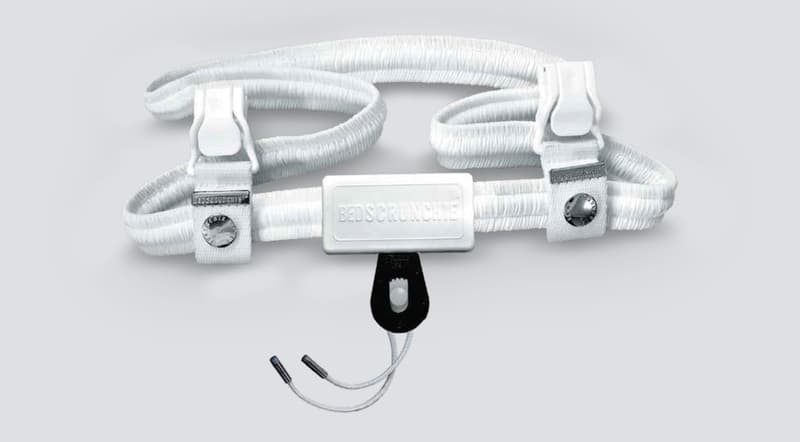
A step up from suspenders is a full 360-degree tightening system: instead of two or four diagonal straps pulling opposite corners together, a continuous cinchable cord runs around the entire underside of the sheet, gripped at 8–12 points, and you pull one central buckle to tension the whole thing at once. The Bed Scrunchie is the mainstream example — parachute-cord bungee, clips that grip the hem rather than pierce it, adjustable to any size — and the mechanism is a genuine improvement over suspenders because the tension is distributed evenly rather than concentrated at two or four points. Even, whole-perimeter tension is what keeps the sheet locked to the mattress the way a tailored bottom sheet would if manufacturers still made them.
The other real advantage is that a 360° tightener also rescues sheets that were never fitted to begin with — a flat top sheet from an old set, a mismatched sheet size, a hand-me-down that came without a matching bottom. Clip it around the flat sheet, cinch, and the sheet behaves like a deep-pocket fitted sheet even though it isn't one. Households with mixed inherited linen, guest rooms with random sheet sets, or anyone who's ever bought a flat-and-pillowcase-only bundle without realizing get a genuine second life out of otherwise-orphan sheets. Setup is a five-minute one-time job per sheet, and after that re-cinching after a wash takes about ten seconds.
Fourth: add friction between the mattress and the sheet
Most mattress covers and toppers are slick — quilted polyester, cool-touch fabric, silky surface treatments — and slick surfaces let sheets slide as you move. Two under-sheet fixes reduce that slippage without any hardware. First, a layer of woven cotton or flannel between the mattress and the fitted sheet: a mattress protector or a folded flat sheet made of a grippy weave gives the fitted sheet something to hold onto. This is the household-hack answer that keeps showing up in bedding forums, and it genuinely works — the price is one washable protector at $20-30 and the whole sheet system tightens up dramatically.
The other friction-based fix is silicone or rubber grip strips — sold as 'rug grippers' or 'mattress non-slip pads' — cut to a few inches and stuck to the top corners of the mattress. The fitted sheet is pulled over the grip strip and the tacky surface holds the elastic in place. This is a temporary solution (the adhesive gives up in a year or two of washes), but it's dramatically effective while it lasts, especially on a memory-foam mattress with a slick cover. Neither friction approach solves a pocket-depth mismatch, but both stack usefully on top of a properly-sized sheet or a 360° tightener for restless sleepers who just can't stop the corner from working loose.
Fifth: if all else fails, upgrade the sheet itself
There's a floor below which no amount of hardware or friction can save the sheet. If the elastic is visibly bunched and worn thin, if the corners have tears or pulled seams, or if the sheet has been washed 200+ times, it's spent. The elastic in a $30 percale set typically has a useful life of 18–36 months of weekly washing; premium sets ($100+) with reinforced perimeter elastic (elastic sewn all the way around instead of just at the corners) can last 3–5 years but still eventually give up. When a fitted sheet is dead, no gadget on top of it will help.
What to look for in a replacement: pocket depth clearly labeled and matched to your actual mattress (measure first), all-around elastic (not just corner elastic), sturdy woven fabric (percale for grip, sateen or bamboo if you prefer smoother — sateen slips more), and a reputable brand with a real return policy since fit varies. Brooklinen, Parachute, Boll & Branch, and the higher-end Amazon Basics deep-pocket sets are safe bets. Skip the ultra-cheap microfiber sets from marketplace sellers where 'deep pocket' is aspirational marketing rather than a measured spec. And once you have the right sheet, layer a 360° tightener like the Bed Scrunchie over the top and the corner-pop problem is genuinely solved for the life of the sheet — not just papered over.
The five-fix decision tree
Run down this list in order the next time your fitted sheet pops off: (1) Measure your mattress + topper, check the sheet's pocket depth, and buy correctly-sized sheets if there's a mismatch. This is the free fix that solves 40% of cases. (2) If the pocket depth is right but the sheet still creeps loose, install four sheet suspenders in an X pattern under the mattress — $10, 5-minute install, solves another 30% of cases. (3) If the sheet is old, the mattress is very deep, or you're a restless sleeper who moves a lot, use a 360° sheet tightener — the whole-perimeter tension holds even when suspenders don't. (4) If the sheet still shifts on a slick mattress cover, add a cotton or flannel protector underneath or silicone grip strips at the corners for friction. (5) If nothing works with a specific old sheet, replace the sheet — elastic has a finite lifespan and no tightener saves a truly dead sheet.
The pattern most households end up with once they've worked through the list: correctly-sized sheets (step 1), a 360° tightener as insurance (step 3), and replacements every 2-3 years on the primary bed. That combination keeps the bed genuinely drum-tight through years of nightly wear, and it eliminates the specific 3-a.m.-corner-pop that ruins sleep quality for restless sleepers. For guest beds and secondary rooms where you're not replacing sheets as often, the suspenders-or-tightener approach on top of whatever sheet is on hand is the pragmatic answer. The fix isn't complicated once you see the problem as sheet-vs-mattress geometry rather than a laundry technique failure.
A note on hospital corners, folded flat sheets, and other zero-hardware methods
You'll find bedding advice that recommends replacing the fitted sheet with a flat sheet folded into hospital corners — the crisp military tuck where the sheet is folded diagonally at each corner and tucked deep under the mattress. It genuinely works on a properly-sized flat sheet and a firm-cornered mattress, and it's how hotels get the tight look. The catch is that pillow-top and Euro-top mattresses have soft corners that hospital corners don't grip well, and the tuck starts to loosen the moment someone sits on the edge. It's a fine method on a firm-topped bed with a large enough flat sheet, but it's not a durable solution on a modern soft-topped mattress.
For a properly hotel-tight look on any mattress type without daily re-tucking, the Bed Scrunchie 360° system is genuinely the closest thing to a permanent hospital-corner tuck — because the whole-perimeter tension mimics what a properly-fitted, tightly-tucked flat sheet does, on a fitted sheet, without the daily labor. Set it up once per sheet, re-cinch after washes, and the surface stays smooth. Combine with the pocket-depth check from step one and the friction layer from step four for a bed that stays looking made through actual sleep, not just for the twenty seconds after you finish making it.
See the Bed Scrunchie review
A 360° cinchable system that pulls the entire fitted sheet drum-tight around the mattress with one central buckle — even on deep pillow-tops, even on old sheets with tired elastic, and it works on flat sheets too. The whole-perimeter tension mechanism that suspenders and hospital corners try to approximate.
See the Bed Scrunchie reviewFrequently asked questions
Why do my fitted sheets pop off my bed at night?
Almost always one of three things: (1) your mattress plus topper is deeper than the sheet's labeled pocket depth (modern pillow-tops are often 14–16 inches while cheap sheets are labeled 7-10 inches), (2) the elastic around the sheet has stretched or weakened from repeated washing, or (3) the mattress cover is too slick and the sheet slides as you move. Measure your mattress with a tape (top surface to bottom seam) and add any topper thickness — that number is your minimum sheet pocket depth. If your sheet's pocket is smaller, no technique keeps it on and you need deeper-pocket sheets or a 360° tightener like the Bed Scrunchie to hold what you have.
How do I keep fitted sheets from popping off a deep pillow-top mattress?
For a deep pillow-top or Euro-top mattress (typically 14–20 inches with a topper), you need sheets labeled 15" pocket depth or deeper, ideally with all-around elastic sewn along the entire perimeter of the hem rather than only at the corners. If your existing sheets are close but not quite deep enough, layer a 360° sheet tightener like the Bed Scrunchie over the top — the whole-perimeter tension keeps the sheet locked to the mattress even when the pocket depth is a little tight. For the deepest mattresses (18"+), pair deep-pocket sheets with a 360° tightener and the corner-pop problem is genuinely solved for the life of the sheet.
Do sheet suspenders actually work?
For sheets that fit but slowly work loose during the night, yes — sheet suspenders (elastic bands with clips that stretch diagonally or in an X pattern under the mattress) reliably solve the standard 3-a.m.-pop problem. Get the pin-clip style rather than alligator clips (which tear holes in sheet hems over time), and use four in an X pattern rather than two diagonals for better hold. What they don't solve: sheets whose pocket depth is fundamentally too shallow for your mattress, or old sheets with completely spent elastic. For those cases, a whole-perimeter 360° tightener works better because it distributes tension evenly around the entire sheet rather than concentrating pull at two or four points.
What's the difference between sheet suspenders and a 360° sheet tightener?
Sheet suspenders use two or four elastic straps to pull opposite corners of the sheet together diagonally under the mattress — cheap, easy to install, effective for mildly-loose sheets. A 360° sheet tightener like the Bed Scrunchie uses a continuous parachute-cord bungee threaded through 8–12 clips around the entire underside of the sheet, tightened with one central buckle — more expensive (~$40), and dramatically more secure because the tension is even around the entire perimeter rather than pulling from four points. For a genuinely deep mattress, an old but salvageable sheet, or a restless-sleeper household where suspenders keep failing, the 360° system is the correct upgrade. It also lets you convert a flat sheet into a fitted one for guest beds or mismatched linen sets — something suspenders can't do.
How can I measure my mattress pocket depth correctly?
Strip the bed completely, take a soft measuring tape, and measure from the very top surface of the mattress (the surface you sleep on) straight down to the seam at the bottom edge where the mattress meets the box spring or bed frame. Add the thickness of any mattress topper you keep on it — a 3-inch topper effectively adds 3 inches to the depth your sheet has to reach around. That total number is your minimum required sheet pocket depth. Modern mattresses typically measure 10–16 inches; add a topper and 15–19 is common. Buy sheets labeled at or above that number, ideally with 1–2 inches of headroom for slippage. Measuring first is the single most reliable improvement anyone can make — it solves about 40% of fitted-sheet problems without buying any hardware at all.
How long do fitted sheets actually last before the elastic gives up?
The elastic in a budget-tier percale or microfiber set (under $40) has a useful life of about 18–36 months of weekly washing. Premium sheets ($100+) with reinforced all-around elastic (sewn along the entire hem, not just the corners) can last 3–5 years, sometimes longer. Signs the elastic is spent: visible stretch or bunching around the hem, corners that no longer snap back after being stretched, tears at the corner where the elastic meets the fabric, and the sheet consistently popping off regardless of what tightener or suspender you add. When a sheet is fundamentally dead, no gadget on top of it will save it — replace it with a properly-sized deep-pocket set and add a Bed Scrunchie as insurance to extend the life of the new set from the day it goes on the bed.
Can I keep fitted sheets on the bed by folding a flat sheet under them?
Yes, sort of, and it's a decent free hack. Layering a woven cotton or flannel flat sheet between the mattress cover and the fitted sheet gives the fitted sheet a grippier surface to hold onto — most mattress covers are slick quilted polyester or cool-touch fabric that lets sheets slide. A cotton or flannel layer underneath reduces slippage measurably. It doesn't solve a pocket-depth mismatch (the sheet still isn't reaching around the mattress), but for a properly-sized sheet on a slick mattress cover, it stops the sideways-creep that suspenders don't fully address. Combined with the Bed Scrunchie 360° tightener or a deep-pocket replacement sheet, the flannel-underneath trick is the cheapest useful add-on in the whole category.
TopCrate is reader-supported. When you buy through links on our site we may earn an affiliate commission, at no extra cost to you. Content is for general information and isn't a substitute for professional advice.