PICKLEBALL
How to Choose a Pickleball Paddle for Beginners: The 5-Minute Buying Guide That Actually Matters
Weight, grip, core, face material — most beginner buying guides bury the answer under specs you can't feel. Here's what actually moves the needle in your first six months, and the trap that makes half of new players buy the wrong paddle twice.
Pickleball is the fastest-growing sport in the US, and the fastest-growing sub-industry inside it is the beginner-paddle market — which has quietly ballooned into a confusing wall of $30-to-$300 paddles with feature lists nobody understands. Carbon face or fiberglass. Polypropylene honeycomb core, but at what thickness. 4¼-inch grip vs 4½. Elongated shape vs widebody. USA Pickleball approved vs not. It is entirely possible for a first-time buyer to spend an hour reading spec sheets and end up more confused than when they started, then panic-buy the wrong paddle and wonder why the game feels harder than it should.
This is the short version of what actually matters in your first six months of play, in the order it matters. If you're picking your first paddle for backyard rec, a local drop-in league, or a two-person kit to get you and a partner started, the four decisions below are the ones that change how the ball behaves. Everything else on the spec sheet is either marketing (spin-rating claims), overkill (tournament-level materials), or a preference you can't actually diagnose until you've played twenty games. Read this once, buy one paddle (or one two-player kit), play, and re-decide in a season.
Decision #1: weight (the single spec most beginners get wrong)
Weight is the one number that changes how a paddle feels in your hand within the first swing, and the range that suits new players is narrower than the industry lets on. Aim for a mid-weight paddle in the 7.3 to 8.0 ounce range. Heavier paddles (8.0+ oz) generate more power on contact but fatigue your wrist and shoulder faster and slow your reaction time at the net — a bad combination for players still learning where the ball goes. Lighter paddles (under 7.3 oz) feel effortless to swing but rely on your own arm speed for power, which most beginners don't have the technique to produce yet, so shots feel weak and mishits sting.
The sweet spot near 7.8 oz gives you enough head weight that a normal swing generates a reasonable shot without your having to muscle it, and it's light enough to reflex-block at the kitchen line without your arm giving out in the third game. Both of the paddles in a beginner set like the Hajimari pickleball set land in that range, which is not an accident — the entry-level manufacturers have all converged on it because it's genuinely the least-wrong weight for a new player, and it takes years of play before you can honestly tell the difference between 7.7 and 7.9 oz.
Decision #2: grip size (the fix for tennis elbow you don't want to develop)
Grip circumference is measured in inches around the handle: common sizes are 4″, 4⅛″, 4¼″, 4⅜″ and 4½″. A grip that's too small forces you to squeeze harder to control the paddle, and a squeezed grip transmits vibration straight into your forearm — this is how most beginners give themselves pickleball elbow (medial epicondylitis) inside six weeks of picking up the sport. A grip that's too big is less common but sluggish, and makes wristy shots (dinks, drops) harder to control.
The finger-index test is the industry-standard rule of thumb: hold the paddle in your dominant hand as if you're about to shake hands with it, then slide the index finger of your other hand into the gap between your fingertips and the base of your thumb on the gripping hand. If your index finger fits snug in that gap, the grip is right. If it doesn't fit, the grip is too small (buy a bigger size, or wrap an overgrip to add ⅛″); if there's obvious wiggle room, the grip is too big. For adults, most players land at 4¼″ (smaller hands, women) or 4⅜″ (larger hands, most men). Fixed-configuration starter kits typically ship in one grip size — check what it is before ordering, and be prepared to add an overgrip if it comes up short.
Decision #3: core and face material (the one place cheap is genuinely fine)
Modern paddles are a sandwich: a honeycomb core in the middle (almost always polypropylene these days), a face material bonded on each side (fiberglass, graphite, or carbon fiber), and an edge guard around the perimeter. The core provides the pop; the face provides the surface texture that grips the ball for spin. What you need to know as a beginner: polypropylene honeycomb is the industry-standard core across every price tier from $30 to $300, so you're not sacrificing anything at the entry level. And a carbon-fiber or fiberglass face over that core is genuinely fine — carbon is slightly grippier for spin, fiberglass gives slightly more pop, and at the beginner level the difference is invisible under all the other things you're doing wrong.
What you should NOT chase as a first paddle: raw-carbon-fiber-face 'spin king' paddles at $200+, thermoformed edge construction, elongated 'graphite-plus' 16mm cores. Those exist to serve competitive intermediate and advanced players who have the technique to feel the difference. On a beginner, they're wasted money — you're paying for spin potential you can't yet generate, and often trading it against a smaller sweet spot that punishes off-center hits (which is 80% of what a beginner does). A $30–70 paddle with a polypropylene core and either face material will do everything you need for the first season.
Decision #4: shape and sweet spot (why widebody wins for beginners)
Paddle shape comes in three main flavors: widebody (roughly 8″ wide, 15¾″ tall — the classic pickleball shape), elongated (7¼″ wide, 16½″ tall — extra reach), and hybrid (something in between). Widebody paddles have the largest sweet spot, which is the region of the face where a hit produces a solid, predictable shot; miss the sweet spot and the ball flies unpredictably or hits weakly. For a beginner learning where the ball is in space, a larger sweet spot means more shots go where you meant. Elongated paddles trade sweet-spot size for reach at the net, which matters at the intermediate-plus level but hurts beginners more than it helps.
Buy widebody first. Play a season. Then, if you find you're hitting the sweet spot consistently and specifically wishing you had more reach on stretch volleys, consider elongated for paddle number two. This is also why the vast majority of complete starter kits — the Hajimari set, Franklin, Niupipo, JOOLA entry-level — all ship widebody: it's the least-wrong shape for a first paddle, and the manufacturers know most buyers will outgrow the kit into a specific style paddle in six to twelve months regardless.
The one gotcha: 'USA Pickleball approved' matters (only) for sanctioned tournaments
You'll see 'USA Pickleball approved' or 'USAPA approved' on almost every paddle marketed today. What this actually means: the specific model has been submitted to and passed USA Pickleball's equipment specification tests (surface roughness, thickness, dimensions, deflection), which is the certification required to use the paddle in sanctioned tournament play. For recreational play at a public court, a private club, a backyard net, or an unsanctioned local drop-in league, USAPA approval is a non-issue — nobody checks, and non-approved paddles are perfectly legal to own and play with.
The reason to care: budget brands sometimes use the phrase loosely, listing 'USA Pickleball approved' on the marketing page without a specific model on the official approved-equipment list at usapickleball.org. If you plan to enter sanctioned tournaments in the next year, verify your exact paddle model on that official list before buying — the search takes 30 seconds and saves the awkward pre-match paddle-check moment. If you're just here to play rec pickleball, ignore the whole issue and buy whatever else fits the four decisions above.
Kit or single paddle? (the answer depends on who else is playing with you)
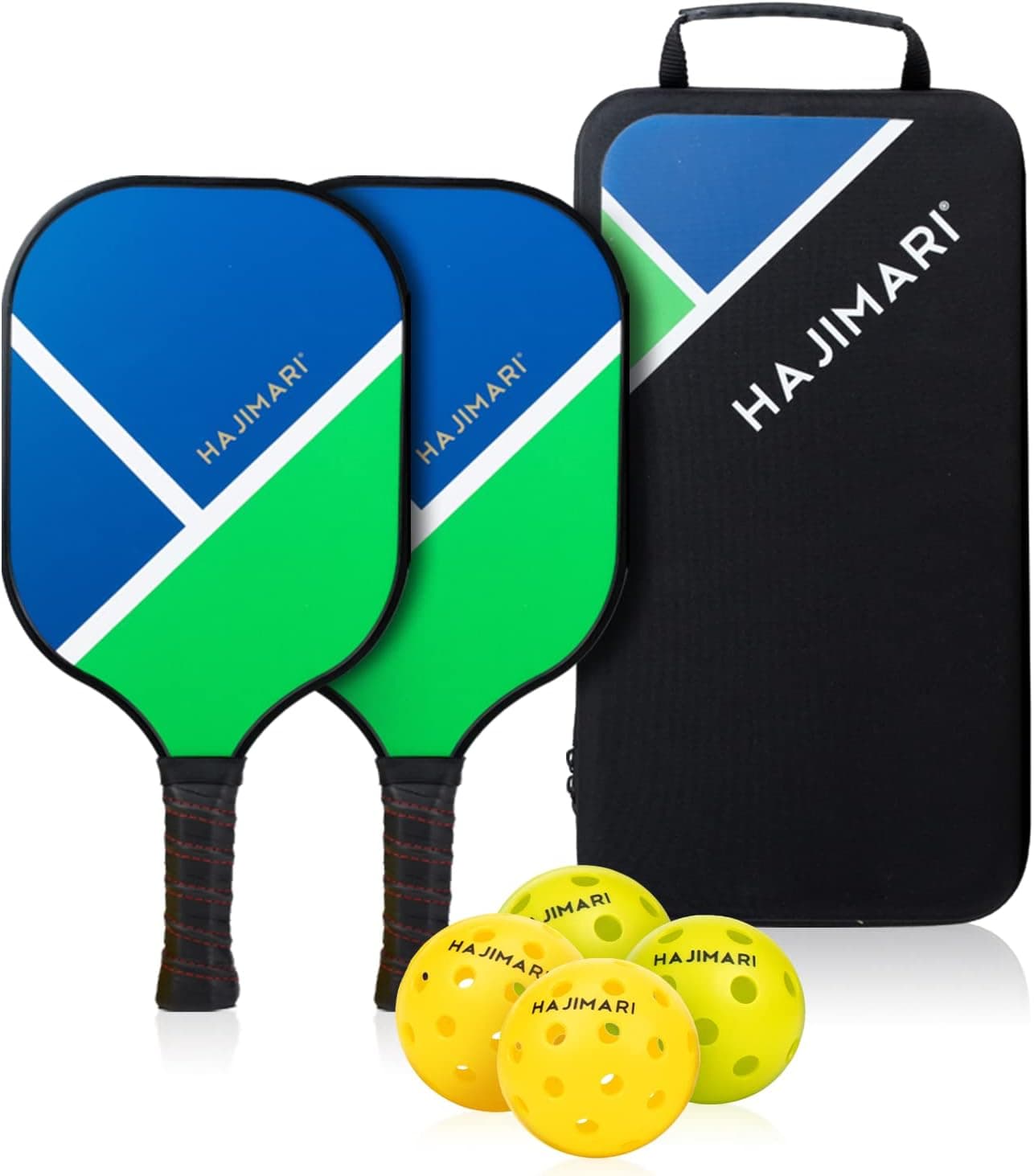
If you're the only one in your household or friend group with a paddle, you'll be lending it out constantly — buy the complete two-paddle kit. A kit like the Hajimari carbon-fiber set gives you two matched paddles, a set of indoor balls (27-hole, for gym floors), a set of outdoor balls (40-hole, for outdoor courts), and a hard carry case, for roughly what one decent standalone paddle costs. The math is unbeatable when you don't already own any of it: two people can play immediately, out of one box, without coordinating separate purchases.
Buy a single premium-tier paddle instead if your household already has a paddle (or three), you're a specific-sport-shopper who wants to invest in one better piece of gear, or you're the confirmed-serious player of a pair whose partner is happy with an entry-level paddle. And when you're playing outdoors in summer with backyard company, a personal cooler like ChillWell between games is the small kit addition that keeps a two-hour rec session from turning into heat exhaustion.
The honest 6-month upgrade path (so you don't over-buy today)
The most expensive beginner mistake in pickleball isn't buying the wrong paddle — it's buying a $200 tournament paddle first, discovering after five sessions that pickleball wasn't actually your thing, and having an expensive piece of graphite as a permanent reminder. The disciplined path is: buy a widebody, ~7.8 oz, polypropylene-core, fiberglass-or-carbon-face paddle in the $30–70 range, ideally as part of a two-player kit so someone can play with you. Give it a season of regular play — at least twenty sessions. By then you'll know three things you can't know today: whether you love the sport, whether you prefer power or control shots, and whether you're a spin-heavy player who'd benefit from a raw-carbon face.
Paddle number two, informed by twenty games of self-knowledge, will be right for you in a way no first-day purchase can be. It'll also cost less relative to your enjoyment, because you'll actually know what you're paying for. Buy cheap first, invest specifically later — this is the pattern every pickleball coach we've read agrees on. Save the flagship-paddle budget for the moment you can honestly describe the shot you're trying to hit but can't with your current gear.
Read our Hajimari pickleball set review
A complete two-player carbon-fiber pickleball kit — two paddles, indoor and outdoor balls, and a hard case — for roughly what one decent standalone paddle costs. The straightforward beginner buy.
Read our Hajimari pickleball set reviewFrequently asked questions
What weight paddle should a beginner get?
A mid-weight paddle in the 7.3 to 8.0 oz range — most beginners land near 7.8 oz. Heavier paddles fatigue your arm and slow your reaction time at the net; lighter paddles feel effortless to swing but rely on arm speed you don't have the technique to produce yet. Nearly every entry-level kit, including the Hajimari pickleball set, lands in this range because it's the least-wrong weight for a new player.
How do I know if a pickleball paddle grip is the right size?
Use the index-finger test: hold the paddle in your dominant hand as if shaking its hand, then slide the index finger of your other hand into the gap between your fingertips and the base of your thumb on the gripping hand. If your index finger fits snug in that gap, the grip is right. Too small = you'll grip too hard and risk pickleball elbow. Too big = wrist-heavy shots feel sluggish. Most adults land at 4¼″ (smaller hands) or 4⅜″ (larger hands).
Carbon fiber vs fiberglass face — which is better for beginners?
At the beginner level, the difference is invisible under everything else you're doing wrong. Carbon fiber is slightly grippier and helps spin; fiberglass has slightly more pop. Both sit over the same polypropylene honeycomb core that every paddle from $30 to $300 uses. Don't overthink face material for paddle #1 — pick whichever fits the price and comes in your grip size. Revisit for paddle #2 once you know whether you're a power or spin player.
Do I really need a 'USA Pickleball approved' paddle?
Only if you plan to enter sanctioned tournaments (USAPA-run events). For rec play, drop-in leagues, private clubs, and backyard games, the approval label is meaningless — nobody checks, and unapproved paddles are perfectly legal. Some budget brands use the phrase loosely on their marketing without a specific model on the official approved list, so if tournaments are in your near future, verify your exact model at usapickleball.org before buying.
Widebody vs elongated paddle for a beginner?
Widebody. It has the largest sweet spot (the forgiving zone where an off-center hit still produces a solid shot), which matters when you're still learning where the ball is in space. Elongated paddles trade sweet-spot size for extra reach at the net — useful at the intermediate-plus level, actively harmful for beginners. Almost every complete starter kit ships widebody for exactly this reason. Consider elongated for paddle #2 after a season of play.
How much should I spend on my first pickleball paddle?
$30–70 for a solo entry-level paddle, or roughly $60 for a complete two-paddle kit with balls and case (which is the better deal if you don't own any of it yet). Avoid spending $150+ on a first paddle: tournament-tier paddles are built for players with the technique to feel the difference, and on a beginner they're wasted money and often have smaller sweet spots that punish off-center hits. Buy cheap first, upgrade specifically after 20+ sessions of play once you know your style.
Is a $60 pickleball kit good enough to play with, or should I buy separately?
A ~$60 two-player kit with widebody polypropylene-core paddles in the 7.5-8.0 oz range and both indoor and outdoor balls is genuinely a reasonable starting setup — you get two paddles and everything you need to play for about what one decent standalone paddle costs. The catch is that the identical kit often shows up on dropship sites marked up to $150-200. Buy from a fair-priced reputable listing and don't overpay. The kit will serve you for the first season; competitive players will outgrow it, but that's true of any entry-level paddle.
TopCrate is reader-supported. When you buy through links on our site we may earn an affiliate commission, at no extra cost to you. Content is for general information and isn't a substitute for professional advice.