COMPARISON
Audien Atom 2 vs Eargo: $189 In-the-Ear OTC vs $1,699+ CIC Invisible Pair — Which One Fits You? (2026)
Audien Atom 2 and Eargo both sell over-the-counter hearing aids without an audiologist visit, but they sit at opposite ends of the OTC price ladder for a reason. One is a $189 rechargeable in-the-ear pair with a physical volume dial; the other is a CIC completely-in-canal invisible pair with in-app self-fitting and licensed-professional support starting at $1,699. Here's how they compare on price, fit, features and guarantee — and which one actually fits your ears.
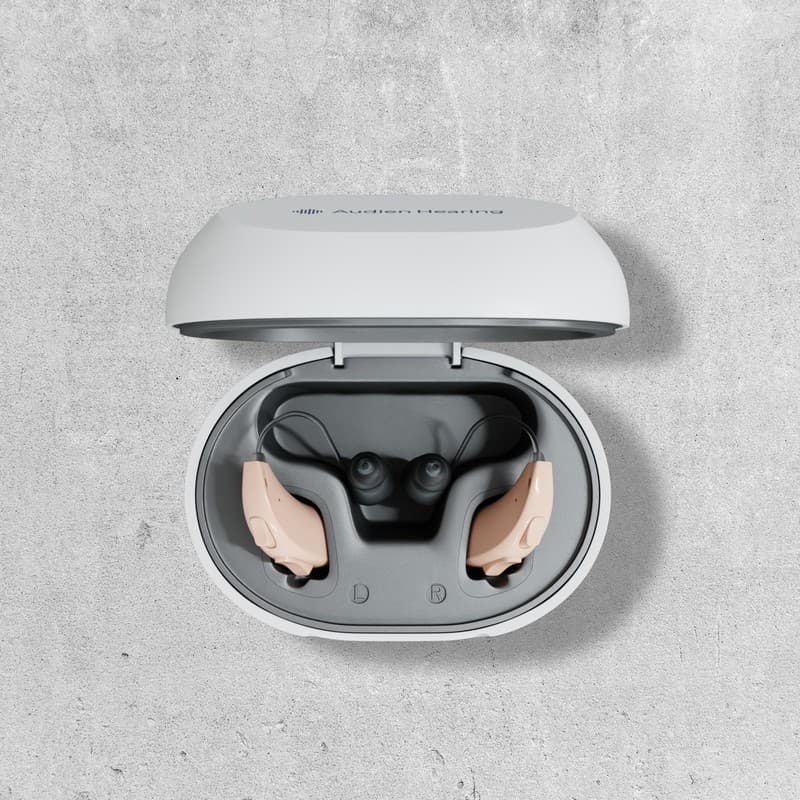
Audien Atom 2 and Eargo are two of the most-searched OTC hearing-aid brands, and they compete for the same customer at very different prices: someone with mild-to-moderate hearing loss who wants to skip the audiologist visit and the $2,000-plus prescription-pair sticker. What they aren't is the same product. The Audien Atom 2 is Audien Hearing's $189-per-pair rechargeable in-the-ear OTC aid, shipped direct from Scottsdale, Arizona, with a physical volume dial, four listening modes and no smartphone app by design. Eargo's 2026 lineup is a CIC (completely-in-canal) family of nearly-invisible OTC pairs — the entry-level Eargo SE at $1,699, the flagship Eargo 8 at $2,699 (with the older Eargo 7 still available at $2,950 while it's phased out), and the earbud-style Eargo Link at $799 — with in-app self-fitting and access to licensed hearing professionals included.
So the right pick depends on how invisible you want the pair to be, whether app-based self-fitting matters, whether you want a licensed professional in the loop, and how much you're willing to spend. If your budget tops out at a few hundred dollars and you just want everyday amplification for mild-to-moderate loss, the Atom 2 is the direct pick — same OTC category, same 45-day money-back guarantee, a fraction of the sticker price. If you want a truly invisible fit that no one can see from a normal conversation distance, in-app self-fitting to your specific hearing profile, and access to a licensed professional between visits, Eargo is what actually delivers that experience.
One quick note: Eargo is a separate company from Audien Hearing, and neither is a clone of the other. Eargo was founded in 2010 by Florent Michel and later restructured through a chapter-11 process and acquisition; it's now based in San Jose, California with support out of the same team. Audien is a Scottsdale, Arizona company founded in 2019 by Ishan Patel and co-founders. If you searched "Audien vs Eargo" and expected one brand to make both, they don't. Our full Audien Atom 2 review covers the Atom 2 pair in depth, and our is Audien legit guide walks through the checkout and the guarantee.
Audien Atom 2 vs Eargo at a glance
What each one is: Audien Atom 2 is a small in-the-ear rechargeable OTC hearing aid from Audien Hearing (Scottsdale, Arizona), sold direct to consumers with a physical volume dial per unit, four listening modes and a pocket-sized charging case. Eargo's 2026 lineup is a family of nearly-invisible CIC (completely-in-canal) rechargeable OTC hearing aids from Eargo Inc. (San Jose, California), sold direct with app-based self-fitting, wireless charging on the higher tiers and included access to licensed hearing professionals via video and phone.
Price: Audien Atom 2 costs $189 per pair at the standard promotional price with a two-pair "Buy 1, Get 1 at 50% OFF" bundle offered at $283.50 (retail listed at $378). Eargo's 2026 lineup runs $799 for the Eargo Link earbud-style pair, $1,699 for the Eargo SE, and $2,699 for the flagship Eargo 8, with the older Eargo 7 still available at $2,950 during phase-out. Eargo also offers financing through Affirm on its funnel; Audien's checkout doesn't advertise financing at the $189 tier because the sticker doesn't warrant it.
Fit: The Atom 2 is in-the-ear with dome-style ear tips in a few sizes — small, visible-if-you-look-closely units that sit near the ear canal opening. Eargo's SE and 8 are CIC (completely-in-canal), meaning they sit deep enough in the canal that most people cannot see them from a normal conversation distance; Eargo calls this the "invisible" fit. The Eargo Link is the earbud-style outlier — visible like AirPods rather than invisible — for buyers who want that form factor and Bluetooth streaming.
Fitting and adjustment: The Atom 2 is a general amplifier — you pick one of four preset listening modes with a button press and set the volume with the dial. There's no self-fitting to your specific audiogram, no companion app, and no professional in the loop. Eargo's SE and 8 include Sound Adjust (an app-based self-fitting tool that shapes the amplification to your specific hearing profile in a few minutes) and access to licensed hearing professionals via the Eargo app and phone — a genuine service layer that no $189 OTC pair can offer.
Guarantee: Both brands offer a 45-day money-back guarantee, which is the industry-standard OTC trial window. Audien's return process starts with a video-conference call with an Audien specialist; Eargo's return process is more conventional — an RMA is issued through the account portal after a conversation with support. Warranty on the Atom 2 is a $39 add-on that extends coverage and adds a one-time loss-and-damage replacement; Eargo's warranty is included on the higher tiers, and both accidental-damage and loss coverage are part of the sticker on Eargo 8.
What Audien Atom 2 actually is
Audien Atom 2 is engineered as the accessible entry point into the OTC hearing-aid category — a $189-per-pair in-the-ear rechargeable amplifier for someone with mild-to-moderate hearing loss who wants everyday hearing help without an audiologist appointment or a four-figure sticker. Each unit is a small, self-contained device that seats near the ear-canal opening with a soft dome tip, holds a full day of use on a single charge (Audien's 24-hour spec), and cycles four listening modes with a button. The included charging case is pocket-sized and holds several full charges before it needs a cable.
The design decisions worth understanding are the ones Audien deliberately didn't make. There's no smartphone app on the Atom 2 — the whole Atom line (except the Atom X launched in September 2025) is app-free by design, which lowers the price and eliminates the tech-setup friction that can put off older buyers, at the cost of no self-fitting and no per-ear customization. There's no Bluetooth streaming, no directional microphones for noisy environments, and no in-app amplification tuning. The four listening modes are Audien's answer to "different environments need different amplification profiles," and the physical dial handles volume in the moment.
For the buyer that design fits — someone whose main hearing complaint is missing words at the dinner table, needing the TV volume higher than their partner tolerates, and asking "what?" more than they used to — the Atom 2 is a legitimate, low-friction way to close that gap. Our full Audien Atom 2 review covers what it does and doesn't do in more depth, and our is Audien legit guide answers the checkout and guarantee questions.
What Eargo actually is
Eargo is the premium OTC brand that pioneered the invisible-in-the-canal form factor at consumer prices, and its 2026 lineup covers three price points. The Eargo SE ($1,699 per pair) is the value-tier CIC pair — completely-in-canal, rechargeable, with the Sound Adjust app-based self-fitting tool and included access to licensed hearing professionals. The Eargo 8 ($2,699 per pair) is the flagship — same CIC fit, upgraded processing, better performance in more challenging environments, more advanced app-based controls, and both accidental-damage and loss coverage bundled into the price. The Eargo Link ($799 per pair) is the outlier: an earbud-style pair with Bluetooth streaming for buyers who want that form factor and don't need the invisibility. The older Eargo 7 remains listed at $2,950 during its phase-out.
The service layer is a real feature and part of what buyers pay for at Eargo's price. Every purchase includes access to Eargo's licensed hearing professionals — audiologists and hearing instrument specialists — for video and phone consultations, remote fine-tuning of the aids' settings through the app, and follow-up support at whatever cadence the buyer needs. That's genuinely close to what an audiology-fitted pair offers, delivered remotely and without an office visit. Sound Adjust, Eargo's in-app self-fitting flow, walks the buyer through a hearing check on the phone and shapes the amplification to their specific profile in a few minutes.
The trade-offs are real. Eargo's pairs are meaningfully more expensive than Audien's, and financing (Affirm on the Eargo funnel) is a common piece of the buy. The CIC form factor requires a comfortable canal fit — some buyers with narrower canals find them uncomfortable, and the return path exists precisely for that reason. And the app-based self-fitting still doesn't equal an audiologist's real-time acoustic-tuning appointment, so buyers with more severe or asymmetric loss are typically better served by a full clinical fitting rather than either OTC brand.
In-the-ear vs CIC invisible: how they fit and how they look
The physical form-factor difference is the single biggest visible distinction between the two brands. The Atom 2 sits in the concha bowl and ear-canal opening — a small unit is visible if someone looks directly at your ear, but not distracting at a normal conversation distance. The dome ear tips come in multiple sizes; getting the right seal is what fixes whistling (feedback from sound leaking around a too-small tip). Both units are the same one-size housing, adjusted by the tip you pick.
Eargo's CIC pairs (SE and 8) sit deeper in the canal, past the visible bend, and are engineered to disappear from view during normal social interaction — the marketing name "invisible" is a reasonable description of the effect. That's the whole reason the CIC price point exists as a consumer option: buyers who specifically don't want the pair to be visible, whether for professional reasons, self-consciousness, or personal preference, get a form factor that meaningfully solves that concern.
The Eargo Link is the exception in the Eargo line — it's an earbud-style pair, visible in the ear like AirPods, and it's engineered for buyers who want Bluetooth streaming and don't need invisibility. If you're comparing Atom 2 to Eargo Link, you're comparing two visible-in-the-ear form factors at $189 vs $799; the Link's premium buys streaming and the licensed-professional support layer, not invisibility.
Fit comfort is the other piece of the visible-vs-invisible trade-off. In-the-ear pairs like the Atom 2 sit shallow enough that the fit is broadly forgiving — most buyers find the right tip on the first or second try. CIC pairs sit deeper, and buyers with narrower canals occasionally find them uncomfortable over long wear. Both brands' 45-day return windows exist precisely so buyers can find out whether the specific form factor fits them before committing.
Price, financing and 3-year cost of ownership
Sticker prices deceive here, because a rechargeable OTC pair is a one-time cost with a real service life, and the honest comparison is total ownership rather than the checkout total. Batteries in rechargeable OTC hearing aids typically hold their charge capacity well for two to three years before they degrade enough to warrant replacement, and the pair itself is designed for roughly that service life at daily wear.
Audien Atom 2 over three years: $189 for the base pair plus $39 for the warranty extension if you add it, for a total near $228 across the three-year period. That's the whole cost — no subscription, no per-visit professional fee, no financing to factor. If a component fails within the warranty window, the extension covers the repair or replacement. If the pair reaches end-of-life at the three-year mark, replacement is another sub-$200 sticker.
Eargo SE over three years: $1,699 for the pair with warranty included, occasional low-friction remote fine-tuning through the app included, and licensed-professional consultations included, for a total of $1,699 across the three-year period (or ~$142/month over 12 months on Affirm financing on Eargo's funnel). Eargo 8 over three years: $2,699 with warranty, damage and loss coverage bundled in — same three-year total, just at the higher tier. Both include the service layer that Audien doesn't offer at the $189 price.
The break-even math is not close and shouldn't be — these are two different tiers of the OTC category and they're honest about what they include. What matters is which trade-off actually fits the buyer. If everyday amplification is the whole ask, the Atom 2 delivers it at a fifth to a fifteenth of Eargo's price. If invisibility, self-fitting to your specific audiogram, and included professional access are worth several thousand dollars to you, Eargo is the tier engineered for that value proposition.
Guarantees, warranty and support
Both brands offer a 45-day money-back guarantee measured from the delivery date, which is the industry-standard OTC trial window. On both, the guarantee is real — refunds get processed within the stated window on standard-price orders. The difference is the friction on the way out. Audien's return path starts with a recorded video-conference call with an Audien specialist who walks through fit, volume and mode adjustments before authorizing the return; some BBB complaints describe that step as friction, others describe it as helpful. Eargo's return path is more conventional — an RMA is issued through the account portal after a conversation with support, and the buyer ships the pair back.
Warranty on the Atom 2 is a $39 add-on at checkout that extends manufacturer defect coverage and adds a one-time loss-and-damage replacement. Without the add-on, the base coverage is shorter. On Eargo, warranty coverage varies by tier — the Eargo 8 bundles both accidental-damage and loss coverage into the sticker price; the Eargo SE includes standard warranty coverage. That's a real value-added service layer that helps justify Eargo's higher price for buyers who wear their pair daily and want the peace of mind.
Support is the biggest service-layer difference. Audien's support is a standard direct-to-consumer support desk — email and phone, useful for return authorizations and warranty questions. Eargo's support layer includes licensed hearing professionals (audiologists and hearing instrument specialists) who consult with the buyer by video or phone, fine-tune the aids' amplification through the app, and follow up on wear and fit. That's meaningfully closer to an audiology-fitted pair's experience, delivered remotely — and it's a legitimate part of what Eargo's higher price buys.
Which one should you buy?
Choose Audien Atom 2 if your hearing loss is mild-to-moderate and everyday amplification is the whole ask — TV volume, dinner-table conversation, the specific frustration of missing words in normal environments. It's also the right pick if the sticker matters (you can buy two or three Atom 2 pairs for the price of one Eargo SE), if you specifically don't want a smartphone app in the loop, and if you'd rather have a physical dial and mode button than a self-fitting flow. At $189 with a 45-day money-back guarantee, it's the lowest-risk entry point into OTC amplification, and the honest positioning is "legitimate hearing help at a price that opens the category" rather than "a clinical experience."
Choose Eargo (SE, 8 or Link) if invisibility, in-app self-fitting to your specific hearing profile, or included licensed-professional support matter enough to you to justify the price step. The Eargo SE at $1,699 is the value-tier CIC pair — the cheapest way into the invisible fit and the app-based self-fitting flow. The Eargo 8 at $2,699 is the flagship for buyers who want the most refined processing and bundled damage-and-loss coverage. The Eargo Link at $799 is the specific pick if you want the earbud-style form factor with Bluetooth streaming rather than invisibility, and you're comfortable with a visible-in-the-ear pair.
Choose neither if your hearing loss is severe, asymmetric or accompanied by tinnitus or medical concerns — that's the case for a full audiology-clinic evaluation and a professionally-programmed prescription pair, not either OTC brand. And if you specifically want Bluetooth streaming plus the invisible fit — the two features neither Atom 2 nor Eargo's premium tiers combine — Audien's own Atom X (September 2025, ~$389 pair) with its touchscreen case and Bluetooth streaming, or a step up to Jabra Enhance's Bluetooth-capable OTC lineup, sits closer to that specific combination.
Our verdict
For the biggest slice of OTC-hearing-aid buyers — someone with mild-to-moderate loss who wants everyday amplification at a legitimately low sticker — Audien Atom 2 is our pick. The $189 pair delivers real amplification, a 24-hour battery life spec, four listening modes and a 45-day money-back guarantee at a price that opens the OTC category to buyers priced out of Eargo's tiers by an order of magnitude. TopCrate earns a commission on Audien purchases, and that's a fact worth naming; the recommendation would be the same for a buyer in that situation whether or not the affiliate paid.
For the buyer who specifically wants an invisible CIC fit, in-app self-fitting to their specific audiogram, or included licensed-professional support, Eargo is the honest pick — most likely the SE at $1,699 as the value tier, with the 8 at $2,699 for buyers who want the flagship's refinement and bundled coverage. That's a legitimately different tier of the OTC category, sold at a legitimately different price for legitimately different value, and it's not a knock on either brand that they don't compete on the same axis.
Choose both, weirdly, and it works: an Eargo SE for wear at work where invisibility matters, an Audien Atom 2 as the backup pair or the household loaner for a family member who wants to try OTC amplification cheaply. Either way, both brands solve the same underlying problem — closing the accessibility gap between not-hearing-well and paying $3,000-$6,000 for an audiology fitting — and either one is a meaningful upgrade over doing nothing. Our full Audien Atom 2 review covers the Atom 2 in more depth.
Read our full Audien Atom 2 review
Our verdict on the $189 in-the-ear OTC hearing-aid pair from Audien — what it delivers at that price, what the tier trade-offs are against premium CIC pairs, and whether it's the right entry point into the category for you.
Read our full Audien Atom 2 review →Frequently asked questions
Is Audien Atom 2 the same technology as Eargo?
Both are FDA-registered over-the-counter (OTC) hearing aids for perceived mild-to-moderate hearing loss, so they sit in the same regulatory category. Beyond that, the two are very different products. The Atom 2 is a $189-per-pair in-the-ear rechargeable amplifier with a physical volume dial and four preset listening modes, no smartphone app, and no self-fitting. Eargo's SE and 8 are CIC (completely-in-canal) pairs with in-app self-fitting via Sound Adjust and included access to licensed hearing professionals, at $1,699 and $2,699 per pair respectively. Same category, different tier.
Are Eargo hearing aids really invisible?
The Eargo SE and Eargo 8 are CIC (completely-in-canal) designs that sit deep enough in the ear canal to be invisible from a normal conversation distance for most wearers — that's the marketing claim and it's a reasonable description of the effect. A person looking directly into the ear at close range can still see the unit; a person in a normal conversation cannot. The Eargo Link, by contrast, is an earbud-style pair that's visible like AirPods and is a different form-factor tier of the Eargo line. Audien Atom 2 is in-the-ear (visible at close inspection but small); it isn't a CIC design.
Does Eargo offer financing?
Yes — Eargo's funnel includes Affirm financing that lets buyers spread the sticker over 12 to 24 months at rates that vary by credit profile. A $1,699 Eargo SE broken over 12 months on Affirm lands around $142/month before interest; the Eargo 8 at $2,699 is closer to $225/month over 12. Audien's Atom 2 is $189 direct, so the sticker doesn't warrant a financing offer at that tier.
What's the difference between Eargo SE, Eargo 8 and Eargo Link?
The Eargo SE ($1,699 per pair) is the value-tier CIC pair — completely-in-canal, Sound Adjust self-fitting, licensed-professional support included. The Eargo 8 ($2,699 per pair) is the flagship — same CIC fit, upgraded processing, more advanced app controls, and both accidental-damage and loss coverage bundled into the price. The Eargo Link ($799 per pair) is the outlier — earbud-style with Bluetooth streaming and app control, visible like AirPods, for buyers who want the earbud form factor and streaming rather than invisibility. The older Eargo 7 at $2,950 is being phased out during 2026.
Which is better for mild vs moderate hearing loss?
Both brands are marketed for perceived mild-to-moderate hearing loss, which is the FDA's defined range for the OTC hearing-aid category. For mild loss, the Atom 2 is genuinely competitive — everyday amplification at a fifth of Eargo's price with a 45-day trial window. For the higher end of moderate loss, Eargo's app-based self-fitting to your specific audiogram (via Sound Adjust) and licensed-professional consultations produce a more shaped amplification profile than the Atom 2's four preset modes, which starts to matter more as the loss becomes more asymmetric or frequency-specific. Either brand is inappropriate for severe or profound loss — that's a case for a full clinical fitting.
Can I return Audien or Eargo after trying them?
Both brands offer a 45-day money-back guarantee from the delivery date, which is the industry-standard OTC trial window, and both process refunds within that window on standard-price orders. Audien's return path starts with a recorded video-conference call with an Audien specialist before an RMA is issued; Eargo's return path is more conventional — an RMA through the account portal after a support conversation. Original shipping is non-refundable on both, and the buyer pays return shipping. Book any return-authorization step early in your 45-day window rather than at the deadline.
TopCrate is reader-supported. When you buy through links on our site we may earn an affiliate commission, at no extra cost to you. Content is for general information and isn't a substitute for professional advice.