AIR FRYER 101
Air Fryer Baked Potato: Crispy Skin, Fluffy Inside, No Hour-Long Wait
Exact temps and times by potato size, the oil-and-salt trick for crackly skin, and the two mistakes that turn a great baked potato into a sad steamed one.
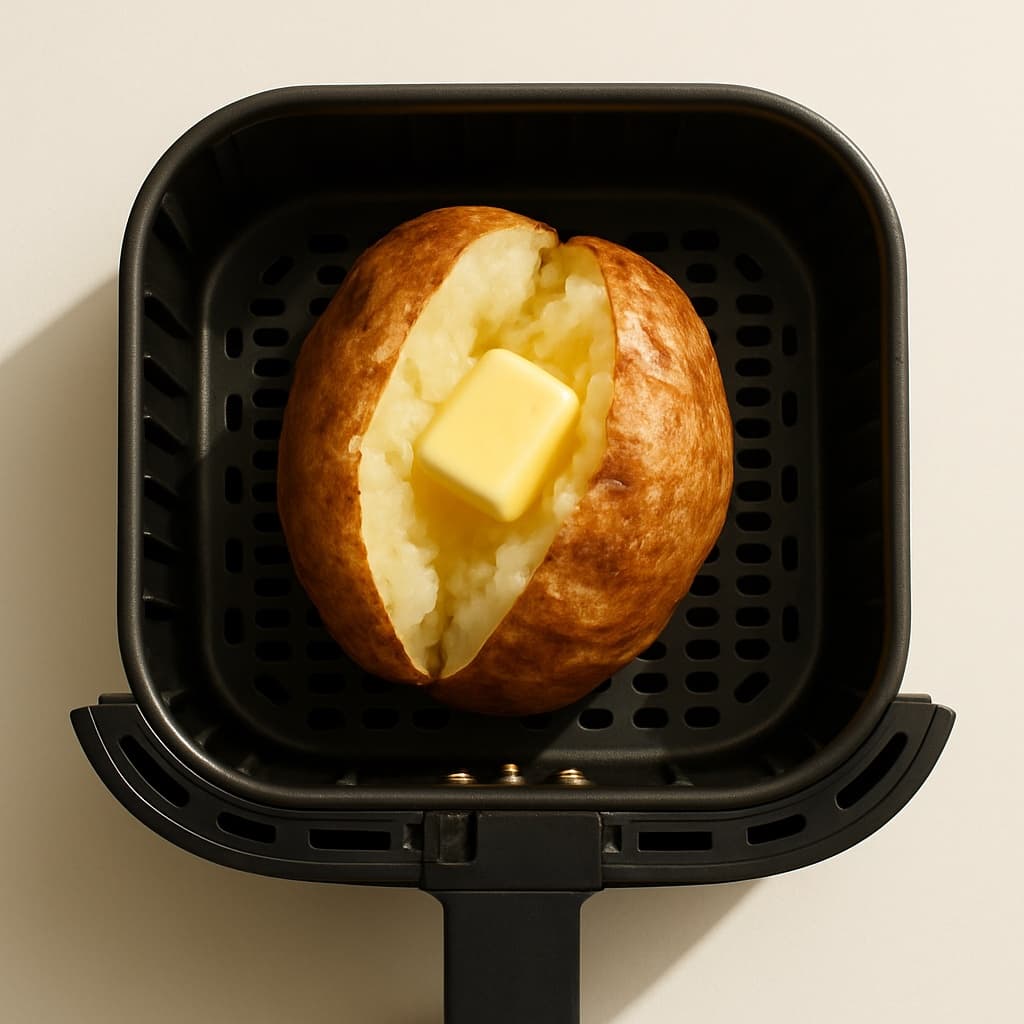
A proper baked potato has crackly, salty skin and an interior so fluffy it barely holds together. The oven can get you there, but it wants an hour of your evening plus preheat time, and it turns the kitchen into a sauna. The air fryer does the same job in around 40 minutes with zero preheat — and the skin actually comes out crispier.
This guide covers the whole play: which potatoes to buy, the oil-and-salt technique, exact times for every size at 400 degrees, how to tell when it's truly done, and the mistakes that ruin more baked potatoes than anything else.
Why the air fryer beats the oven for baked potatoes
An air fryer is a small, aggressive convection oven, and a baked potato is exactly the kind of food convection was made for. Hot air circulates around every side of the potato, pulling moisture off the skin so it dries out and crisps instead of staying leathery. A full-size oven does this too — it just takes longer, needs 15 minutes of preheating first, and heats 40 times more space than one potato requires.
The practical difference: oven baked potatoes are a plan-ahead food. Air fryer baked potatoes are a decide-at-6pm food. Load the basket, set 400 degrees, and walk away. No preheat, no baking sheet, no hot kitchen.
Start with the right potato
Russets are the correct answer. Their thick skin crisps into a shell, and their high-starch flesh bakes up dry and fluffy — the whole point of a baked potato. Waxy potatoes like red or Yukon Gold turn out dense and creamy instead; fine for potato salad, wrong for this job.
Pick potatoes of similar size so they finish together — 8 to 10 ounces each is the sweet spot. Scrub them well and then dry them completely with a towel. A wet potato steams before it crisps, and you lose the skin you came for.
Step by step: the oil and salt method
Step 1 — Scrub the potatoes and dry them thoroughly. Step 2 — Poke each one 6 to 8 times with a fork so steam can escape. Step 3 — Rub each potato with about half a teaspoon of olive or avocado oil, then a generous pinch of coarse salt. The oil conducts heat into the skin and the salt dries and seasons it.
Step 4 — Set the potatoes in the basket with space between them and cook at 400 degrees. Step 5 — Flip them halfway through so both sides get equal exposure to the fan. Step 6 — Test for doneness before you pull them (more on that below). In our Ninja air fryer, medium russets land right around the 40-minute mark.
Temp and time: 400 degrees, 35 to 50 minutes
The temperature never changes — 400 degrees Fahrenheit. Only the time moves with size. Small russets (5 to 7 ounces): 30 to 35 minutes. Medium (8 to 10 ounces): 35 to 40 minutes. Large bakers (11 to 14 ounces): 45 to 50 minutes. Flip halfway through in every case.
Cook to doneness, not to the clock. A fork or paring knife should slide into the center with zero resistance — any pushback means give it 5 more minutes. If you own an instant-read thermometer, the target is 205 to 210 degrees internal. That's the range where the starch fully gelatinizes and the inside turns fluffy instead of dense.
Loading it up
Split the potato open immediately, squeeze the ends toward the middle, and get butter, salt, and pepper in there while it's steaming — everything else builds on that base. From there: broccoli and sharp cheddar, chili and cheese, or the diner classic of sour cream, chives, and crumbled air fryer bacon, which the same machine handles in about nine minutes.
A loaded potato is a full dinner, but if you want to go bigger, it's also the ideal wingman for an air fryer steak — start the potatoes first, then cook the steak while they rest.
The two mistakes that ruin baked potatoes
Mistake one: wrapping in foil. Foil traps steam against the skin, so instead of a crisp shell you get the soft, damp skin of a boiled potato. Foil is for campfires; the air fryer's whole advantage is dry moving air, so let it touch the potato.
Mistake two: overcrowding. The air needs to reach every side of every potato. Pile four big russets into a small basket and the contact points stay pale and leathery. If they don't fit in one layer with a little space, cook in batches — the second round can wait in a warm oven, or just eat in shifts like it's a potato tasting.
Read our Ninja Air Fryer review
Even heat, a roomy basket, and dead-simple controls — the Ninja is the machine we reach for every time we test a recipe.
Read our Ninja Air Fryer reviewFrequently asked questions
How long does a baked potato take in the air fryer at 400?
35 to 40 minutes for a medium russet (8 to 10 ounces), flipped halfway through. Small potatoes run 30 to 35 minutes and large bakers need 45 to 50. It's done when a fork slides into the center with no resistance.
Should I wrap my potato in foil?
No. Foil traps steam and gives you soft, damp skin instead of a crisp one. The air fryer works by moving dry hot air over the potato — let it.
Do I need to poke holes in the potato?
Yes — 6 to 8 fork pokes lets steam vent as the potato cooks. It takes ten seconds and helps the inside cook evenly instead of building pressure under the skin.
What internal temperature should a baked potato reach?
205 to 210 degrees Fahrenheit. That's where the starch fully gelatinizes and the flesh turns fluffy. Below about 200, the center stays dense and slightly chewy.
Can I cook more than one potato at a time?
Yes — as many as fit in a single layer with space between them, usually 3 to 4 medium russets. Use similar-size potatoes so they finish together, and don't stack.
Why isn't my potato skin crispy?
Almost always one of four things: the potato was wet going in, it was wrapped in foil, it never got oiled, or the basket was overcrowded. Dry it, oil it, salt it, give it room.
TopCrate is reader-supported. When you buy through links on our site we may earn an affiliate commission, at no extra cost to you. Content is for general information and isn't a substitute for professional advice.